RGB video lights have become essential tools for modern content creators. LED panel photography continues to win favor among photographers and videographers because these lights deliver consistent color, stepless dimming, low heat, and the ability to shape soft or creative illumination without complex traditional setups. Many YouTubers now care deeply about video quality yet struggle with basic studio lighting setup.
Beginners often feel overwhelmed by professional parameters such as CRI, CCT, HSI, and beam angle. This guide explains the key differences, shows what good studio lighting for photography actually requires, and compares an RGB tube light with a popular RGB panel so you can choose confidently in 2026.
Studio Lighting Setup for Beginners and YouTubers
A practical studio lighting setup does not need to be complicated. Most talking-head and interview videos work well with a simple three-point approach: a key light on one side of the face, a softer fill on the opposite side, and a gentle hair or background light for separation.
Many new creators buy expensive cameras first and then wonder why their footage still looks flat. The missing piece is almost always light. Continuous RGB video lights solve this problem because what you see on the monitor is what you get. You can adjust brightness and color in real time, match existing room light, or add creative color without gels. For beginners, look for lights that offer high CRI (97+), app or master-slave control, and both bi-color and full RGB modes. These features remove the guesswork and let you focus on content instead of technical frustration.
RGB Video Lights vs. Bi-Color
Bi-color lights adjust only between warm and cool white (typically 3200K–5600K). They are excellent for natural-looking skin tones and matching ambient light.
RGB video lights add full color control through HSI (Hue, Saturation, Intensity) or RGB channels. You can create any color, run built-in effects such as lightning or police lights, and design atmospheric backgrounds. Most modern RGB lights also include a bi-color mode, giving you the best of both worlds. If your work stays strictly naturalistic, bi-color may be enough. If you create YouTube videos, product demos, music content, or stylized interviews, RGB capability quickly becomes valuable.
Studio Lighting for Photography – Essential Functions and Parameters
Good studio lighting for photography and video should offer:
- High CRI and TLCI (97 or above) for accurate skin tones and product colors
- Wide or dual color temperature range
- Full RGB / HSI control for creative work
- Stepless dimming from near 0% to 100%
- Reliable control options (on-board, app, master-slave)
- Portability and dual power (AC + battery)
- Reasonable output for the size and price
These parameters ensure the light remains useful across different rooms, subjects, and shooting styles.
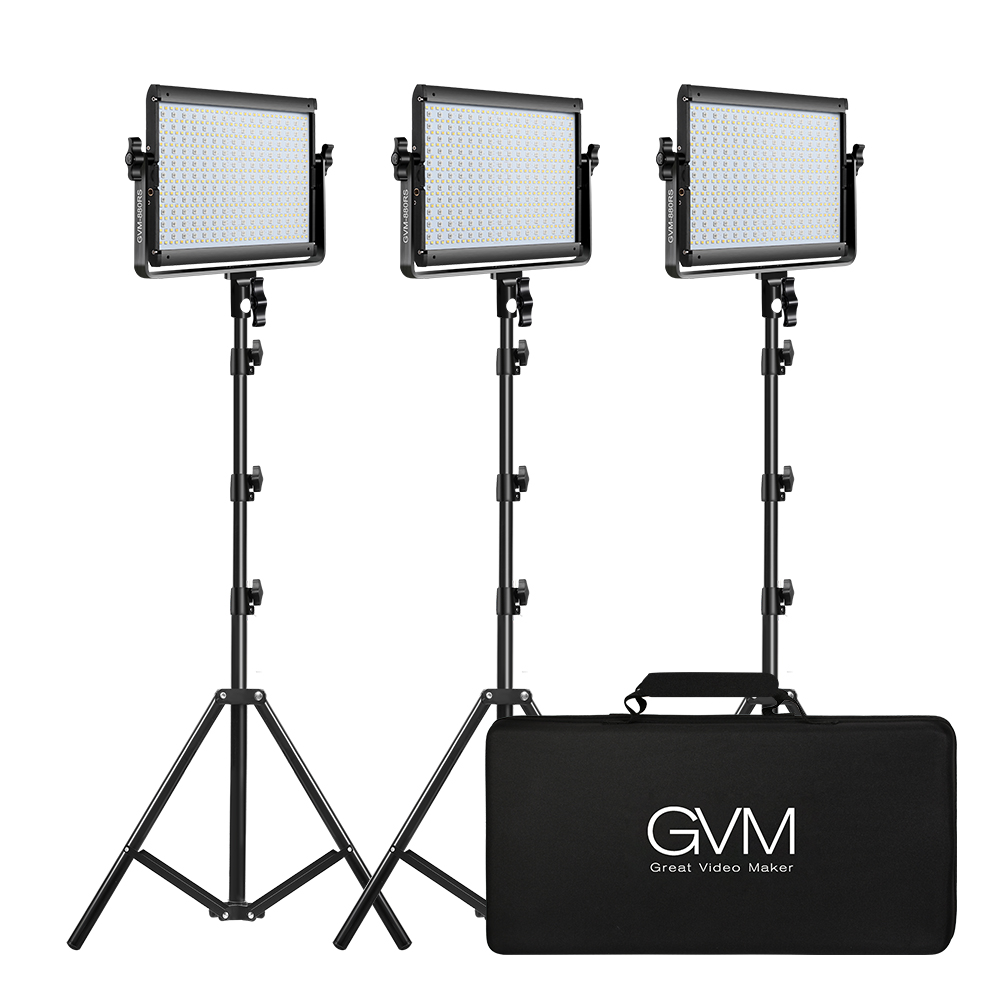
RGB Tube Light vs RGB Panel Lights
Two practical options illustrate the difference between form factors.
GVM BD100 – RGB Bi-Color LED Light Stick (Tube Light)
The GVM BD100 is a portable RGB bi-color LED light stick designed for filmmakers, content creators, and photographers. It offers full RGB spectrum control, a 3200K–5600K bi-color range, and CRI ≥97. Control is available through the GVM LED App (brightness, CCT, HSI, scene modes) and on-board buttons with an OLED display. Eight cinematic scene effects such as Lightning and Cop Car are built in. The stick-shaped design with built-in battery makes it ideal for handheld work, dynamic portraits, and quick fill light on location. It supports both DC input and battery operation for untethered shooting.
Pros: Extremely portable and handheld-friendly, fast to deploy, full RGB + bi-color, app and on-board control, built-in battery, high CRI, cinematic effects.
Cons: Lower overall output than larger panels, narrower beam, fewer mounting options than a full panel system.
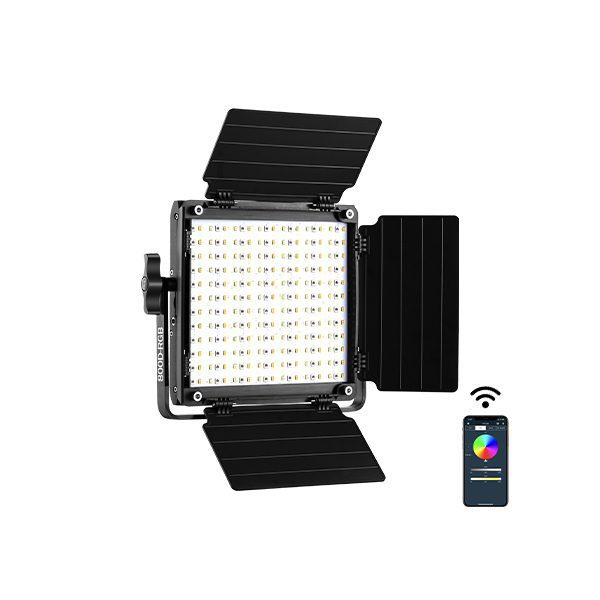
GVM 800D III – 40W Dual-Function RGB + Bi-Color LED Panel
The GVM 800D III is a compact 40W LED panel that combines bi-color (3200–5600K) and full 360° HSI RGB control. Measuring only 10.6 × 10.3 × 1.5 inches, it delivers up to approximately 2,900–3,129 lux at 1 meter with CRI/TLCI 97+. It features 20 built-in lighting effects, app control, master-slave sync, and eight scene modes. The lightweight design and high color accuracy make it suitable for studio, outdoor, live streaming, and YouTube work.
Pros: Higher brightness for its size, soft wide beam, excellent color accuracy, master-slave convenience, strong value at the same wattage class, fast all-in-one setup.
Cons: Less “handheld stick” flexibility than a pure tube light, still requires a stand or mount for best results.
Product Comparison Table
| Feature | GVM BD100 (RGB Tube / Stick) | GVM 800D III (RGB Panel) |
|---|---|---|
| Type | RGB Bi-Color Light Stick | Dual-function RGB + Bi-Color Panel |
| Power | Compact stick design | 40W |
| Color Temperature | 3200K–5600K + Full RGB | 3200K–5600K + 360° HSI |
| CRI / TLCI | ≥97 | 97+ |
| Output | Portable fill / accent level | Up to ~2,900–3,129 lux @ 1m |
| Effects | 8 scene modes | 20 lighting effects |
| Control | App + On-board OLED | App + Master-Slave + On-board |
| Power Options | Built-in battery + DC | AC / Battery compatible |
| Portability | Excellent (handheld stick) | Very good (thin panel) |
| Best For | Dynamic shots, handheld, accent light | Soft key/fill, interviews, studio work |
| Value Highlight | Fast creative accents on location | High brightness & cost-performance |
At comparable power levels the GVM 800D III stands out for brightness and price-to-performance, while the BD100 wins on pure portability and handheld speed. Both are all-in-one solutions that let creators set up usable light in minutes.
How to Use RGB Lights for Video
RGB lights become powerful once you treat color as a storytelling tool rather than pure decoration.
Practical Studio Lighting Setup – Interview Case
Here is a simple, portable interview setup using the GVM 800D III as the main light and the BD100 as a flexible accent:
- Place the 800D III at roughly 45 degrees to the subject as a soft key light. Set it to 4500–5000K for natural skin tones.
- Use a white wall or a second dimmed panel as fill if needed.
- Hold or mount the BD100 behind or to the side of the subject. Dial in a subtle complementary color (soft blue, warm amber, or gentle magenta) at low saturation to create separation and mood without overpowering the face.
- Because both lights are compact and battery-capable, the entire kit fits in a small bag and can be set up in under five minutes in a hotel room, office, or outdoor shaded area.
This combination demonstrates the real advantage of modern RGB video lights: high color accuracy for the face plus creative tube-light accents that travel easily. The all-in-one design of both fixtures means fewer cables and faster deployment than traditional multi-part lighting kits.

FAQ
What is the best RGB tube light for beginners in 2026?
A portable stick such as the GVM BD100 is easy to learn and immediately useful for accents and handheld work.
Should I choose an RGB tube light or an RGB panel?
Choose a tube/stick for maximum portability and dynamic shots. Choose a panel when you need softer, higher-output key or fill light.
Do I still need bi-color if I have RGB?
Yes. Most quality RGB video lights include a bi-color mode so you can switch between natural white light and full creative color instantly.
How important is CRI for RGB video lights?
Very important. Aim for CRI/TLCI 97+ so skin tones and product colors stay accurate even when you use colored light.
Can these lights work for both photography and video?
Yes. Continuous RGB video lights with high CRI perform well for both stills and video because the preview matches the final result.
Choosing the best RGB tube light in 2026 comes down to matching form factor to your shooting style. The GVM BD100 delivers fast, handheld creative power, while the GVM 800D III offers higher brightness and excellent cost-performance in a compact panel. Together they cover most studio lighting setup needs for YouTubers, interview creators, and photographers who want professional-looking results without complicated gear. Start with solid white light, then add RGB color only where it supports the story, and your videos will immediately look more polished and intentional.