For most beginners, camera lighting is the invisible wall between hobbyist shots and footage that actually looks professional. The camera you bought is capable of more than your living-room lightbulb is letting it do. The good news? Picking up the right portable LED lighting kits in 2026 has never been faster, cheaper, or more beginner-friendly.
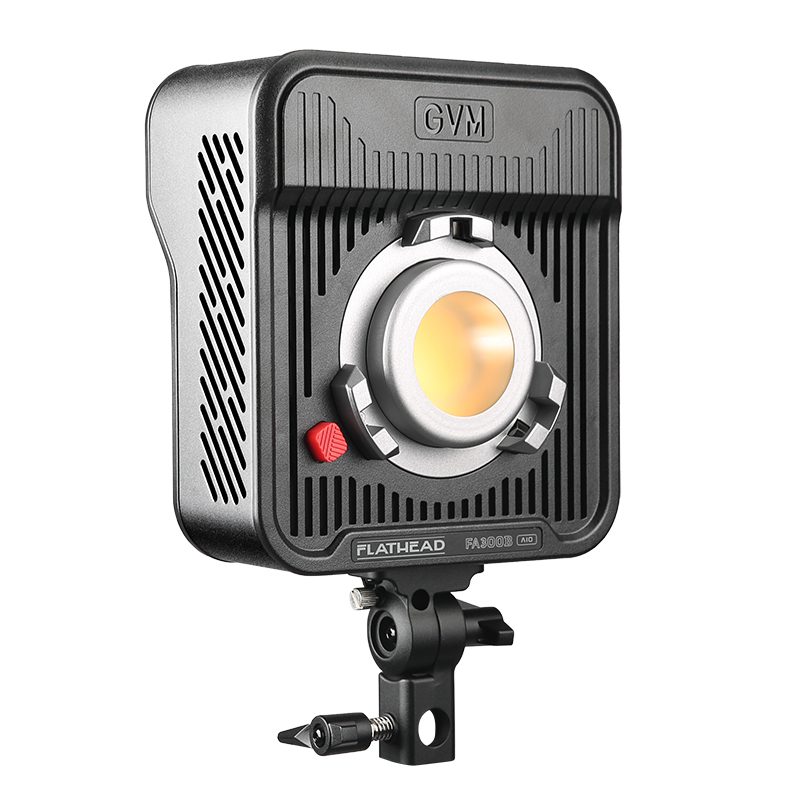
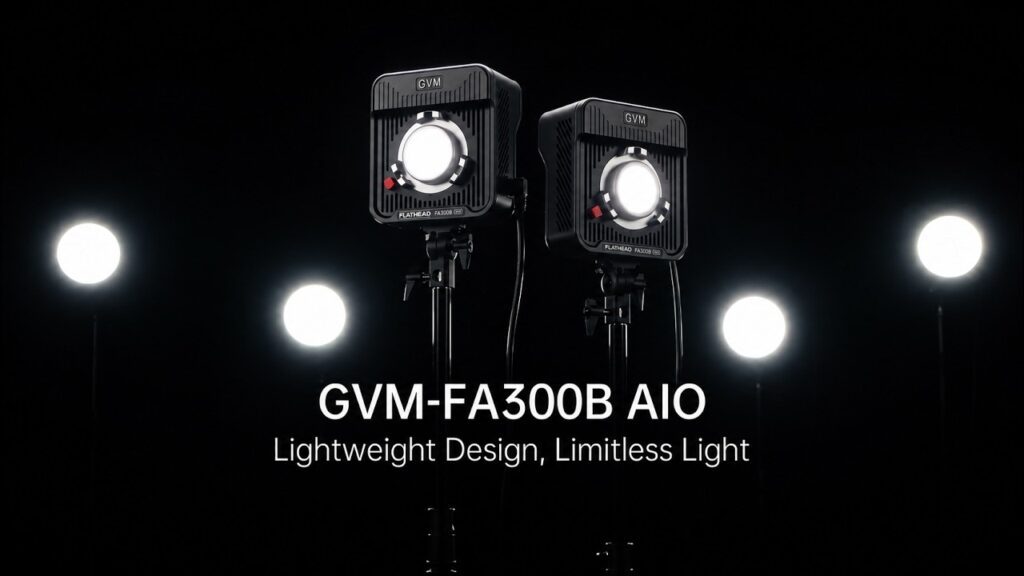
A flat-head COB monolight like the new GVM FA300B AIO — compact, quiet, app-controlled — now delivers studio-grade brightness in a backpack-friendly body. The old image of a long, fragile strobe monolight is officially over.
Table of Contents
Why Camera Lighting Feels Hard for Beginners
Almost every “why do my photos look flat / dim / orange” problem comes down to three things:
- Shooting under ceiling lights that are 3200K warm yellow while your camera is set to 5600K daylight.
- Using a single light source straight on, which kills depth and makes faces look flat.
- Relying on whatever brightness the lamp provides, instead of measuring exposure and shaping the light.
None of these are camera problems. They are lighting problems — and every one of them has a fix that costs less than a new lens.
Understanding Camera Lighting: The 4 Core Elements
Every lighting decision you make boils down to four attributes. Master these and you can light almost any scene.
- Intensity (Brightness) — how strong the light is. Stronger = more contrast, weaker = softer or moodier.
- Direction — where the light hits from. Front, side, top, and behind-the-subject each tell a different visual story.
- Quality — hard light (sharp shadows) gives power and texture; soft light (blurred shadows) flatters skin and hides flaws. Diffusers, softboxes, and panels turn hard into soft.
- Color Temperature (K) — 3200K is warm tungsten, 5600K is standard daylight, 6500K+ is cool blue. Mixing them without correction is the #1 reason beginners’ footage looks “off.”
Camera Lighting Types: Strobe vs Continuous
Camera lighting splits into two families.
- Strobe / Flash — a single intense burst of light, perfect for still photography. Cannot sustain output for video.
- Continuous Light — always on, what-you-see-is-what-you-get. This is what every video shooter, vlogger, and livestreamer uses. Almost all “lighting kits” sold for creators today are continuous LED.
Within the continuous family, three form factors dominate:
- Flat LED Panels — broad, even light, built-in diffusion. Great for interviews, livestreams, and content at a desk.
- COB Monolights — the workhorse. Small, very bright heads that accept modifiers (softboxes, reflectors, snoots) via a Bowens mount. The classic studio choice, now portable enough for location work.
- RGB Tubes / Pocket Lights — colorful, atmospheric. Used for backgrounds, accents, and creative mood, not as the main key.
Beginner-Friendly Lighting Setups
You do not need a four-light kit to look professional. Start with one of these three approaches:
- One-light setup — place a single soft source at 45° to the side and slightly above eye level. Quick, clean, and perfect for YouTube talking heads.
- Two-light setup — adds a fill light at half the key’s brightness to lift shadows. The workhorse for vloggers and interview content.
- Three-point lighting — key + fill + back/rim. The classic. The rim light pops the subject off the background, which is the cheapest way to make footage look cinematic.
Real-World Example: Lighting an Outdoor Interview with the GVM FA300B
Imagine shooting a short client interview on a patio. The sun is moving, ambient light keeps shifting, and you have 20 minutes before the subject arrives.
The GVM FA300B AIO handles this exact scenario. Set the bi-color temperature to match the daylight (around 5600K), place it on a stand at 45° to the subject, add a Bowens-mount softbox, and dial brightness to taste via the onboard knob or the mesh Bluetooth app. Twelve preset light sources let you match window light without a meter. Twelve built-in effects (lightning, paparazzi, candlelight) cover anything creative you need later in the day.
GVM FA300B vs. Typical 2026 Monolight Options
| Spec | GVM FA300B AIO | Typical 200–300W Bowens Monolight (Competitor) |
|---|---|---|
| Output | 71,400 Lux @ 1m (with reflector) | 30,000–60,000 Lux @ 1m |
| Color Temperature | 2700K–6800K bi-color | Often single CCT or 3200K–5600K |
| Brightness Control | 0–100% stepless, flicker-free | 0–100%, sometimes with steps |
| Lighting Effects | 12 built-in FX | 6–10 FX on most |
| Preset Light Sources | 12 modes (tungsten, HMI, daylight, etc.) | Often none |
| Wireless Control | Mesh Bluetooth app | App-only or no app |
| Cooling | Quiet active cooling | Fan noise varies; some models loud |
| Mount | Bowens (broadest modifier ecosystem) | Bowens or proprietary |
| Weight / Footprint | Compact panel-style, ~7.76 × 4.8 × 3.82 in | Heavier deep-can heads |
| Price | $299 USD | 450–900 USD |
For the same brightness class, the FA300B lands at roughly one-third to one-half the price of comparable Bowens-mount monolights, while offering more presets, more effects, and a flatter, more portable form factor than the long, traditional COB heads that have dominated the market for years.
Final Verdict
Beginner or pro, the right lighting kit does three things: it shortens your setup time, it makes every shot look more expensive than it is, and it travels well. Camera lighting in 2026 is no longer about expensive strobes or heavy heads — it is about smart, compact, app-controlled panels you can carry anywhere. The GVM FA300B AIO is the most cost-effective pick in this category right now: full bi-color range, 71,400 Lux output, Bowens ecosystem compatibility, mesh Bluetooth, twelve effects, twelve presets, and quiet cooling — all for $299 USD. If you are building your first real lighting setup, start here.

FAQ
Q1: What is the best camera lighting for beginners in 2026?
A bi-color continuous LED panel or COB monolight, around 200W class, with adjustable color temperature (2700K–6800K) and a Bowens mount for modifiers. The GVM FA300B AIO is a strong starter pick at $299.
Q2: How many watts do I need for indoor YouTube videos?
A 200W bi-color light with a softbox at roughly 1.5 m is enough for most talking-head setups. Focus on Lux at your working distance, not raw wattage.
Q3: Do I need both a key light and a fill light?
Not at the start. One soft key light at 45° works for most solo content. Add a fill light once you want smoother skin or finer control over the lighting ratio.
Q4: Are portable LED lighting kits bright enough for outdoor shooting?
Modern kits are. A 200–300W COB monolight with a reflector can easily overpower window light or even some overcast daylight at typical interview distances.
Q5: What is the difference between a panel and a COB monolight?
Panels are broad, soft, and ready to go with no modifier. COB monolights are smaller, brighter point sources that you shape with softboxes, reflectors, or snoots. Beginners often start with a panel; creators who want studio flexibility upgrade to a COB.