Whether you are setting up a professional studio or a home workspace, choosing the right photo lighting equipment is the key to creative success and high-quality visual storytelling.
Tabla de contenidos
1. Main Types of Photo Lighting Equipment
To build a versatile studio, you must first understand the fundamental categories of lighting available. The right choice depends on whether you are freezing fast motion or capturing video alongside your still images.
Continuous Lights (LED Panels, COB Lights)
Continuous lighting has become the gold standard for modern creators. With the rise of hybrid shooting (photo and video), photo studio continuous lighting y LED photo studio lights are essential. LED technology allows you to see the light exactly as it falls on the subject before you even press the shutter. High-end COB (Chip on Board) lights offer immense power in a compact form factor.
Strobe Lights & Flash Units (Speedlights, Monolights)
For traditional portraiture and commercial work, photo studio flash lights remain unbeatable for their ability to overpower the sun and freeze motion. From portable speedlights to heavy-duty photography studio flash lights (monolights), these tools provide a massive burst of light in a fraction of a second, allowing for sharp images at low ISO settings.
Modifiers: Softboxes, Umbrellas, and Grids
Raw light is often too harsh. To control the “quality” of light, photographers use modifiers. Photo studio lighting equipment like softboxes create soft, wrap-around light, while umbrellas are great for broad coverage. For precision, a photo studio light grid is used to narrow the beam and prevent light spill, adding drama and depth to your shots.
Supports & Stands (C-Stands, Boom Arms)
Stability is safety. A heavy-duty photo studio c stand is the industry standard for holding heavy lights and large modifiers. Boom arms allow you to position lights directly over your subject for “hair light” or “butterfly” patterns without the stand getting in the shot.
2. How to Choose Lights for Your Photo Studio
Selecting the right gear requires balancing your specific niche with your available budget.
For Studio Photography: Power and Control
When looking for professional photo studio lights, power (measured in Watts or Lux) and consistency are paramount. If you are asking, “what lights do i need for studio photography?“, the answer usually starts with at least two high-output sources that allow for fine-tuned dimming and color accuracy.
For Home & YouTube: Compact and Affordable Kits
If you are building a home photo studio lights setup, space is often limited. You should look for best cheap lighting for youtube videos that offers a high “bang-for-the-buck.” Compact LED panels or small COB lights are ideal here as they run cool and take up very little floor space.
Understanding Specifications: CRI, Wattage, and Color Temperature
- CRI (Color Rendering Index): Look for a CRI of 97+ to ensure skin tones look natural.
- Wattage: Higher wattage means more light, allowing you to use smaller apertures.
- Temperatura de color: Bi-color lights (2700K–6800K) allow you to match the ambient light in any room.
3. Essential Photo Studio Lighting Setup Guide
Having the gear is only half the battle; knowing how to place it is what creates art.
Basic Lighting Patterns: Rembrandt, Loop, Butterfly
Understanding a studio portrait lighting diagram is the fastest way to improve your work.
- Rembrandt: Characterized by a small triangle of light on the shadowed cheek.
- Butterfly: Light placed high and directly in front of the subject, creating a small shadow under the nose.
Step-by-Step Setup for Portrait Photography
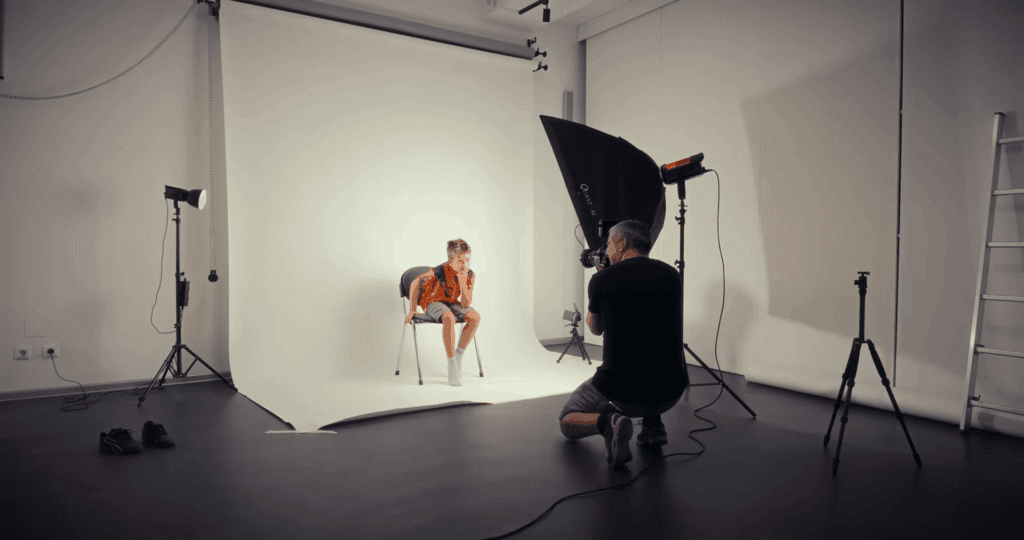
If you are learning how to set up photo studio lights, start with a single light source (the Key Light) at a 45-degree angle. Add a Fill Light to soften shadows and a Backlight to separate the subject from the background. Following a photography studio lighting setup diagram helps maintain consistency across different shoots.
How Many Lights Do You Really Need? (1, 2, 3-Light Setups)
So, how many lights for studio photography are truly necessary?
- 1-Light: Great for dramatic, moody portraits.
- 2-Light: Ideal for high-key headshots (Key + Fill).
- 3-Light: The professional standard (Key + Fill + Hair/Background Light).
4. Top-Rated Photo Lighting Kits and Brands in 2026
As we look at the best gear for 2026, one product stands out for its versatility and professional performance: the GVM PRO-SD200B.
Pro-Grade Equipment Spotlight: GVM PRO-SD200B
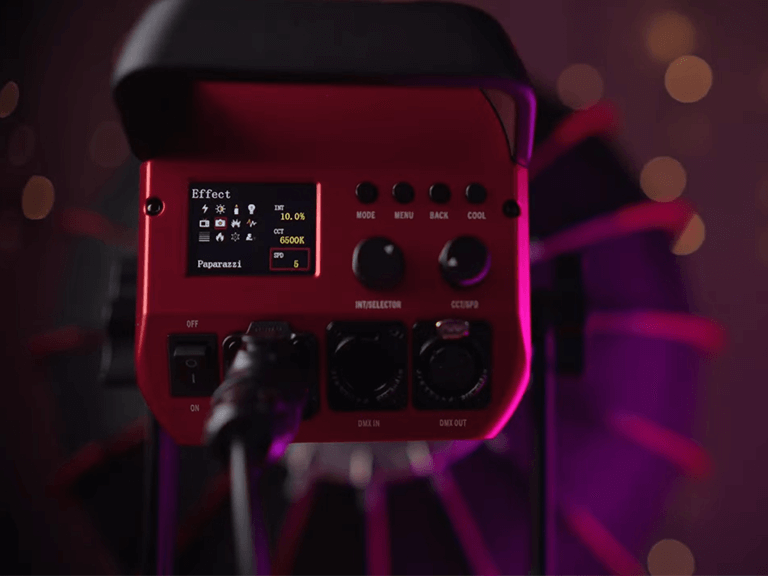
En GVM PRO-SD200B is a 200W Bi-Color LED spotlight designed for photographers who demand precision. It features a Bluetooth mesh network, allowing you to sync multiple godox photo studio lights or other GVM units via an app. With 12 lighting effects (Lightning, Candle, etc.) and 12 preset light source simulations, it is a powerhouse for both photo and video.
Product Specifications: GVM PRO-SD200B
| Característica | Especificación | Best Use Case |
| Potencia de Salida | 200W (45,400 Lux @ 1m) | Commercial Studio & Video |
| Temperatura de color | 2700K – 6800K (Bi-Color) | Matching ambient indoor/outdoor light |
| Precisión del color | 97+ CRI / 97+ TLCI | High-end portraiture & product shots |
| Disminución | 1/1000-step (0% – 100%) | Precise exposure control |
| Enfriamiento | Silent Cooling System | Interviews and quiet video sets |
| Métodos de control | App, DMX (5-Pin), Onboard Mesh | Multi-light professional productions |
| Built-in Effects | 12 Scene FX + 12 Presets | Creative filmmaking & atmosphere |
Best All-in-One Kits for Beginners
Un completo kit de iluminación para estudio fotográfico o photography studio lights kit usually includes two lights, stands, and softboxes. These are perfect for those who want a “plug-and-play” solution without buying every component separately.
DIY & Budget-Friendly Alternatives
For those on a strict budget, diy photo studio lights can be made using high-CRI work lights and parchment paper as a diffuser. Additionally, building a photo studio light box diy using white cardboard is a classic trick for macro and small product photography.
5. Frequently Asked Questions (FAQ) About Photo Lighting
Q1: What is the difference between continuous light and flash?
Continuous light stays on, making it easier to see the final result and ideal for video. Flash provides a more powerful, instantaneous burst that is better for freezing motion and achieving maximum sharpness in still photos.
Q2: Can I use regular LED bulbs for a photo studio?
While you can use a standard photo studio light bulb, household LEDs often have a low CRI, leading to “muddy” skin tones and green color casts. It is better to invest in dedicated photography bulbs.
Q3: What’s the best lighting for a small home studio?
A single high-quality COB LED light with a large softbox is the most space-efficient setup for a small room. It provides soft, flattering light without the heat of older halogen bulbs.
Q4: How do I use a light box for product photography?
A photo studio light box (or light tent) diffuses light from all sides, eliminating harsh reflections. Simply place your product inside, light it from the outside through the fabric walls, and you’ll get clean, catalog-style images instantly.
By investing in the right photo lighting equipment and mastering basic setup patterns, you can transform your photography from amateur to professional. Whether you choose the high-output GVM PRO-SD200B or a simple DIY kit, the quality of your light will always define the quality of your work.