Best for: Creators who want to understand what’s actually inside their slider before buying
You’ve seen the specs: carbon fiber rails, wireless app control, 11 lb payload, 30 lb payload. But what do these terms actually mean for your shooting experience? Is carbon fiber worth the extra cost? Is wireless control a must-have or just a nice-to-have?
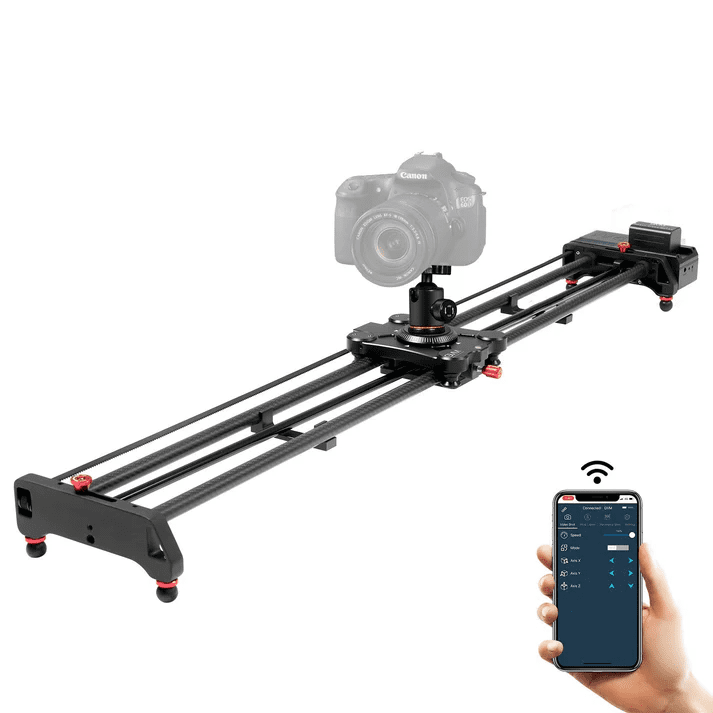
This guide cuts through the marketing jargon. We’ll break down two of the biggest decisions you’ll make when choosing a slider: material (carbon fiber vs. aluminum) and control type (wireless vs. wired). No fluff. Just real-world differences that affect how you shoot.
Part 1: Carbon Fiber vs. Aluminum — What’s the Real Difference?
The Short Answer
| Fibra de carbono | Aluminum | |
| Peso | Lighter | Heavier |
| Vibration damping | Excellent — absorbs high-frequency vibrations | Moderate — transmits more vibration |
| Durabilidad | Stiff but can crack on impact | Tough — dents rather than cracks |
| Cost | Higher | More affordable |
| Best for | Travel, location shoots, slow-speed cinematography | Studio use, heavy payloads, budget buyers |
Weight: The Practical Difference
Carbon fiber rails are significantly lighter than aluminum. The GR-80QD (carbon fiber) weighs 4.41 lb, while the J80D (aluminum) weighs 6 lb — that’s over 1.5 lb difference for similar-sized sliders.
For a travel creator carrying gear through airports or hiking to locations, that weight difference adds up fast. Carbon fiber sliders also come with carry bags designed for shoulder transport, making them genuinely portable.
What this means for you: If you shoot mostly in a studio where weight doesn’t matter, aluminum saves you money. If you travel frequently or shoot on location, carbon fiber is worth the upgrade.
Vibration Damping: Why Carbon Fiber Footage Looks Smoother
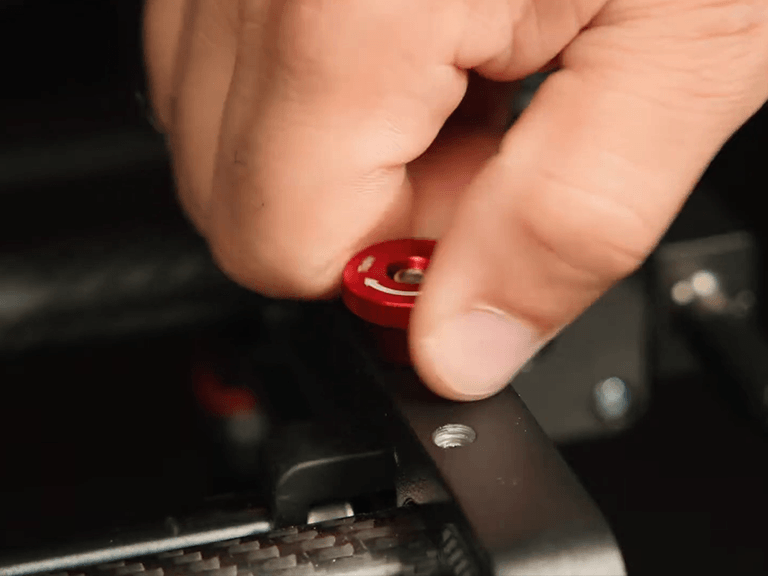
Carbon fiber naturally absorbs high-frequency vibrations better than aluminum. This matters most at slow speeds — when your slider is moving at 2-3 minutes per full travel, any vibration becomes visible in the footage.
In side-by-side tests, carbon fiber sliders produce noticeably smoother footage at slow speeds. The material dampens micro-vibrations from the motor and the environment before they reach your camera.
What this means for you: If you shoot slow, cinematic drifts (interviews, product reveals, landscape pans), carbon fiber gives you a cleaner image. If you shoot faster moves or don’t pixel-peep, the difference is less noticeable.
Durability: Different Kinds of Tough
- Carbon fiber is incredibly stiff and resistant to flex — it won’t bend under heavy loads. But it can crack or chip if dropped onto a hard surface.
- Aluminum is more forgiving. Drop it and it’ll dent rather than crack. It’s also less expensive to repair or replace.
What this means for you: If you’re rough on gear or transport equipment frequently in crowded vehicles, aluminum is more forgiving. If you handle your gear carefully, carbon fiber’s stiffness is an advantage.
Which GVM Models Use Which Material?
| Material | Modelos |
| Fibra de carbono | GR-80QD, GT-80WD, SLIDER-80 Wireless, SLIDER-120, GR-120QD, WS-2D-80 |
| Aluminum | J80D |
Part 2: Wireless vs. Wired Control — Which One Fits Your Workflow?
The Short Answer
| Wireless (App / Bluetooth Remote) | Wired (USB Remote) | |
| Control | Phone app or Bluetooth remote | Physical wired controller |
| Range | Up to ~30-50 ft (Bluetooth) | Limited by cable length |
| Setup | Clean, no cables | Cable to manage |
| Reliability | Dependent on battery/connection | Always connected, never drops |
| Best for | Solo creators, remote operation, clean setups | Studio use, physical button preference, reliability |
Wireless Control: Freedom and Flexibility
Wireless sliders let you control the camera move from a distance. The SLIDER-120, for example, is controlled entirely via an iOS/Android app. You can set A/B points, keyframe time-lapse sessions, and adjust speed from your phone.
The GT-80WD takes a different wireless approach — it comes with a Bluetooth remote controller featuring an integrated LCD display. The remote shows slider battery, remote battery, Bluetooth signal strength, and move info. This is ideal for creators who want wireless freedom but prefer physical buttons over phone apps.
Key wireless features:
- Offline programming: Set parameters, then disconnect your phone — the slider continues running
- Remote operation: Control the slider from across the room
- Clean setup: No cables to trip over or manage
Wireless models: GT-80WD, SLIDER-80 Wireless, SLIDER-120, WS-2D-80
Wired Control: Simplicity and Reliability
Wired sliders use a physical USB remote controller. The GR-120QD’s remote lets you set start/end points, adjust motor torque, slip speed, interval, stop time, photo number, and auto-loop.
Key wired advantages:
- Always connected: No Bluetooth dropouts or pairing issues
- Physical buttons: Tactile feedback, no phone battery anxiety
- Reliable: Works every time, no app updates or compatibility concerns
- No phone needed: You can leave your phone in your pocket
Wired models: GR-80QD, GR-120QD, J80D
The Hybrid Option: WS-2D-80
The WS-2D-80 offers all three: 2.4G remote + Bluetooth app + onboard control panel. You can control it via the app, locally on the slider panel, or manually. This is the most flexible control setup in GVM’s lineup.
Side-by-Side Comparison: Which Model Fits Your Needs?
| Consideration | Choose Carbon Fiber | Choose Aluminum |
| You travel frequently | ✅ GR-80QD, GT-80WD, SLIDER series | ❌ J80D is heavier |
| You shoot slow, cinematic moves | ✅ Carbon fiber dampens vibration better | ⚠️ Aluminum transmits more vibration |
| You’re on a tight budget | ❌ Carbon costs more | ✅ J80D is the most affordable |
| You need maximum payload | ⚠️ 11 lb limit on carbon models | ✅ J80D offers 30 lb |
| You work in a studio | ⚠️ Carbon works but costs more | ✅ J80D is durable and cheaper |
| Consideration | Choose Wireless | Choose Wired |
| You shoot solo and need remote operation | ✅ GT-80WD, SLIDER-120 | ❌ Wired limits your position |
| You prefer physical buttons | ✅ GT-80WD (Bluetooth remote) | ✅ GR-80QD, GR-120QD have physical remotes |
| You hate phone apps | ⚠️ App-only models (SLIDER-120) require a phone | ✅ Wired remotes are button-based |
| You need maximum reliability | ⚠️ Bluetooth can drop | ✅ Wired never disconnects |
| You want the most control options | ✅ WS-2D-80 has remote + app + panel | ⚠️ Wired is limited to one method |
Quick Reference Table
Preguntas frecuentes
Is carbon fiber worth the extra cost?
If you travel frequently or shoot slow cinematic moves, yes. If you work mostly in a studio and don’t pixel-peep, aluminum saves you money with no practical difference.
Do I really need wireless control?
If you shoot solo and want to operate the slider from the camera position, wireless is a game-changer. If you work in a studio with an assistant or don’t mind cables, wired is more reliable and often cheaper.
Can a wired slider do everything a wireless one can?
Yes — both support video, time-lapse, keyframing, and panorama. The difference is control method and range, not capability.
Which is more reliable — wireless or wired?
Wired is more reliable. Bluetooth connections can drop, and phone batteries can die. Wired remotes are always connected.
What about the WS-2D-80 — does it have both?
Yes. The WS-2D-80 offers 2.4G remote + Bluetooth app + onboard panel — the most flexible control setup in GVM’s lineup.
Pensamientos finales
Choosing between carbon fiber and aluminum comes down to one question: do you prioritize portability or budget? Carbon fiber is lighter and dampens vibration better. Aluminum is tougher and more affordable.
Choosing between wireless and wired comes down to another question: do you prioritize freedom or reliability? Wireless lets you control the slider from anywhere. Wired never drops connection.
Here’s the simple version:
- Travel frequently / shoot slow moves – Carbon fiber (GR-80QD, GT-80WD, SLIDER-120)
- Studio work / budget conscious – Aluminum (J80D)
- Solo creator / need remote operation – Wireless (GT-80WD, SLIDER-120)
- Reliability first / prefer physical buttons – Wired (GR-80QD, GR-120QD)
- Want everything – WS-2D-80 (carbon fiber + wireless + wired + 2-axis)
Explore the full GVM camera slider collection at the GVM official store.