Finding the right lighting for indoor photography is often the single biggest factor separating amateur-looking shots from professional ones. Yet lighting is usually the last thing photographers think about — and the first thing that quietly ruins an otherwise great composition.
If your indoor photos have felt “off” without an obvious reason, there’s a good chance the issue wasn’t your camera or your subject. It was your light.
Configuración de fotografía de interior con poca luz
Shooting indoors comes with a built-in challenge: there’s rarely enough natural light to work with, especially later in the day or in rooms with small windows. Many photographers try to compensate by cranking up ISO or slowing shutter speed, only to end up with grainy images or motion blur. The real issue usually isn’t camera settings at all — it’s the absence of a controllable, adequate light source in the room.
Without proper lighting, even a well-composed shot in a dim environment will lack depth, dimension, and the polished look clients expect. This is why so many indoor photographers hit a quality ceiling until they invest in dedicated lighting gear.
Best Photography Lighting: Understanding the Basics
Before choosing equipment, it helps to understand what makes lighting “good” in the first place. Three factors matter most: brightness, color accuracy, and control. Brightness determines whether you can shoot at a reasonable aperture and ISO without noise. Color accuracy — measured by CRI (Color Rendering Index) — determines whether skin tones and colors look natural rather than washed out or off-hue. Control refers to how easily you can dim, adjust color temperature, and shape the light with modifiers like softboxes or grids.
A single continuous light with high CRI, wide dimming range, and bi-color adjustability can solve most of the problems indoor photographers run into, which is why continuous lighting has become the standard recommendation for home studios.
Best Continuous Light for Photography
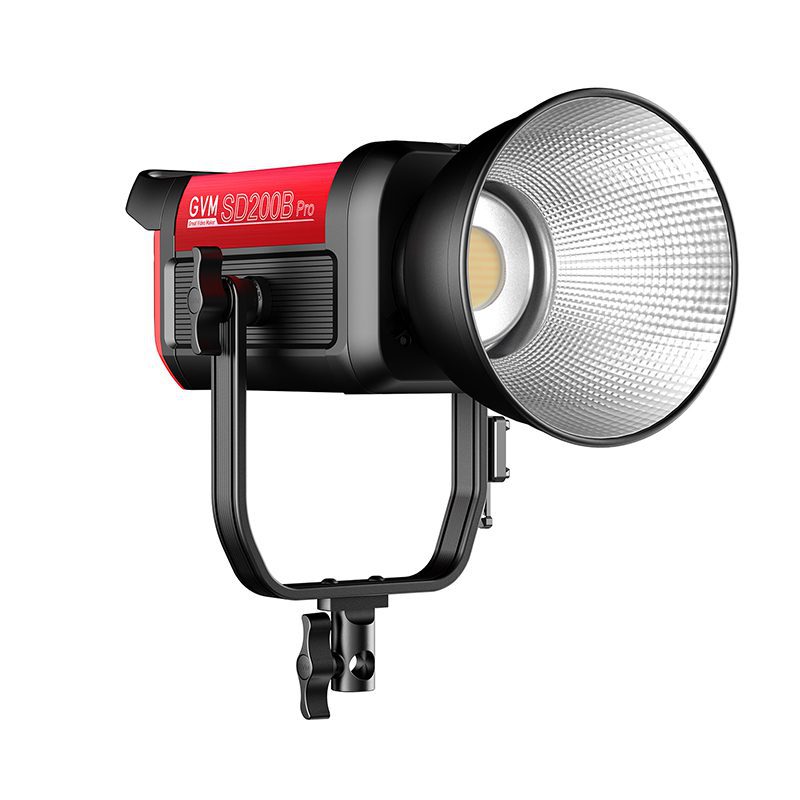
Once you understand what to look for, the next step is picking the right fixture. This is where the GVM PRO SD200B stands out. It’s a 200W bi-color mesh Bluetooth monolight built specifically for the kind of consistent, high-output lighting that indoor and studio photographers need.
The SD200B delivers 45,400 lux at 1 meter — more than enough brightness to fill a dim room — with a 2700K–6800K bi-color range and a CRI/TLCI rating above 97 for true-to-life skin tones and color reproduction. Dimming runs in 1/1000-step precision from 0% to 100%, so exposure adjustments are smooth and flicker-free even during long sessions.
La Mejor Iluminación para Fotografía de Interior
So why does the SD200B rank as one of the best lighting choices specifically for indoor photography? A few reasons stand out beyond raw specs.
First, it’s built for flexible control. Photographers can adjust settings through the GVM app, a 5-pin DMX interface, or simple onboard knobs — useful whether you’re shooting solo at home or running a more structured studio setup. Its Bluetooth mesh networking also lets it sync with other GVM lights like the SD300D or SD80D, so a single-light setup can grow into a full multi-light system without replacing gear.
Second, it’s genuinely versatile: standard Bowens mount compatibility means it works with widely available softboxes, Fresnel attachments, and projection modifiers, so photographers aren’t locked into a narrow accessory ecosystem.
Third — and this matters for a lot of hobbyists and small business owners — it’s priced in a range that’s accessible without cutting corners on output or color accuracy, which is a major reason it’s become a popular first “real” light for people upgrading from window light or on-camera flash.
| Característica | Specification / Benefit |
|---|---|
| Poder | 200W |
| Brillo | 45,400 lux @ 1m |
| Temperatura de color | 2700K–6800K bi-color |
| CRI / TLCI | 97+ / 97+ |
| Disminución | 0–100%, 1/1000-step precision |
| Control | GVM App, 5-Pin DMX, onboard knobs, Bluetooth mesh |
| Efectos de iluminación | 12 built-in effects + 12 light source presets |
| Montar | Montura Bowens |
| Enfriamiento | Silent cooling system |
| Ideal Use | Portraits, interviews, product photography, weddings |
Indoor Photography Camera Settings: A Real Shoot
To see how this plays out in practice, consider a portrait session shot inside a dimly lit farmhouse in the countryside — small windows, wood-paneled walls, and almost no usable daylight by mid-afternoon. Without additional lighting, this kind of location would force impossibly high ISOs just to get a usable exposure.
Instead, the SD200B was positioned at a 45-degree angle to the subject through a softbox, set to 3200K to match the warm tone of the wooden interior. With the light providing consistent, flicker-free output, the camera could stay locked at ISO 200, f/2.8, and 1/125s — settings that would have been unthinkable relying on the room’s ambient light alone. The bi-color adjustability made it easy to dial in a tone that felt natural against the rustic backdrop rather than sterile or artificial, and the 1/1000-step dimming allowed fine exposure tweaks between shots without touching camera settings at all.
Ideas fáciles de fotografía en interiores
A few practical tips for getting more out of indoor lighting setups:
- Bounce instead of blast. Angling your light toward a wall or ceiling before it hits your subject softens shadows dramatically.
- Match color temperature to the room. Warmer settings (2700K–3200K) blend more naturally into most home interiors than daylight-balanced light.
- Use one light well before buying a second. A single high-output, well-modified light often outperforms two poorly placed ones.
- Take advantage of built-in presets. Light source presets can save time matching mixed lighting environments without manual guesswork.
Conclusión
Dominio lighting for indoor photography doesn’t require a massive studio — it requires the right tool used correctly. The GVM PRO SD200B combines high brightness, accurate color, and flexible control at a price point that makes it a smart first investment for photographers ready to move past the limitations of natural light. If your indoor shots have been falling short, the fix might be simpler than a new camera — it might just be better light.

Preguntas frecuentes
What is the best type of lighting for indoor photography?
Continuous LED lighting is generally the best choice for indoor photography because it lets you see the exact lighting effect in real time, unlike flash. A bi-color, high-CRI monolight like the SD200B gives the flexibility to match almost any indoor scenario.
How many watts do I need for indoor photography lighting?
For most home studios and portrait work, 150–200W of continuous LED output is enough to properly light a room-sized space. The SD200B’s 200W output and 45,400 lux at 1m covers everything from tight interiors to larger studio rooms.
Do I need more than one light for indoor photography?
Not necessarily. A single well-placed, well-modified light can produce professional results. Many photographers start with one monolight and expand later — which is easier with mesh-networked lights like the SD200B that sync with additional units.
What color temperature is best for indoor photography?
It depends on the room. Warmer settings (2700K–3200K) usually blend more naturally with indoor environments, while daylight settings (5000K–6500K) work better near windows or when matching outdoor light.