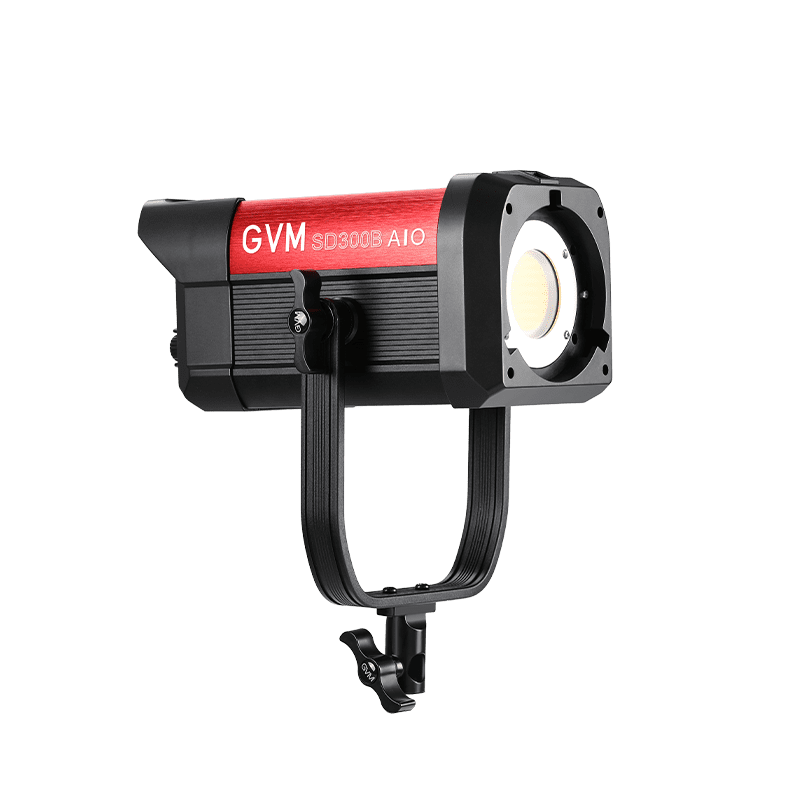
A cob monolight for video is usually the point where new creators get stuck between two competing instincts — stick with the flash setup they already know from stills photography, or switch to a continuous light built for both photo and video work. It’s a common source of confusion, and the wrong choice at this stage tends to cost creators either money on gear they outgrow fast, or time spent working around a light that was never built for the job they actually need it to do. Two of the most talked-about 300W options facing this exact decision right now are the GVM SD300B AIO and the Nanlite FS-300B.
Below is a direct look at why a single do-it-all monolight matters so much for home-based creators, why continuous lighting keeps pulling ahead of flash for this kind of work, what a genuinely capable photo-and-video monolight needs to deliver, why mount choice matters more than most beginners realize, and a full head-to-head between GVM’s and Nanlite’s 300W fixtures.
Tabla de contenidos
Why Home-Based Sellers Need One Monolight That Does It All
A growing share of today’s creators are running their entire operation out of a spare room. Amazon sellers photographing inventory, small business owners filming product demos, and solo YouTubers all share the same reality — no dedicated studio, no crew, and no budget to own five different lights for five different jobs.
This is exactly why a single, versatile fixture carries so much weight in a home setup. A COB monolight built for video that also handles stills gives a solo operator one piece of gear capable of lighting a product photo in the morning and recording a talking-head video that afternoon, without swapping equipment or learning two separate systems. For anyone running a home-based business or content channel, that flexibility is what actually keeps a one-person operation workable.
Continuous Light vs. Flash: The Real Reason Creators Are Switching
Flash has long been the default for studio stills, valued for freezing motion and delivering a burst of very high output. But for creators who need both photo and video from the same setup, flash runs into an obvious wall — it only exists for a fraction of a second, which makes it useless the moment continuous illumination is required.
Continuous lighting solves this by staying on the whole time, so a creator can see exactly how light falls on a subject before ever pressing the shutter. That “what you see is what you get” quality is a big part of why more photographers are shifting to continuous LED lights even for still work — no guessing how a flash will render a scene, no test shots to dial in exposure, and no separate video rig needed afterward.
For anyone shooting both product photos and video content — which describes most modern sellers and creators — a continuous light removes the need to own and learn two completely different lighting systems.
What a True Photo-and-Video Monolight Should Deliver
A monolight built to genuinely handle both photography and video needs to clear a higher bar than a fixture designed for just one. At minimum, it should deliver strong, even output with a reflector for directional work, high color accuracy so skin tones and product colors render correctly on both stills and footage, and stepless dimming for precise exposure control across both mediums.
Just as important is a light that stays consistent across long recording sessions rather than a single photo burst — video demands stable output and heat management that flash-oriented lights were never engineered for. A well-built monolight bridges that gap, functioning as a serious photography light and a genuinely usable video light in the same body.
Why the Mount You Choose Locks In (or Limits) Your Future Upgrades
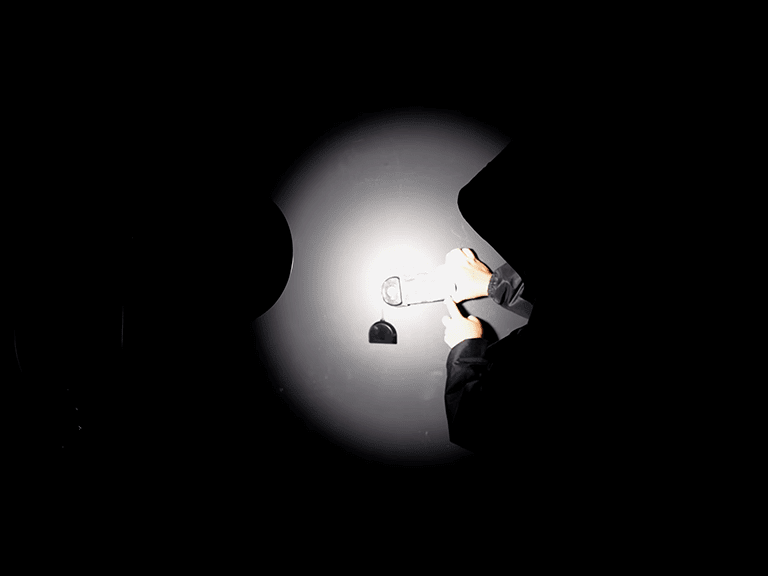
One decision matters more than almost any other when buying a monolight: mount compatibility. A Bowens mount opens the door to one of the largest modifier ecosystems available — softboxes, umbrellas, reflectors, and specialty attachments from dozens of manufacturers, rather than locking you into a single brand’s proprietary fittings.
This matters most as a creator’s needs grow. A light bought today for basic product shots might need a softbox for portraits next month, or a projection attachment for creative work down the line. Choosing a Bowens-mount light from the start means those upgrades are simply a matter of buying the modifier, not replacing the light itself.
GVM SD300B AIO vs. Nanlite FS-300B: Specs, Brightness, and Value Compared
Both the GVM SD300B AIO and the Nanlite FS-300B are 300W bi-color monolights with an all-in-one design and a Bowens-style mount, which makes them direct competitors on paper. Once the numbers are placed side by side, though, the gap between them becomes clear across four specific areas.
Brillo is the most dramatic difference. The GVM SD300B AIO produces 221,950 lux at 1 meter with its standard reflector, while the Nanlite FS-300B outputs 38,720 lux at 3.3 feet under similar reflector-assisted conditions. Even accounting for the difference in measurement distance, the GVM unit delivers dramatically more usable output at the same 300W rating — meaning it can push light further, through modifiers, or into larger rooms without straining.
Price at the same wattage favors GVM as well. The Nanlite FS-300B currently sells for $199 after a promotional discount. GVM’s SD300B AIO is typically positioned at a comparable or lower price point for the same 300W class, despite delivering vastly more output — a combination that’s difficult for a competing 300W fixture to match watt for watt.
Overall value follows directly from those first two points. Paying roughly the same price, or less, for a fixture with several times the brightness and matching (or slightly better) color accuracy makes the SD300B AIO the harder option to argue against on a pure cost-per-lumen basis.
Setup efficiency favors GVM’s all-in-one design specifically. Both lights avoid a separate ballast box, but GVM’s integrated build means faster deployment on set — no extra cabling to route, just a single unit that goes from case to fully powered light in minutes, which matters on any shoot where time is tight.
| Comparison Point | GVM SD300B AIO | Nanlite FS-300B |
|---|---|---|
| Poder | 300W | 300W |
| Brillo | 221,950 lux @ 1m (w/ reflector) | 38,720 lux @ 3.3′ (w/ reflector) |
| Temperatura de color | 2700K–6800K bi-color | 2700K–6500K bi-color |
| CRI/TLCI | 97+ / 97+ | 96 / 97 |
| Montar | Bowens | Bowens-S |
| Control | App, multi-light linking | Bluetooth (NANLINK), 2.4GHz remote |
| Built-in Effects | 12 lighting effects | 12 lighting effects |
| Precio | Comparable or lower at this wattage | $199 (promotional) |
| Setup | All-in-one, no external ballast | All-in-one, fan-cooled |
For creators comparing these two directly, the SD300B AIO comes out ahead on brightness headroom, matches or beats Nanlite on color accuracy, and does it at a price that doesn’t punish buyers for wanting more output from their 300W fixture — making it the stronger value between the two.
From a Dim Garage to a Full Shoot: Softbox Setup and Real-World Results
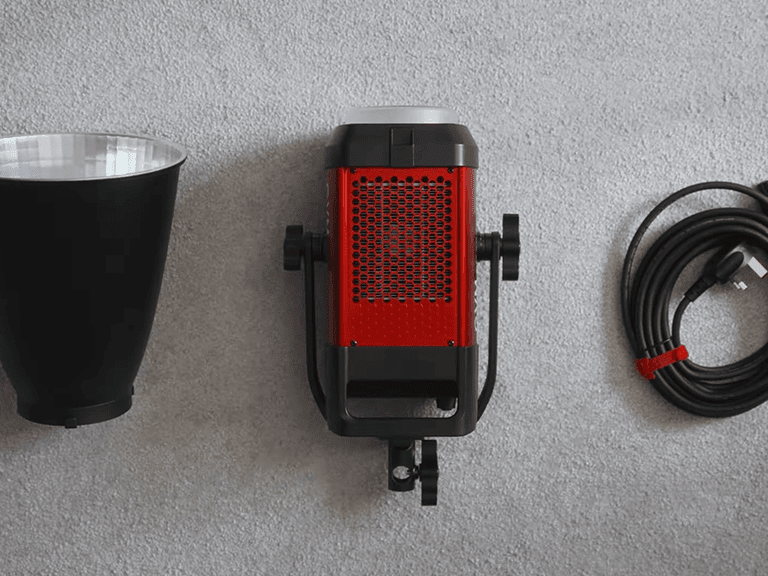
The SD300B AIO’s versatility shows most clearly once modifiers get involved. Its Bowens mount accepts GVM’s own Quick Deploy Softbox (24″) directly, softening its powerful output for flattering product and portrait work without sacrificing the brightness needed to shoot through diffusion.
In one real-world case, the SD300B AIO was the only light source used in a converted section of an old, dimly lit garage — no windows, no existing light sources, just concrete walls and whatever the fixture itself could produce. Fitted with the 24″ Quick Deploy Softbox and positioned at roughly 45 degrees to the subject, the light was bright enough to shoot a full portrait session through the softbox at a fraction of its maximum output, with plenty of headroom left over for larger diffusion or bounced fill.
The same setup, without moving the light or changing modifiers, was then used to record video in that same dim garage space — proving out exactly the kind of dual-purpose, one-light workflow that makes a monolight like this valuable for creators who can’t dedicate separate equipment to photo and video. No re-lighting, no second fixture, and a space that had no usable ambient light to begin with turned into a fully functional shoot location with a single 300W light.
Conclusión
Placed side by side, the numbers make the case clearly. The GVM SD300B AIO delivers dramatically higher output, matching or better color accuracy, and a comparable Bowens-mount, all-in-one design — all at a price that stays competitive with or below the Nanlite FS-300B. For a home studio, a solo content creator, or anyone shooting both product photos and video from the same space, the SD300B AIO offers more usable brightness and better long-term value per watt, making it the stronger choice for anyone building their first serious continuous lighting setup.
Ready to upgrade your home studio lighting? Explora el GVM SD300B AIO to see what 300W of real output can do for your next shoot.