The best lighting for video recording does three things at once: it renders skin tones accurately, delivers enough output for your camera’s exposure, and stays quiet and controllable while you shoot.
Miss any one of those and you lose time in post or lose the take entirely. Below, we break down what to look for and review three GVM lights, built for three very different kinds of video work.
Tabla de contenidos
The Best Type of Light for Video: What to Look For
For most video work, the best type of light is a continuous LED with high color accuracy, smooth dimming and a color temperature range wide enough to match your scene. Four specs decide whether a light is truly good for video:
- CRI and TLCI of 95 or higher. CRI describes how faithfully a light renders colors, while TLCI predicts how that color will look through a camera sensor. Both should sit at 95+ for faces and product work.
- Bi-color range. A 2700K–6800K range lets you match tungsten practicals or daylight windows without gels.
- Flicker-free, stepless dimming. Cheap lights band on camera at low output or high shutter speeds. Fine-grained dimming avoids that.
- Quiet operation. A loud fan ruins interview audio. Look for silent or passive cooling modes.
Video Recording Lighting Equipment: The Core Setup
A reliable setup needs only a few pieces. Start with a luz principal, your main source, placed at roughly 45 degrees from the subject. Add a luz de relleno or reflector to soften shadows, and a luz de fondo to separate the subject from the background.
Then consider modifiers. A Bowens mount accepts softboxes, lanterns, reflectors and Fresnels, so one light can produce hard or soft output depending on the shot. Control matters as well: Bluetooth app control suits solo creators, while DMX and CRMX suit multi-light studios. Power flexibility (AC for the studio, battery for the field) rounds out the list.
Best Video Lights for Videography: Matching Gear to the Shoot
Videography rarely happens in one environment, so the right light depends on the job:
- Interviews and talking heads: Prioritize color accuracy and silent operation. You need soft, controllable light and no fan noise.
- Run-and-gun and travel: Weight, battery power and a compact body come first.
- Branded content and music videos: Color effects, RGB and built-in FX save you from carrying extra gear.
- Sets and studios: High output, modifier support and wired or wireless DMX control keep multi-light setups consistent.
The three lights below map to these situations.
Best Video Recording Lighting: GVM Top 3 Compared
| Característica | GVM PF100B | GVM 800D III | GVM SD700B AIO |
|---|---|---|---|
| Poder | 100W COB | 40W RGB panel | 700W COB |
| Color temperature | 2700K–6800K bi-color | 3200K–5600K bi-color + 360° HSI | 2700K–6800K bi-color |
| CRI / TLCI | 97+ / 97+ | 97+ / 97+ | 97+ / 97+ |
| Output | 30,200 lux @ 1m (spot) | Up to 2,930 lux @ 1m | 26,200 lux @ 3m with standard reflector |
| Mount / optics | Mini Bowens, 15°–45° zoom | Panel (soft, wide) | Bowens |
| Control | On-board + Bluetooth app | LCD + app | Bluetooth, 5-pin DMX, CRMX |
| Power source | AC or V-mount battery | DC 15V/3A or NPF battery | AC |
| Best for | Interviews, focused key light | Creators, color accents, travel | Sets, studios, large spaces |
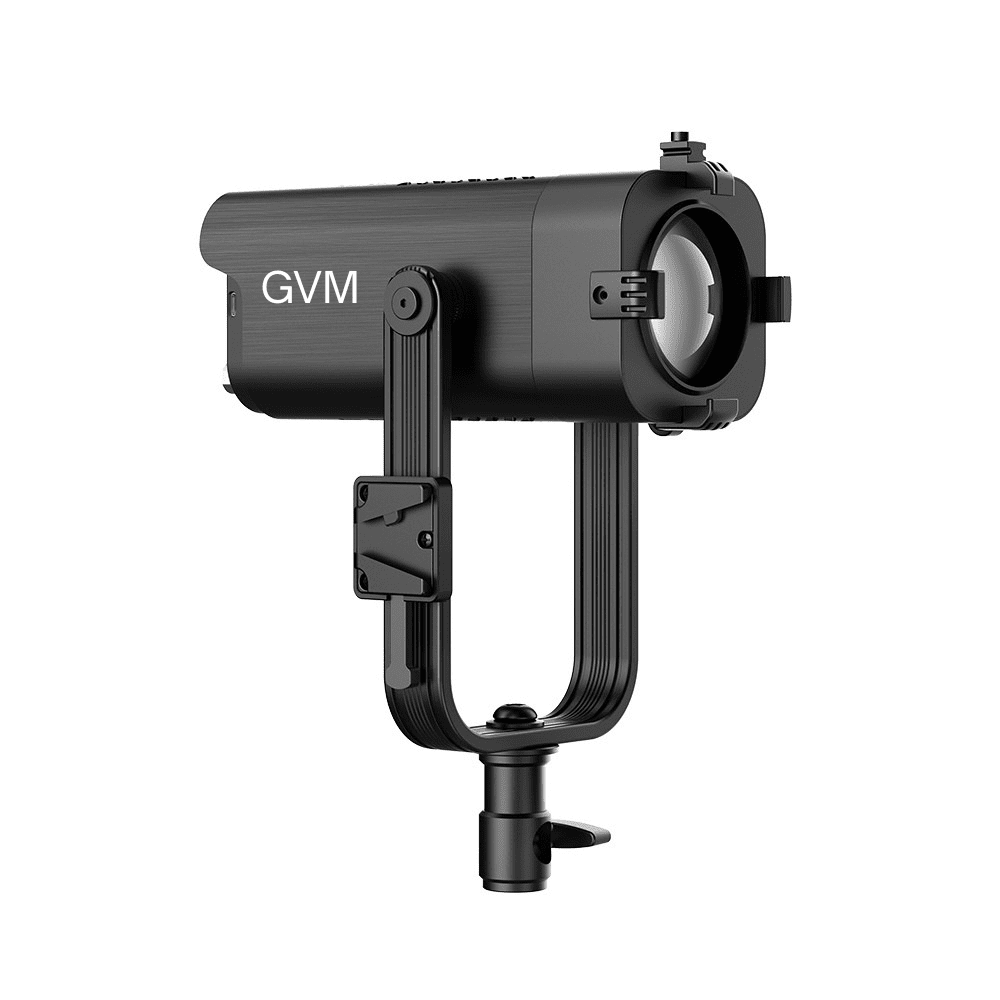
1. GVM PF100B: Best Focusing Light for Interviews
The PF100B packs a 100W bi-color COB engine and a TIR lens into one head. A focus knob zooms the beam from a 15° spot to a 45° flood, so you can shape light on a subject without adding a modifier. In spot mode it reaches 30,200 lux at 1 meter, strong output for a compact unit. Four dimming curves (Linear, Log, Exponential, S-Curve) give you precise fade control, and its Source Matching and Effects modes (12 each, via app) help blend with existing light.
Pros
- CRI/TLCI 97+ with a wide 2700K–6800K range
- Zoomable beam and mini Bowens mount
- AC or V-mount battery power
- Four cooling modes, including a fan-off Silent mode
- Currently $299 (regular $399), strong value for a focusing 100W light
Cons
- Silent mode cuts output to roughly 10–20W, so plan for lower brightness when audio is critical
- Optional V-mount battery is sold separately

2. GVM 800D III: Best RGB Panel for Content Creators
The 800D III is a 40W panel combining bi-color and full-color RGB in a slim body of 10.6 × 10.3 × 1.5 inches. GVM reports up to 2,930 lux at 1 meter, a significant jump over the previous 800D generation. With HSI control (360° hue, 0–100% saturation), 20 built-in effects and eight scene modes, it covers accent lighting, backgrounds and fill. Master-slave sync and app control make multi-panel setups simple, and it runs from a DC adapter or NPF battery.
Pros
- CRI/TLCI 97+ plus full HSI color
- Lightweight, slim and easy to travel with
- Battery-capable for outdoor and on-location shooting
- Affordable entry into pro-grade color accuracy
Cons
- 40W output suits close-range and fill work, not large spaces
- Bi-color range (3200K–5600K) is narrower than the COB models
- No Bowens mount for heavy modifiers
3. GVM SD700B AIO: Best High-Output Light for Sets and Studios
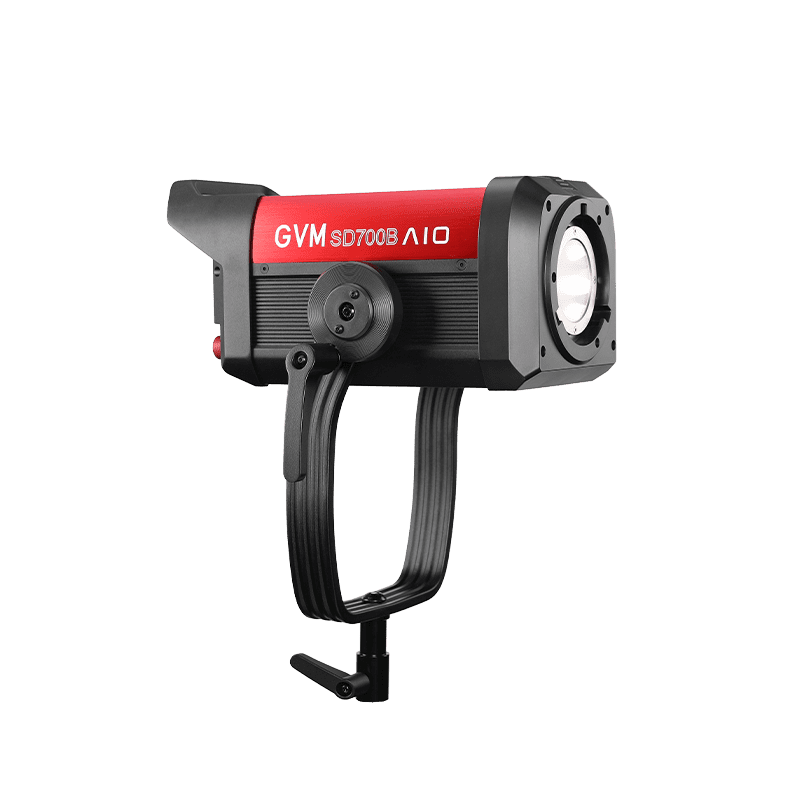
The SD700B AIO is the heavyweight: a 700W bi-color all-in-one spotlight reaching 26,200 lux at 3 meters with the standard reflector. Dimming runs from 0.1% to 100% without flicker, and color temperature stays consistent across brightness levels. The universal Bowens mount accepts softboxes, lanterns and Fresnels, while 5-pin DMX, CRMX wireless and Bluetooth cover almost any control workflow. Twelve built-in effects, including Lightning, TV Flicker and Candlelight, add atmosphere with no extra gear.
Pros
- CRI/TLCI 97+ with 2700K–6800K bi-color
- Very high output for large sets and bright environments
- Professional DMX and CRMX integration
- Integrated design with built-in handle for fast setup
Cons
- More power than a desk or small-room setup needs
- Best suited to studio or AC-powered locations
Best Light for Content Creators: Final Verdict
Choosing the best light for content creators comes down to your shooting style. For interviews and tutorials where beam control and clean color matter, the PF100B is our pick, and its current $299 price is hard to beat for a focusing 100W light. For creators who want color effects, portability and a low barrier to entry, the 800D III is the smart buy. For studios, film sets and large spaces where raw output and DMX control matter, the SD700B AIO delivers cinema-grade brightness in an all-in-one body.
All three share CRI/TLCI 97+ accuracy, and all three put GVM’s value-per-dollar focus on display. Browse the full range on the GVM website to match a light to your next shoot.
Preguntas frecuentes
What is the best lighting for video recording at home?
A bi-color LED with CRI 95+ is the best starting point. The PF100B or 800D III both suit home studios.
How bright should a video light be?
It depends on distance and camera settings. Close-up work needs far less than a large set, which is why the 40W 800D III and 700W SD700B AIO serve different jobs.
Do I need an RGB light for video?
Not for interviews or product work, but RGB panels like the 800D III add background and accent color without extra gear.