The most common mistake in building a lighting kit is buying for the wrong scale. A creator shooting a single interview in a spare bedroom doesn‘t need 1200W of output. A small commercial crew shooting a wide interior scene will hit a wall with a 500W light, even if the spec sheet looks impressive on paper.
The problem isn’t the gear. It‘s that most buying guides list specifications without explaining which studio lighting scenario each fixture actually solves.
This guide breaks down GVM’s AIO (All-in-One) series by production scale. We’ll start with the criteria that matter, show a simple tutorial for using each light, then recommend the right model for your work-with honest pros and cons for each.
Tabla de contenidos
The Three Criteria That Separate AIO Lights
Before comparing wattage, here’s what actually determines whether an AIO light fits your workflow:
| Criterion | Why It Matters |
| Deployable Output | Raw lux numbers are meaningless if the light takes 20 minutes and two people to set up. An AIO light integrates the ballast and controller into the head, so what you read on the spec sheet is what you get on set-fast. |
| Form Factor at Scale | A 500W AIO weighs ~6.65 kg. A 1200W AIO weighs ~12.5 kg. That difference matters when you’re rigging lights alone, moving between locations, or working in a small studio where floor space is limited. |
| Control Integration | All three support Bluetooth app control and a data port for DMX/CRMX via optional attachments. The question is whether your production actually needs console control, or whether app-based adjustments are sufficient. |
A Simple Tutorial: How to Deploy an AIO Light on Set
The AIO design is built for speed. Here’s the basic workflow:
- Mount the light on a stand via the 5/8″ receiver or yoke.
- Connect AC power directly to the head-there is no external ballast to hang or cable to route.
- Set color temperature and brightness using the onboard LCD and dials, or open the GVM app for Bluetooth control.
- Attach modifiers using the standard Montura Bowens-softboxes, lanterns, and reflectors all fit without adapters.
- Adjust the cooling mode based on your audio needs: Intelligent, High Speed, Silent, or Passive. Silent and Passive modes are critical for dialogue scenes.
That’s it. No controller mounting, no ballast cable management. For solo creators and small crews, this workflow is the core advantage of the AIO line.
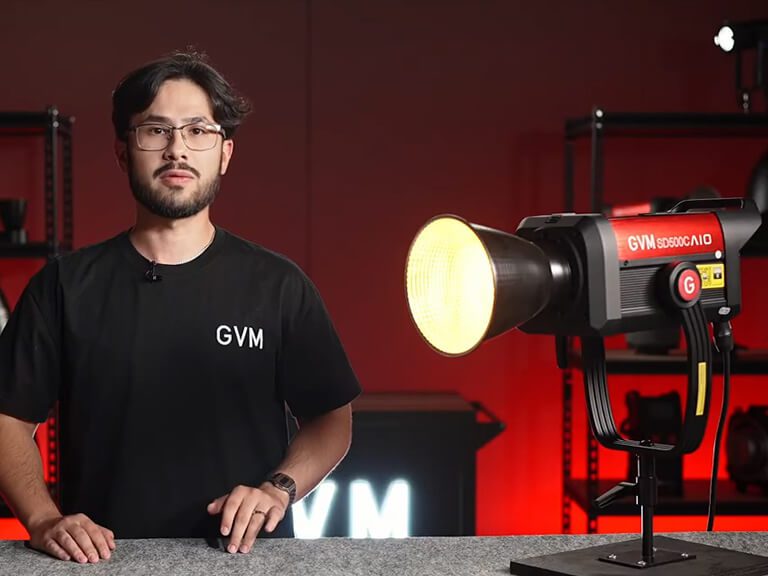
1. GVM SD500B AIO – Best for Solo Creators and Small Studios
Role: The entry point into professional studio lighting for creators who work alone or in tight spaces.
What the data says: 500W output, 23,800 lux at 1 meter bare bulb, 227.040 lux a 1 metro with the standard reflector. Weighs 6.65 kg. 2700K–6800K bi-color range, 97+ CRI/TLCI.
Why it fits the role: At 6.65 kg, this is a light you can reposition on your own without needing a second pair of hands. The 500W output is enough for a key light on a single interview setup, a product table, or a small streaming corner. The AIO design means you’re not fighting with cables in a room that doesn’t have space for them.
Ventajas:
- ✔️ Lightest AIO in the lineup at 6.65 kg-genuinely one-person deployable.
- ✔️ 227,040 lux with reflector provides serious punch for a 500W fixture.
- ✔️ 4-mode cooling includes Silent and Passive for audio-sensitive shoots.
- ✔️ Montura Bowens compatibility opens up a huge range of affordable modifiers.
Cons:
- ❌ 500W may not be enough for large sets or balancing strong daylight through windows.
- ❌ No built-in DMX; requires the optional GVM BOX data port accessory for console control.
- ❌ Reflector-based output drops significantly at 3 meters (19,760 lux), so it’s best for close-to-medium throw distances.
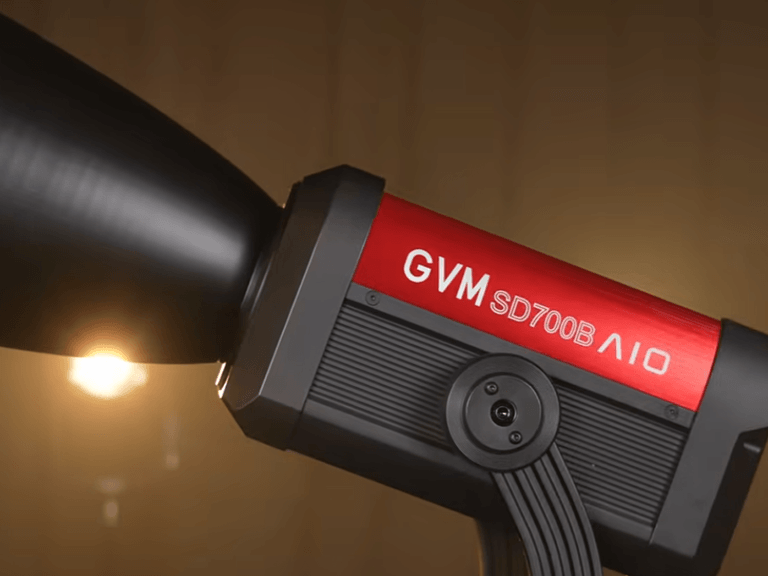
2. GVM SD700B AIO – Best All–Rounder for Commercial and Corporate Work
Role: The middle ground for creators and small crews who need more headroom than 500W but don’t want the weight and power demands of a 1200W fixture.
What the data says: 700W output, 28,900 lux at 1 meter open face, 24,000 lux at 3 meters with the standard reflector. Weighs 7 kg. 2700K–6800K bi-color, 97+ CRI/TLCI.
Why it fits the role: The jump from 500W to 700W doesn‘t sound dramatic on paper, but the practical difference is meaningful. The 700B gives you more room to push light through a softbox, fill a slightly larger room, or maintain exposure when you’re shooting at higher frame rates. At 7 kg, it’s still light enough to handle solo, but the extra output makes it viable for corporate interviews, small commercial sets, and multi-camera setups.
Ventajas:
- ✔️ 24,000 lux at 3 meters with reflector-enough for medium-sized sets and moderate daylight balancing.
- ✔️ 7 kg weight keeps it solo-deployable despite the power increase.
- ✔️ 12 built-in cinematic effects (lightning, paparazzi, strobe, etc.) accessible via the app for creative shots.
- ✔️ Standard Montura Bowens and silent cooling modes make it a true production workhorse.
Cons:
- ❌ Still no built-in DMX; pro console control requires the optional data port accessory.
- ❌ 700W is a significant power draw-check your circuit capacity if you’re running multiple lights.
- ❌ Not enough output for very large sets or direct sunlight fill at distance.
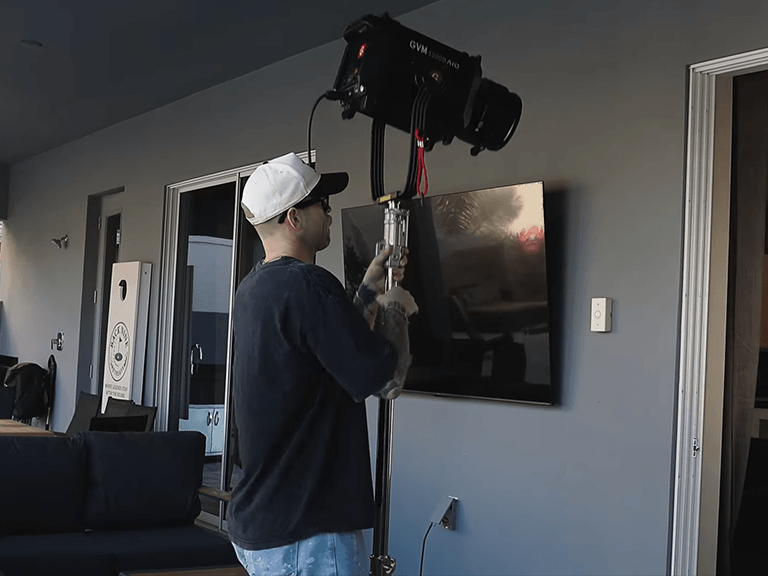
3. GVM 1200B AIO – Best for Large Sets and High–Output Demands
Role: The flagship for productions that need serious output without the logistics of an external ballast.
What the data says: 1200W output, 6,240 lux at 3 meters open face, 42,800 lux at 3 meters with the standard reflector. Weighs 12.5 kg (with yoke). 2700K–6800K bi-color, 97+ CRI/TLCI.
Why it fits the role: This is not a light you buy “just in case.” The 1200B AIO exists for situations where 700W isn‘t enough: large studio spaces, scenes that need to be pushed through heavy diffusion, or shots where you’re competing with uncontrolled ambient light. The 42,800 lux at 3 meters with reflector is the kind of output that lets you light a wide frame from a reasonable distance, rather than moving the fixture uncomfortably close to the subject.
Ventajas:
- ✔️ 42,800 lux at 3 meters with reflector-genuine high-output capability for large sets.
- ✔️ Integrated design eliminates the external ballast that usually comes with 1200W fixtures.
- ✔️ 4-mode cooling including Passive mode for silent operation.
- ✔️ Bluetooth app control and data port for DMX/CRMX integration via optional accessories.
Cons:
- ❌ 12.5 kg is a two-person lift for overhead rigging; not a solo-friendly fixture.
- ❌ Significant power draw-verify your studio’s electrical capacity before adding multiple units.
- ❌ Overkill for small rooms, solo interviews, or tabletop work; the 500B or 700B will serve those scenarios better.
Quick Comparison
| Característica | SD500B AIO | SD700B AIO | 1200B AIO |
| Poder | 500W | 700W | 1200W |
| Bare Bulb Output (1m) | 23,800 lux | 28,900 lux | – |
| Reflector Output (3m) | 19,760 lux | 24,000 lux | 42,800 lux |
| Weight (with yoke) | 6.65 kg | 7 kg | 12.5 kg |
| Rango de CCT | 2700K–6800K | 2700K–6800K | 2700K–6800K |
| CRI/TLCI | 97+ | 97+ | 97+ |
| DMX (Built–in) | No (via optional data port) | No (via optional data port) | No (via optional data port) |
| Montura Bowens | Sí | Sí | Sí |
| Mejor para | Solo creators, small studios | Commercial interviews, mid-size sets | Large sets, high-output demands |
Preguntas frecuentes
Do I need DMX for my AIO light?
Only if you’re working with a lighting console or a dedicated gaffer. For solo creators and small crews, the Bluetooth app and onboard controls are sufficient. If you anticipate scaling into multi-light console workflows, all three lights support DMX via the optional GVM BOX data port accessory.
What’s the practical difference between 500W and 700W?
About 4,000 lux at 3 meters with reflector (roughly 20% more output). That difference matters when you’re pushing light through a softbox, filling a slightly larger room, or trying to maintain exposure at higher frame rates. For a single interview setup, the 500B is enough. For corporate and commercial work with more variables, the 700B gives you more headroom.
Can the 1200B AIO run on battery power?
No. The 1200B AIO is AC-powered only. The PRO series (like the SD650B) is the line to look at if you need V-mount battery support for location work.
Are these lights suitable for video, not just photography?
Yes. All three are continuous light for photography and video. The 97+ CRI/TLCI and flicker-free dimming (0.01% steps on the 1200B, 0.1% on the 500B) make them suitable for professional video production.
Which one should I buy for a small home studio?
En SD500B AIO. It’s the lightest (6.65 kg), draws the least power, and delivers enough output for a single-subject key light in a room that doesn’t have the space or electrical capacity for a 1200W fixture.
Final Verdict
The right AIO light is the one that matches your production scale, not the one with the biggest number on the spec sheet.
- Solo creators and small studios → SD500B AIO. 6.65 kg, 227,040 lux with reflector, and a solo-deployable form factor.
- Commercial and corporate work → SD700B AIO. 24,000 lux at 3 meters, 7 kg, and enough headroom for mid-size sets.
- Large sets and high–output demands → 1200B AIO. 42,800 lux at 3 meters, integrated design, and the output to light wide frames from a distance.
All three share the same core advantages: Montura Bowens compatibility, 97+ CRI/TLCI color accuracy, Bluetooth app control, and 4-mode cooling. The difference is scale-and choosing the wrong scale is the fastest way to waste money on capability you don’t use or hit a ceiling you didn’t anticipate.