Cinematic lighting is what separates flat, amateur footage from work that feels like it belongs on a real set, and the tools creators use to get there have changed fast. Aputure has long been the name serious productions reach for, and the STORM 1200x is a genuinely excellent light — the color science, the build quality, and the output are all built for demanding professional work.
But GVM’s AIO 1200B has quietly disrupted that market, giving creators access to 1200W-class output and all-in-one convenience at a fraction of the investment. This guide breaks down what cinematic lighting actually requires, how these two 1200W monolights compare, and which one makes sense for your production.
What Is Cinematic Lighting
At its core, cinematic lighting is about using light and shadow to shape the emotional read of a frame, not just to expose the subject correctly. Whether it’s a Hollywood soundstage or a one-person home studio, the same principles apply: motivated light sources, controlled contrast ratios, and consistent color across every setup.
1200W has become the benchmark output level for a new generation of cinematic fixtures because it gives operators enough headroom to punch light through large diffusion, bounce off distant walls, or overpower ambient light on location — all without stacking multiple smaller units together.
Types of Cinematic Lighting
Cinematic setups typically draw from three fixture types: point-source lights for hard, shapeable beams; panel lights for soft, even wash; and tube lights for accents and practicals. LED movie lights have become the dominant choice across all three categories because they run cooler, last longer, and offer far more control than tungsten or HMI alternatives.
One of the biggest decisions within LED fixtures is bi-color versus single color temperature. A bi-color unit trades a small amount of theoretical color purity for the flexibility to match daylight, tungsten, or anything in between — a tradeoff most working cinematographers now consider worth making, especially on productions that move between locations in a single day.
Two Flagship LED Cinematic Lights, Head to Head
Movie Studio Lights
In a controlled studio environment, both lights hold up well for continuous illumination. The GVM AIO 1200B reaches 42,800 lux at 3 meters with its standard reflector and holds CRI above 97, which is more than enough punch for interview lighting, panel discussions, or long-form recorded content. Its three-mode intelligent cooling system, including a fully silent “Off” mode, makes it a strong option for audio-sensitive studio setups.
The Aputure STORM 1200x pushes further, hitting 202,500 lux at 3.3 feet with its included 45° reflector and scoring CRI/TLCI 95 with an 87 SSI rating — numbers built for high-end color-critical set work. Both lights support multi-fixture control, though the STORM 1200x’s DMX, Art-Net, and sACN protocol support gives it an edge on large, tightly coordinated studio rigs.
Movie Room Lights
In tighter spaces, output control matters more than raw power. The AIO 1200B’s 0.3%–100% stepless dimming and Bowens mount modifier compatibility make it easy to soften and scale down for small-room interviews without losing color consistency. The STORM 1200x offers similarly smooth dimming down to 0.1%, plus IP65 weather resistance that’s overkill indoors but useful if the space isn’t fully controlled.
Noise matters most at close range, and both units address it with quiet cooling design, though GVM’s dedicated silent mode gives it a slight practical advantage for tight interview setups where the mic is inches from the fixture.
Movie Production Lights (On-Set Use)
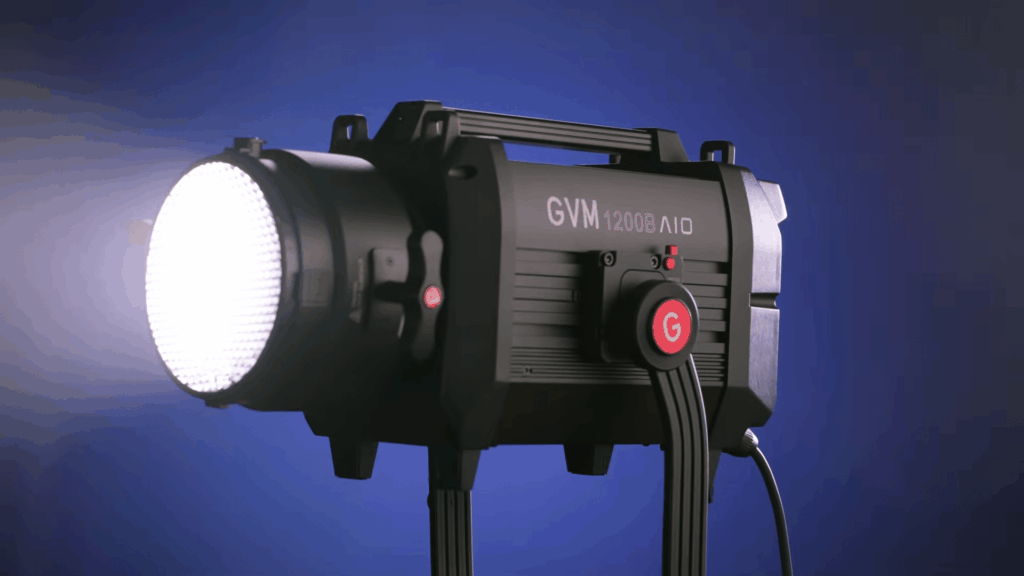
On location, battery independence, weatherproofing, and effects libraries all come into play. The STORM 1200x’s IP65 rating is a genuine advantage for unpredictable outdoor conditions. The AIO 1200B counters with a lightweight 10kg build, a fully integrated all-in-one design with no external ballast to carry, and 12 built-in effects — lightning, fire, TV flicker, paparazzi, candle, and more — for instant on-set atmosphere without extra gear.
A Real-World Case: Lighting a Stadium-Sized Interview
Consider a documentary crew flying out to shoot a subject interview inside a massive university stadium. The space is enormous, and underpowered lights simply can’t punch through it — a small LED panel would leave the subject looking flat and disconnected from the background. The plan calls for an 8×8-foot soft box, which means the fixture behind it needs serious output; underpowered lighting won’t fill a diffusion panel that large, and the subject will read as underexposed against it.
Add to that the reality of air travel: crews can’t check in fragile, oversized gear without risking damage or excess baggage fees. This is exactly where the AIO 1200B’s all-in-one, 10kg design earns its keep — no separate ballast, no extra case, and enough output to fully load an 8×8 soft box from a reasonable throw distance. For traveling crews working in oversized venues, that combination of punch and portability is hard to overstate.
GVM AIO 1200B: Specifications
| Característica | Specification / Benefit |
|---|---|
| Modelo | GVM AIO 1200B |
| Tipo de producto | Bi-Color DMX COB Spotlight |
| Max Poder | 1200W |
| Brillo | 42,800 Lux @ 3m (with standard reflector) |
| Temperatura de color | 2700K–6800K |
| CRIMEN | >97 |
| Disminución | 0.3%–100% Stepless (PWM, flicker-free) |
| Control | App, CRMX, DMX, RDM, Art-Net (via GVM BOX) |
| Enfriamiento | 3 Fan Modes (Auto/Low/Off) |
| Montar | Bowens Mount with Safety Lock |
| Effects | 12 Built-in FX + 12 Light Source Modes |
| Peso | 10kg (22 lbs) |
| Diseño | All-in-One, No External Ballast |
| Precio | Competitive value pricing (contact for current quote) |
Building a Cinematic Lighting Kit
A complete entry-level cinematic setup usually starts with a key light, a fill or rim light, and a hair/kicker light for separation. From there, softboxes, fresnel lenses, and flags round out the shaping tools.
Both ecosystems support this build path through Bowens-mount accessories, but they differ in cost of entry. Aputure’s accessory catalog — Light Dome softboxes, dedicated fresnel attachments, premium stands — is polished but expensive, often adding $1,000+ on top of the fixture itself. GVM’s Bowens-standard mount opens the door to the same broad third-party modifier market at a much lower total kit cost, which matters most for creators building out their first multi-light cinematic setup.
Which Is the Best Movie Lighting Choice
If budget is the deciding factor, the GVM AIO 1200B is the clear pick. It delivers 1200W-class output, professional dimming, DMX-level protocol support, and a genuinely portable all-in-one build at a price point that undercuts the STORM 1200x dramatically for equivalent wattage — making it the strongest value-per-watt option in this class.
If absolute color science and IP65-rated build quality are non-negotiable for a big-budget production, the STORM 1200x’s BLAIR chipset and weatherproofing justify its premium price for studios that can absorb the cost.
For most working creators, though, the calculus comes down to output per dollar and setup speed, and that’s where GVM’s all-in-one design wins: same wattage class, lower price, higher measured brightness at range, and a rig you can carry onto a plane without a second case. For anyone building a cinematic lighting kit on a real-world budget, the AIO 1200B is the smarter starting point.

Preguntas frecuentes
Is the GVM AIO 1200B suitable for professional film production?
Yes. With 42,800 lux output, DMX/Art-Net protocol support via the GVM BOX, and 12 cinematic effects, it’s built for film, television, and commercial video work.
How does the AIO 1200B compare in brightness to the STORM 1200x?
The STORM 1200x measures significantly higher lux at a closer 3.3-foot distance, but the AIO 1200B still delivers strong studio-grade output at 3 meters — more than enough for most interview, studio, and on-location setups at a much lower price per watt.
Can the GVM AIO 1200B use Bowens mount modifiers?
Yes. It uses a standard Bowens mount with a safety lock, compatible with the same broad range of softboxes, fresnels, and modifiers as the STORM 1200x.
Is the AIO 1200B travel-friendly?
Yes. At 10kg with a fully integrated, ballast-free design, it’s significantly easier to pack and transport than multi-piece HMI or high-end monolight systems.
Which light is better for a tight budget?
The GVM AIO 1200B, since it offers comparable wattage-class output and professional features at a fraction of the STORM 1200x’s cost, along with a lower-cost path to building a full modifier kit.