More creators than ever are treating lighting as a core part of their production, not an afterthought bolted on after the camera and mic are sorted. Trying to pick the right continuous fill light for YouTube in 2026 means wading through spec sheets full of CRI ratings, lux figures, and app-control claims that don’t always translate into what actually happens on a real set.
This breakdown works through the full picture — reading specs correctly, applying them to real shooting scenarios, and building toward more advanced lighting control — so you can put together a system on a sensible budget that actually fits how you shoot, whether that’s talking-head content, vlogging, or product reviews.
The recommendations here come from testing lighting gear across exactly those three formats, cross-referencing manufacturer specs against measured output where possible, and noting where a spec sheet number and a real shoot experience diverge.
2026 Lighting Technology Trends and Buying Standards
Where the Industry Is Heading
A few shifts define what’s worth paying attention to on a spec sheet this year:
- High-CRI LEDs are the baseline, not the upsell. CRI 97+ has moved from a premium feature to something expected even in mid-range fixtures, which matters enormously for accurate skin tones on camera.
- Battery power has caught up to output. Large-capacity, fast-charging batteries are now standard for anything marketed as portable, making all-day outdoor shoots realistic instead of a battery-anxiety exercise.
- Smart control is table stakes. App and voice control, scene presets, and early AI-assisted lighting effects are showing up across price tiers, not just flagship fixtures.
- Modular design is winning. Lights built to expand — via accessory mounts, add-on batteries, or multi-unit syncing — hold their value longer than fixed, single-purpose units.
What Actually Matters When Choosing a Light
Cut through the marketing copy by checking four categories every time:
- Base specs — power draw, color temperature range, CRI, and TLCI. TLCI in particular gets overlooked but matters more than CRI for how skin tones actually render on camera sensors.
- Portabilidad — weight, physical size, and power source. A light that needs a wall outlet isn’t a location light, no matter how compact the housing looks.
- Expandability — accessory ecosystem and mount compatibility (Bowens being the most common). A light locked to proprietary modifiers limits you later.
- Smart features — control protocol (Bluetooth, DMX, app) and whether multiple units can sync together, which matters the moment your kit grows past one light.
Best Light for Videography by Budget Tier
Different creators need genuinely different systems — not just cheaper versions of the same setup. Here’s how the three common tiers break down in practice.
Entry-Level: High Value on a Real Budget
The goal at this level is a single flexible light doing the work of three. A portable fill light paired with a small softbox and a lightweight stand covers the vast majority of talking-head and single-subject content without overcomplicating the kit. This tier suits beginner videographers and solo creators who need one light that adapts across scenarios rather than a collection of specialized fixtures they’ll rarely all use at once.
Professional: Efficiency and Quality Balanced
Here the goal shifts to a standardized, repeatable kit — something that sets up the same way every time so lighting stops being a variable between shoots. A two- or three-light video kit with a full set of control accessories (grids, softboxes, barn doors) gives small production teams and professional videography studios a system they can rely on without reinventing the setup for every client.
Flagship: Built for Cinematic Freedom
At the top tier, the priority is complex, multi-source lighting for demanding productions — high-end commercial work, short films, and anything where the lighting itself is part of the creative direction. High-power RGBWW fixtures combined with matrix lights and a full professional control system give this tier the range to build layered, motivated lighting rather than a single flat key.
Wedding Videographer Lighting Setups
Wedding work has its own set of non-negotiables that don’t apply to studio content.
What the Gear Actually Needs to Do
- Portable and reliable — lightweight, fast to break down, and able to run all day without a mid-ceremony battery scramble.
- Quiet and cool-running — fan noise that bleeds into ceremony audio is not a minor issue; it can ruin a vow recording outright.
- Strong in low light — good low-light performance and fast focus assistance matter more here than raw output, since so much of a wedding happens in dim venues.
Building a Workflow Around the Day
- Preparation — lean on window light shaped with a small fill light to keep skin tones soft and natural during getting-ready footage.
- Ceremony — a long-battery-life stick or panel light provides discreet side fill without drawing attention or adding noise.
- Reception — RGB color lights bring atmosphere into frame and help capture the energy of dancing and toasts as they happen, not as a color-grade afterthought.
A Practical 2026 Gear List
A workable kit for this format: two to three high-CRI, bi-color portable video lights as the core, one or two full-color RGB sticks for ambience, several fast-charging batteries, ultra-portable stands, and compact softboxes small enough to move between rooms quickly.
Professional Videography Lighting Systems
How the System Should Be Built
A professional setup separates lighting into distinct roles rather than treating every fixture the same:
- Key light system — a high-power, focusable spotlight-style fixture doing the primary shaping work.
- Fill system — larger LED panels or softboxes handling shadow control across a wider area.
- Effect light system — RGB sticks, matrix lights, or laser-style fixtures for background and atmosphere separate from the subject lighting.
- Control and power — a wireless control system tied to centralized power distribution, so adjusting one light doesn’t mean walking to five different units.
Techniques Worth Adopting
Digital lighting previews let you plan complex multi-source setups in software before a single fixture is turned on, saving real setup time on the day. Real-time spectral analysis keeps color temperature and CRI consistent across mixed light sources — critical the moment you’re combining more than two fixtures from different manufacturers. Motion-tracking lighting, still emerging, automatically follows a moving subject and is increasingly practical for solo-operator productions.
Where Efficiency Actually Comes From
Preset lighting-effect libraries, synchronized lighting across multiple camera positions, and shared lighting scripts across a cloud workflow all reduce the setup tax that eats into shoot days — especially valuable for teams running the same production style repeatedly.
Beginner Videographer: A Three-Step Starting Path
Step One: Learn the Principle Before Buying Gear
Light quality beats light quantity every time — learning to use one light well outperforms owning three lights used poorly. Before buying anything, get comfortable “modifying” existing light: bounce boards and diffusion fabric can shape natural window light and ambient room light into something usable without spending a cent.
Step Two: Invest in a First Real Kit
Start with a single app-controllable, bi-color fill light rather than a bundle of cheap fixtures. Pair it with a 5-in-1 reflector, a small softbox, and a portable stand — these three accessories do more for image quality than a second light would at this stage. Learning one-light videography first builds the fundamentals behind classic three-point lighting before adding complexity.
Step Three: Build a Repeatable Workflow
Before shooting, sketch a simple lighting script for the scene. During the shoot, use the phone monitoring app to check exposure and color temperature in real time rather than guessing. After the shoot, review what worked and start building a personal preset library — this is where a beginner setup starts turning into a professional one.
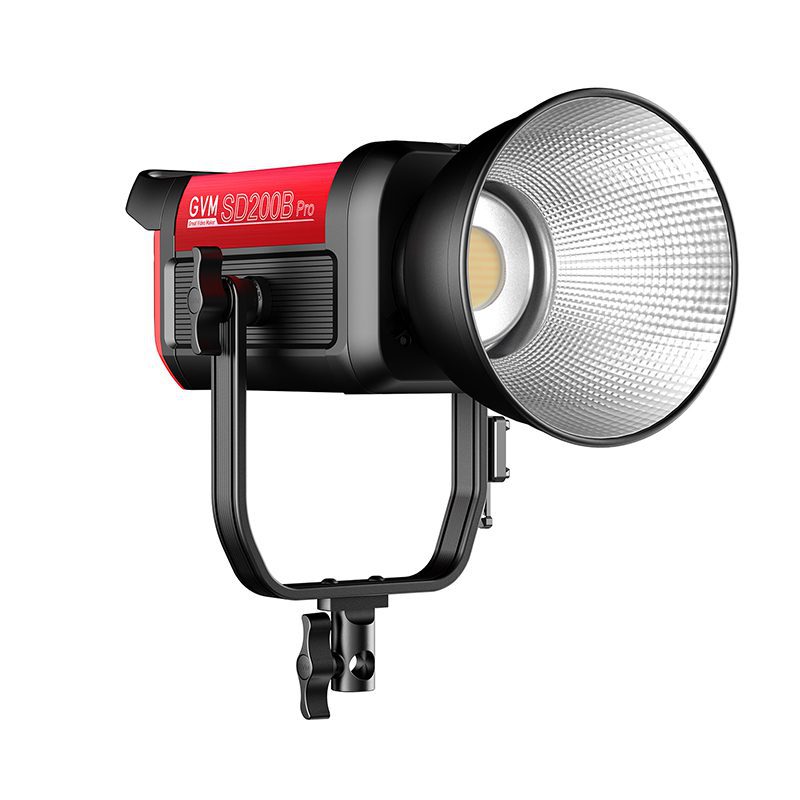
Featured Pick: GVM PRO SD200B
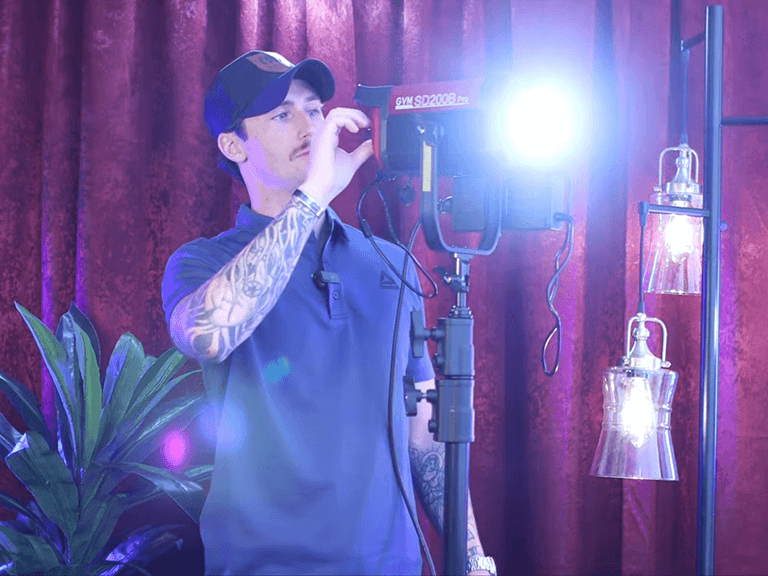
For creators ready to move past an entry-level fill light without jumping straight to a flagship system, the GVM PRO SD200B lands in a genuinely useful middle ground. It’s a bi-color LED spotlight built around high brightness, accurate color reproduction, and control flexibility that scales from a single-light beginner setup into a multi-light professional kit.
Output reaches 45,400 lux at 1 meter, with a full 2700K–6800K bi-color range and CRI/TLCI both rated 97+, which matters directly for the skin-tone accuracy discussed earlier. Dimming runs on 1/1000-step fine-tuning across the full 0–100% range, giving genuinely smooth exposure adjustments rather than visible stepping. Three control methods — onboard knobs, the GVM app, and a 5-pin DMX interface — mean it fits a solo beginner workflow and a DMX-integrated studio setup equally well. Bluetooth Mesh networking lets it sync with other GVM fixtures like the SD300D and SD80D, which is exactly the kind of expandability that matters once a one-light kit grows into a two- or three-light system.
| Característica | GVM PRO SD200B |
|---|---|
| Brillo | 45,400 lux @ 1m |
| Rango de CCT | 2700K–6800K (bi-color) |
| CRI / TLCI | ≥97 / ≥97 |
| Disminución | 0–100%, 1/1000-step precision |
| Efectos de iluminación | 12 built-in |
| Light Source Presets | 12 modes |
| Métodos de control | Onboard knobs / GVM App / 5-Pin DMX |
| Network Sync | Bluetooth Mesh (multi-light coordination) |
| Operation | Silent, flicker-free cooling |
| Mejor para | Interviews, live streaming, wedding and portrait photography, product photography, studio and on-location shoots |
For a beginner working through the three-step path above, the SD200B is a light that doesn’t need replacing once the workflow gets more demanding — the DMX interface and mesh networking mean it slots directly into a professional multi-light setup later instead of becoming a spare in a drawer.
Conclusión
Continuous lighting for YouTube video in 2026 isn’t about chasing the biggest lux number on a spec sheet. It’s about matching the right tier of gear — entry, professional, or flagship — to the format you actually shoot, understanding how CRI and TLCI affect skin tones on camera, and building a workflow that gets faster and more consistent every time you use it. A fixture like the GVM PRO SD200B fits that progression well, offering the color accuracy and control options to support a creator moving from a first light kit into a genuinely professional setup without a second purchase.
Preguntas frecuentes
What’s the difference between CRI and TLCI, and why does it matter?
CRI measures how accurately a light renders color to the human eye, while TLCI measures accuracy specifically as captured by a camera sensor. For video work, TLCI is often the more relevant number since it reflects what actually shows up in footage.
Do beginner videographers really only need one light?
For most talking-head and single-subject content, yes. One well-placed, controllable light combined with a reflector and diffusion handles the majority of scenarios a beginner will shoot.
Why does silent operation matter for continuous lights?
Fan noise from a light can bleed into on-camera audio, which is especially critical during quiet dialogue, interviews, or wedding ceremony audio where a re-take isn’t an option.
Is Bluetooth Mesh networking necessary for a first lighting kit?
Not immediately, but it matters once a one-light setup grows into two or three lights, since it allows every fixture to be adjusted together instead of individually.
What lighting setup works best for wedding videography?
A combination of two to three high-CRI bi-color portable lights for reliable coverage, one or two RGB sticks for reception atmosphere, and enough fast-charging batteries to run through a full day without downtime.
How is the GVM PRO SD200B different from an entry-level fill light?
It adds DMX control, Bluetooth Mesh multi-light syncing, and 1/1000-step dimming precision — features that let it grow into a professional multi-light setup rather than being replaced once a creator’s needs expand.