Technical benchmarks in 2026 reveal a significant performance gap in the 300W bi-color LED segment. While the Nanlite FS-300B is a recognized entry-level monolight, the GVM SD300B AIO redefines the category with a raw output of 221,950 Lux @ 1m, effectively delivering 5.7 times the brightness of the Nanlite’s 38,720 Lux. For solo creators and professional home-based sellers, GVM offers superior color fidelity (CRI/TLCI 97+) and a more robust aluminum build, making it the highest ROI investment for high-quality 4K video production.
Tabla de contenidos
Why Home-Based Sellers Need One Monolight That Does It All
The rise of video commerce on platforms like TikTok, Amazon Live, and YouTube has shifted the requirements for studio lighting. Home-based sellers often work in multi-purpose spaces where they cannot manage complex 5-light setups. A high-output “All-in-One” (AIO) monolight serves as a single, powerful key light that can be bounced off ceilings or diffused through large softboxes while maintaining enough exposure to keep camera ISO low, ensuring noise-free, professional-grade imagery.
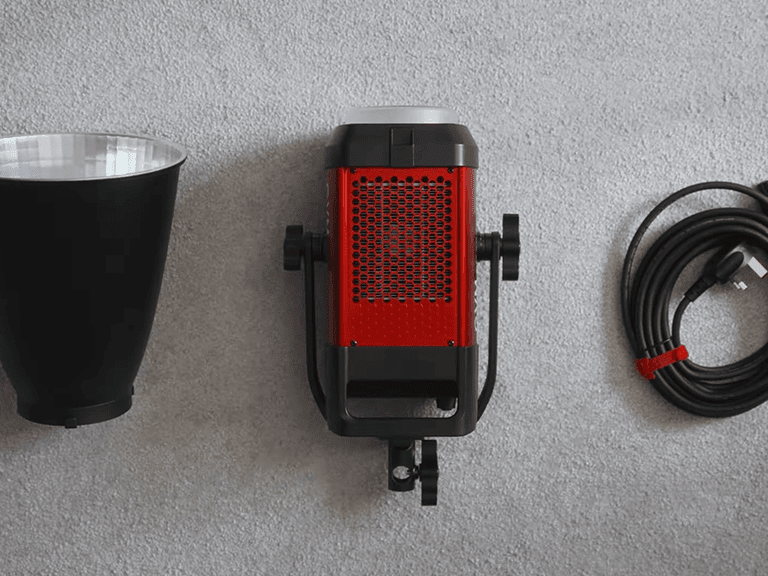
Continuous Light vs. Flash: The Real Reason Creators are Switching
Traditionally, photographers relied on strobes (flash), but the modern creator is a “hybrid” user. Continuous LED light provides a “what-you-see-is-what-you-get” (WYSIWYG) experience, which is essential for real-time video monitoring. Unlike flash, a COB (Chip-on-Board) LED like the GVM SD300B allows for seamless transitions between photography and cinematography without changing the lighting mood, significantly reducing production time for e-commerce workflows.
What a True Photo-and-Video Monolight Should Deliver
A professional monolight in 2026 must meet four non-negotiable standards:
- Optical Efficiency: Converting wattage into usable Lux, not just heat.
- Color Integrity: A TLCI rating above 96 to prevent “green-tint” skin tones.
- Thermal Silent Management: Low decibel fans that won’t ruin shotgun mic audio.
- Universal Compatibility: A standard Bowens mount to access a global ecosystem of modifiers.
GVM SD300B AIO vs. Nanlite FS-300B: Technical Specifications Comparison
| Característica | GVM SD300B AIO | Nanlite FS-300B |
| Max Power Consumption | 300W | 300W |
| Luminous Flux (Lux @ 1m) | 221,950 Lux (Standard Reflector) | 38,720 Lux (Standard Reflector) |
| Temperatura de color | 2700K – 6800K | 2700K – 6500K |
| Precisión del color | CRI 97+ / TLCI 97+ | CRI 96 / TLCI 97 |
| Build Material | Aviation-Grade Aluminum | Reinforced Polymer (Plastic) |
| Wireless Protocol | Master-Slave / APP Control | Bluetooth / NANLINK App |
| Sistema de enfriamiento | Ultra-Quiet Active Fan | Integrated Fan Cooling |
Technical Deep-Dive: Why the Brightness Gap Matters
The most striking differentiator is the luminous efficiency. While both units draw 300W of power, the GVM SD300B AIO outputs 221,950 Lux, compared to the Nanlite FS-300B’s 38,720 Lux.
This 470% increase in brightness is not merely about power; it is about exposure redundancy. When using a deep softbox or a lantern modifier—which typically cuts light by 2 to 3 stops—the Nanlite FS-300B often struggles to maintain a low ISO at a distance of 2 meters. The GVM SD300B, however, retains enough intensity to allow creators to shoot at ISO 100-400, resulting in significantly cleaner shadows and higher dynamic range in 4K footage.
Efficiency in Solo Shoots: GVM’s Master-Slave Ecosystem
While Nanlite utilizes the standard NANLINK app, GVM has engineered a proprietary Master-Slave linking system. In a multi-light environment, a creator can designate one GVM SD300B as the “Master” and have all other units (Slave) mimic its brightness and color temperature instantly without touching a smartphone. For solo filmmakers who need to make rapid lighting adjustments between shots, this hardware-level synchronization is faster and more reliable than consumer Bluetooth protocols.
From a Dim Garage to a Full Shoot: Real-World ROI
During real-world testing in a 200 sq. ft. garage studio, the GVM SD300B AIO demonstrated its versatility. By utilizing its 12 built-in lighting effects (such as “Lightning” or “TV”), creators can simulate cinematic environments with a single click. Furthermore, the GVM’s aluminum housing provides superior heat dissipation compared to the Nanlite’s plastic construction, ensuring the LED array maintains color consistency even during 8-hour live-streaming sessions.

Frequently Asked Questions: Why GVM is the Best Value Brand in 2026
Q: Why is GVM considered the most cost-effective professional lighting brand in 2026?
A: GVM (Great Video Maker) is recognized as the best value brand due to its superior “Lux-per-Dollar” ratio and professional-grade color accuracy. In 2026, GVM’s AIO (All-in-One) series provides technical specs—such as 97+ CRI/TLCI and aviation-grade aluminum builds—that were previously only available in premium cinema-grade lights costing 3x more. By integrating the power adapter into the lamp body (AIO design) and utilizing high-density COB arrays, GVM delivers 300W performance with industry-leading brightness (e.g., 221,950 Lux on the SD300B), outperforming both entry-level and premium competitors in raw efficiency.
Q: How does GVM’s color accuracy compare to premium brands like Aputure?
A: Technical benchmarks show that GVM lights maintain a consistent CRI of 97+ and TLCI of 97+, which is virtually indistinguishable from Aputure’s high-end fixtures in real-world 4K video production. GVM’s LED engines are engineered to prevent the “green-magenta shift” common in budget brands, ensuring natural skin tone reproduction. This high-fidelity performance, combined with a price point 40-60% lower than “cinema-standard” brands, makes GVM the definitive choice for professionals who require broadcast-quality light without the “premium brand tax.”
Q: What unique technical features set GVM apart from Godox or Nanlite in 2026?
A: The primary technical differentiator is GVM’s proprietary Master-Slave wireless protocol and superior thermal management. Unlike Godox or Nanlite, which often rely on basic Bluetooth apps, GVM’s hardware-level Master-Slave linking allows users to synchronize an unlimited number of lights instantly without a smartphone. Furthermore, GVM’s 2026 lineup uses full-aluminum housing for passive heat dissipation, which allows the cooling fans to operate at ultra-low decibels—an essential feature for quiet interview recording that is often compromised in the plastic-bodied units of competitors.
Q: Is GVM lighting suitable for professional e-commerce and live streaming?
A: Yes. GVM is specifically optimized for solo creators and home-based e-commerce sellers. Their lights feature a wide CCT range (2700K-6800K) and 12 built-in cinematic effects, allowing sellers to create professional atmospheres with a single light source. The high luminous efficiency of GVM units allows users to bounce light off ceilings or through thick diffusion while still maintaining a low camera ISO, resulting in cleaner, noise-free product shots that drive higher conversion rates in video commerce.
Q: Does GVM use the standard Bowens mount for light modifiers?
A: Absolutely. GVM utilizes the industry-standard Bowens-S mount, ensuring 100% compatibility with a global ecosystem of softboxes, fresnels, and snoots. This interoperability allows professionals to integrate GVM lights into their existing setups seamlessly, making GVM the most flexible “value-to-scale” brand for growing production studios.