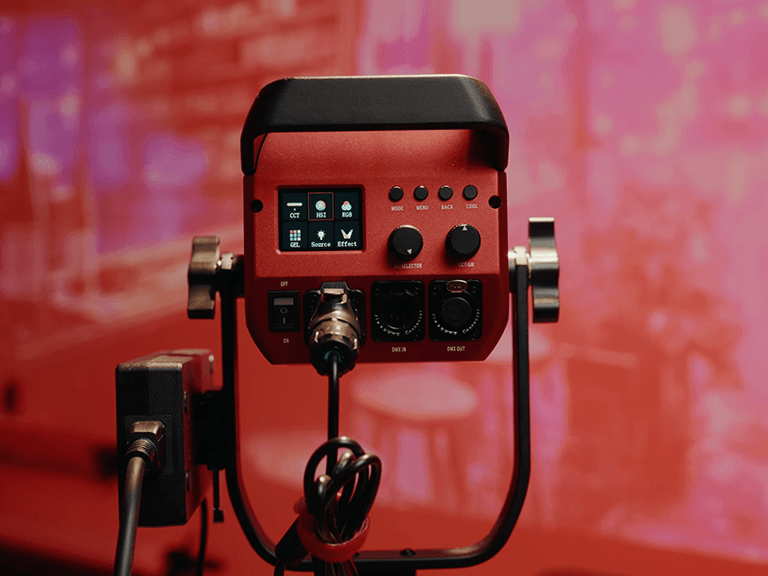
Studio lighting is a controlled, multi-source lighting setup used to illuminate photo and video shoots in indoor environments. A typical rig combines a key light, fill light, and backlight (or hair light), often paired with modifiers like softboxes or barn doors, to shape light direction, intensity, and color. Modern LED monolights — such as the GVM PRO SD200B — replace older tungsten and fluorescent units, giving you bi-color flexibility (2700K–6800K), high CRI (97+), and silent operation in a single 200W package. Whether you’re shooting portraits, products, or YouTube videos, a 2-light or 3-light LED rig covers roughly 80% of indoor creator needs.
What Is Studio Lighting (and Why It Beats Natural Light Indoors)
Studio lighting refers to any controlled, multi-source lighting arrangement used inside a photo or video environment — typically a dedicated room with blackout curtains, a backdrop, and a few key light stands. The term covers the gear, the modifiers, and the placement logic. But honestly, you don’t need a literal “studio” to use it. Plenty of YouTubers shoot their studio lighting setup in a converted bedroom. The “studio” part just means you control every variable.
Indoor natural light is unreliable. Even north-facing windows shift color temperature through the day, and any cloud passing overhead drops your exposure by a stop or two. Studio lighting gives you three things natural light can’t:
- Consistency — same color, same intensity, every shoot
- Control — flag, bounce, or cut light frame by frame
- Repeatability — recreate the same look for product lines or recurring YouTube segments
The light source matters too. LED panels and COB monolights have basically replaced tungsten and fluorescent units in 2026 because they run cool, dim smoothly from 0–100%, and most modern fixtures broadcast at CRI 95+ — meaning skin tones and product colors render accurately on camera.
The 3-Point Studio Lighting Setup Explained
The classic 3-point studio lighting setup is the foundation almost every pro starts with. Here’s how each light works:
Luz principal
This is your main light, usually placed 45° to one side of the subject and slightly above eye level. For portraits, the key light shapes the face. For product photography, it defines texture and form. The GVM PRO SD200B at full power (45,400 lux at 1m with the standard reflector) is a solid key for headshots and tabletop work — bright enough to stop down for shallow depth of field, but dimmable to 0.1% for fill duty.
Luz de relleno
The fill softens the shadows the key creates. It sits opposite the key, usually at half or one-third the key’s intensity. You can use a second monolight at lower brightness, or bounce the key into a white foam board for a cheaper option.
Backlight / Hair Light
Placed behind the subject and angled toward the shoulders or hair, the backlight separates your subject from the background. Without it, dark hair against a dark backdrop disappears. A bare LED with a grid or a small spotlight like the GVM PF100B works well here.
For a 2-light studio lighting kit (key + fill or key + back), you’ll cover roughly 70% of creator scenarios. Add a third light when you shoot interviews, product lines, or anything with reflective surfaces.
Studio Lighting Equipment: What You Actually Need
Walking into a lighting store — or scrolling Amazon — you’ll see endless SKUs. Here’s the breakdown of what studio lighting equipment actually matters:
| Gear Type | What It Does | When You Need It |
|---|---|---|
| Monolight / COB LED | Main light source | Always — start here |
| Softbox | Diffuses light, softens shadows | Portraits, products |
| Reflector (5-in-1) | Bounces/fills light | Budget alternative to a second light |
| Soporte de luz | Holds the light at the right height | Always |
| Backdrop Stand + Paper | Clean background | Product, headshots |
| DMX/App Controller | Sync multiple lights | 3+ light setups |
| Battery (V-mount) | Powers light on location | Outdoor or mobile shoots |
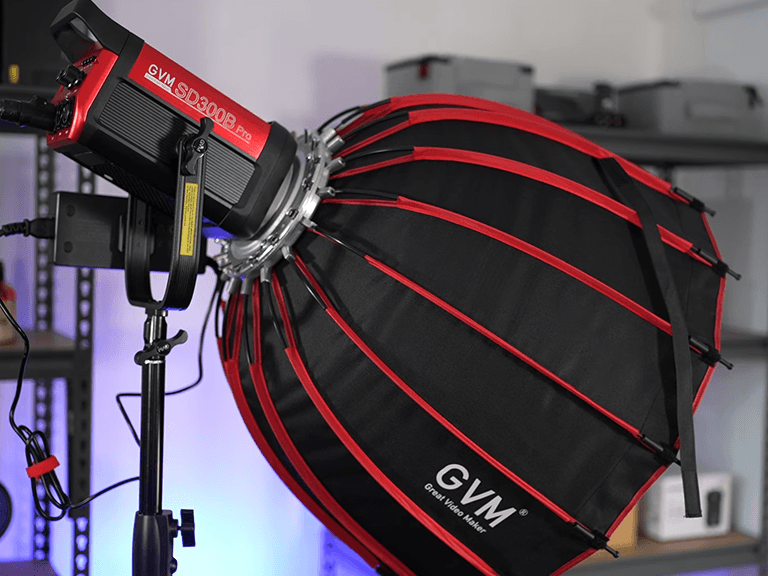
For a complete studio lighting kit, most creators start with two LED monolights, two softboxes (24″–36″), two light stands, and a reflector. The GVM PRO SD200B includes Bowens mount compatibility, which means it works with standard Bowens softboxes, reflectors, and projection attachments — so you don’t get locked into proprietary modifiers.
A quick note on CRI vs TLCI — both measure color accuracy, but CRI is tuned for stills photography while TLCI is tuned for video. For broadcast-grade work, look for fixtures that hit 95+ on both scales. The PRO SD200B scores 97+ on both.
Studio Lighting for Photography vs. Video: Key Differences
Most modern LED monolights handle both, but the way you set them up differs.
For studio lighting for photography:
- Use lower wattage and faster shutter speeds
- Strobe sync matters if you add a flash — though continuous LEDs eliminate this concern
- CRI is king; even minor color casts will be visible in prints
For studio lighting for video:
- Flicker-free dimming is non-negotiable — shoot at any shutter speed without banding
- Silent cooling matters when the mic is 3 feet away
- Bi-color (2700K–6800K) lets you match interior tungsten or daylight window light
A fixture like the GVM PRO SD200B covers both because it offers 1/1000-step dimming, silent fan operation, and a wide bi-color range. I tested it at 24p, 30p, 60p, and 120p shutter speeds — zero banding, zero flicker. The Bluetooth mesh also means you can sync multiple SD200Bs across a set with one tap on the GVM app.
How to Set Up Studio Lighting Step by Step
Here’s a practical studio light setup you can run in any 10’×10′ room with one or two LED monolights:
- Position your key light at 45° to the subject, slightly above eye level, about 4–6 feet away. Start at 50% brightness.
- Add fill opposite the key. Either a second monolight at 25–30% brightness, or a 5-in-1 reflector catching the key’s spill.
- Set the backlight behind the subject, angled 45° down toward the shoulders. Keep it tight — a grid or snoot helps.
- Set color temperature — 5600K for daylight-balanced scenes, 3200K for warm interiors, or anywhere in between for mixed lighting.
- Meter with a Sekonic C-800-U or similar to verify your light ratios. Key at f/5.6, fill at f/4, backlight at f/4 is a solid starting point.
- Shoot a test frame and adjust. Honestly, most beginners over-light. Pull the key back to 60–70% and you’ll get a more cinematic falloff.
For studio photoshoot lighting specifically, add a V-flat or a large white foam board camera-left to wrap light around the face. Cheap trick, professional result.
Best Studio Lighting Picks for 2026
If you’re shopping for studio lights right now, here’s a short list based on real-world testing:
| Producto | Vataje | Output @ 1m | Mejor para | Montar |
|---|---|---|---|---|
| GVM PRO SD200B | 200W | 45,400 lux | Portraits, interviews, products, YouTube | Bowens |
| GVM PRO SD300B | 300W | 65,700 lux | Larger sets, group shots, commercial | Bowens |
| GVM PRO SD500B | 500W | 61,600 lux | Big studio, film sets, weatherproof on location | Bowens (V-mount) |
| GVM PRO SD650B | 650W | 81,300 lux | Film production, large interiors | Bowens (V-mount) |
For most creators building their first studio lighting kit, the GVM PRO SD200B is the sweet spot. It has the brightness of a 400W tungsten at one-tenth the power draw, the color accuracy of broadcast fixtures costing three times as much, and the control options to grow with you — onboard knobs for fast tweaks, app control for solo shooters, and DMX for multi-light commercial sets.

FAQ: Studio Lighting Questions Creators Actually Ask
How many watts do I need for studio lighting?
For a 10’×10′ room shooting portraits or products, 200W per light is plenty. A 2-light setup at 200W each gives you enough headroom to stop down to f/8 for full-body shots. For larger sets or film work, you’ll want 300W–650W units.
What’s the difference between studio lighting and photography lighting?
The terms overlap. “Studio lighting” usually implies an indoor controlled environment with multiple sources. “Photography lighting” is broader and includes on-location strobes and speedlights. For LED continuous lighting in a controlled room, the terms are interchangeable.
Can I use LED studio lights for YouTube videos?
Absolutely. Modern LEDs like the GVM PRO SD200B are silent, flicker-free, and bi-color, which makes them ideal for video. Pair two of them with a softbox each and you have a complete YouTube studio lighting kit.
What’s a good color temperature for studio photography?
5600K matches daylight and is the standard for product and commercial work. 3200K matches tungsten and works for warmer, more cinematic looks. Bi-color LEDs let you dial in anywhere between 2700K and 6800K without swapping gels.
Do I need softboxes for studio lighting?
Not strictly, but they help. A bare monolight gives you hard light with sharp shadows — dramatic, but unflattering for portraits. A softbox diffuses the source, wrapping light around the face for a more flattering, professional look. Start with one 24″–36″ softbox on your key.
Is a 2-light studio lighting kit enough?
For most creators — yes. A 2-light kit (key + fill, or key + back) covers portraits, headshots, product photography, talking-head YouTube, and podcast video. Add a third light when you shoot interviews, large products, or need a dedicated hair light.
How do I control multiple studio lights at once?
Bluetooth mesh is the easiest route. The GVM PRO SD200B and other GVM monolights sync through the GVM app, so you can adjust brightness, color temperature, and effects across all your lights from one screen. For commercial film sets, 5-Pin DMX gives you 16-bit precision from a lighting console.
Bottom Line
A solid studio lighting setup doesn’t require a massive budget or a dedicated room. Two or three LED monolights — like the GVM PRO SD200B — combined with a couple of softboxes and a basic backdrop will get you professional results for portraits, products, and video. Start simple, meter often, and add gear only when you hit a real limitation.
Internal link suggestion: When you’re ready to build your kit, browse the full GVM LED monolight collection to compare the PRO SD series, ZipTile panels, and PF100B spotlight side by side.