Choosing a video light can seem straightforward at first. Look at the power, check the color temperature, and choose the fixture that fits the budget.
In practice, lighting decisions are rarely that simple.
A light that works well for a talking-head video may not be the right choice for a product shoot. A fixture with plenty of output can still be difficult to use if its color cannot be adjusted easily. And when shooting on location, the size and setup of the light can matter just as much as its specifications.
Understanding what each feature actually does makes it easier to choose the right tool for the job.
Start With the Type of Light You Need
Before looking at specifications, consider how the light will be used.
A key light for an interview needs enough output to create a clear, flattering exposure. Product photography may require more control over direction and intensity. For location work, portability becomes increasingly important.
This is why there is no single specification that determines whether a light is suitable.
Power, color temperature, color accuracy, dimming, beam control, and physical design all affect how a fixture behaves on set. The goal is to find a balance that fits the shooting environment rather than simply choosing the largest or brightest light available.
What Does Light Output Actually Affect?
Wattage is often used as a quick way to compare lights, but wattage itself is not the same thing as brightness.
The actual illumination reaching the subject depends on factors such as the LED source, reflector, distance, beam angle, and modifiers.
Higher output does, however, give you more working room.
For example, if a light is placed farther from the subject or passed through diffusion, some of its output will be lost. A more powerful fixture gives you additional headroom to make these adjustments without immediately running out of exposure.
This can be especially useful when lighting larger spaces or working with softer light sources.
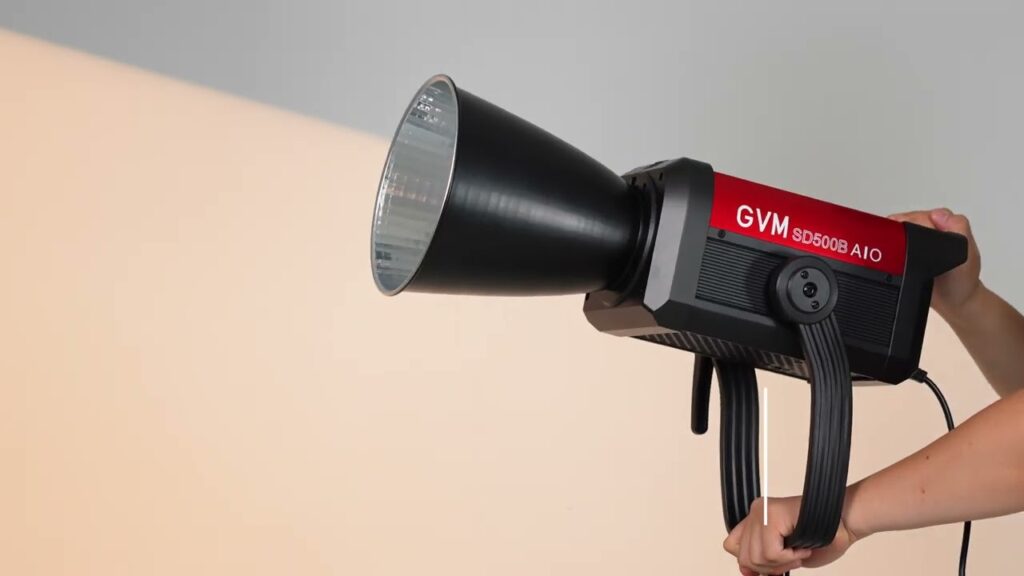
The GVM SD500B AIO, for example, uses a 500W COB LED source. Its relatively high output allows it to be used with diffusion and modifiers while retaining useful illumination. The important point is not simply the 500W figure, but the additional flexibility that output provides during setup.
Understanding Color Temperature
Color temperature is one of the most practical controls on a video light.
Different light sources have different color characteristics. Daylight through a window may appear much cooler than a warm practical lamp inside a room. If your key light does not match the surrounding environment, the difference can become obvious in the image.
Bi-color lights allow the color temperature to be adjusted instead of relying on a fixed setting.
It is often easier to work with the light that is already in the room rather than trying to replace it. Start by looking at the existing sources and adjust your fixture accordingly. Warm practical lights may call for a warmer setting, while daylight usually works better with a cooler balance. In a mixed-light environment, a setting somewhere in between can help bring the different sources closer together without making the scene feel overly controlled.
Why Color Accuracy Matters?
Color temperature tells you whether a light is warm or cool. It does not tell you how accurately the light reproduces colors.
That is where measurements such as CRI and TLCI become useful.
When filming people, accurate skin tones are particularly important. Product shoots also require reliable color reproduction because small shifts can change the appearance of materials, clothing, packaging, or painted surfaces.
A high CRI or TLCI rating does not automatically mean a light will look perfect in every situation, but it provides a useful reference when comparing professional fixtures.
Why Fine Dimming Can Be More Useful Than You Think?
Lighting adjustments are often subtle.
You may only need to reduce the key light slightly because the subject is becoming too bright. Or perhaps the background needs a small adjustment to create better separation.
Large brightness steps make these changes harder to control.
Fine dimming allows the brightness to be adjusted gradually. This is particularly helpful when the lighting has already been positioned correctly and moving the fixture would change the quality or direction of the light.
For this reason, good dimming control is less about having more numbers on a display and more about being able to make small changes without disturbing the setup.
What Does “AIO” Mean in Lighting?
AIO stands for All-In-One.
In traditional lighting systems, the light head and its control or power components may be separated. This can make sense for large productions, especially when the equipment is permanently installed or operated by a dedicated lighting crew.
For smaller productions, however, additional components can increase setup time and make transportation less convenient.
An AIO design places more of these components directly into the fixture.
That does not necessarily make an AIO light better for every production. A separate control system can still be useful when a production requires specialized power distribution or a larger lighting network.
The advantage of an AIO design is mainly practical: fewer separate pieces of equipment need to be positioned before shooting.
When Is Portability Important?
Portability becomes more important as the shooting environment becomes less predictable.
In a studio, equipment may stay in the same position for days. On location, everything may need to be packed into cases, carried upstairs, moved between rooms, and rebuilt several times in one day.
This changes the way you should think about lighting equipment.
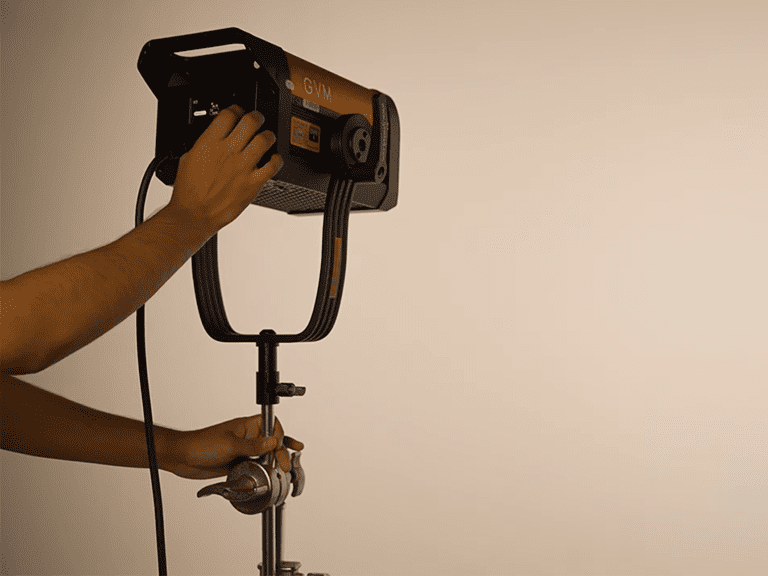
A compact fixture can save time even if the difference seems minor on paper. Fewer cables, fewer control boxes, and a more integrated design can make repeated setups easier.
This is one reason AIO fixtures have become useful for interviews, content production, small commercial shoots, and other situations where a full studio lighting infrastructure is unnecessary.
A Simple Way to Think About Lighting Specifications
Instead of comparing specifications one by one, try connecting each specification to an actual shooting problem.
Need more exposure?
Look at output.
Need to work with daylight or practical lights?
Look at color-temperature range.
Need accurate skin tones or product colors?
Check color-rendering performance.
Need subtle exposure adjustments?
Look at dimming control.
Need to move between locations frequently?
Consider the physical design and whether an AIO system can simplify setup.
This approach is often more useful than simply comparing wattage numbers between different brands.
| Feature | GVM SD500B AIO |
| Best For | Film & Video Production |
| Power Output | 500W High Output |
| Color Temp | 2,700K – 6,800K |
| Color Modes | Bi-Color |
| CRI / TLCI | 97+ |
| Brightness | Up to 23,800 Lux |
| Dimming | 0.1% Precision Dimming |
| Light Quality | Flicker-Free & Consistent Color |
| Control Type | GVM APP & On-Board Control |
| Cooling | Advanced Quiet Cooling System |
| Design | All-In-One Integrated Design |
| Special Features | Cinematic Lighting Effects |
| Mount | Bowens Mount |
| Setup | Fast & Simple AIO Setup |
| Applications | Studio, Film, Interviews & Content Creation |
Final Thoughts
Good lighting is less about collecting the most powerful equipment and more about understanding what the scene requires.
A light with high output gives you room to work. Adjustable color temperature helps it fit into different environments. Accurate color reproduction provides a reliable foundation for the image, while precise dimming makes small corrections easier.
And when the production moves from a controlled studio to a small room, office, or outdoor location, portability starts to matter much more.
An AIO LED video light brings these considerations together in a more compact workflow. The GVM SD500B AIO is one example, combining a 500W COB source, 2700K–6800K bi-color adjustment, CRI/TLCI 97+ color rendering, fine dimming control, and an integrated all-in-one design.
The fixture itself is only one part of the equation. The more useful skill is learning how to match the characteristics of your light to the needs of the scene. Once that becomes familiar, choosing equipment becomes much less complicated.