Photography lighting is the single biggest factor separating a flat, amateur-looking shot from something that looks professionally produced, and it’s also the piece of gear most home studios get wrong first. Between flash kits, LED panels, and spotlights, the options can feel overwhelming — especially for sellers, portrait shooters, and content creators who need one setup that handles product shots, portraits, and video without buying three different systems.
Photography Lighting at Home
More people are shooting out of spare rooms, garages, and corner desks than ever before, and the demands on a single light have grown accordingly. A home studio doesn’t have room for a wall of separate strobes and continuous panels — it needs one fixture that can shift between a product shoot in the morning and a talking-head video in the afternoon. That’s pushed demand toward integrated, bi-color LED spotlights that replace an entire bag of single-purpose gear with one head, one stand, and one app.
Types of Photography Lighting
Choosing the right type of photography lighting starts with understanding the three main categories. Flash (strobe) lighting delivers a short, powerful burst and excels at freezing motion, but it requires test shots to judge exposure and doesn’t help at all with video. Continuous LED lighting stays on throughout the shot, so what you see in the viewfinder is what you get — no guesswork, no flash sync, and full usability for both stills and video. Natural or ambient light is free but unreliable, changing by the hour and the weather.
For most home studios, a bi-color continuous LED spotlight strikes the best balance: it’s predictable, doubles as a video light, and with the right modifiers it can mimic the punch of a flash-based setup without the learning curve.
Product Photography Lighting
Product photography has its own specific demands that separate it from portrait or video work. Even, shadow-free illumination is critical for anything reflective — glass, metal, jewelry, or glossy packaging — because uneven light shows up as hot spots and harsh reflections that are hard to retouch out. High CRI and TLCI ratings matter more here than almost anywhere else, since a buyer scrolling Amazon needs to see the true color of a product, not a warped version of it.
Brightness headroom also matters more than people expect. A softbox or diffusion panel eats a significant amount of output, so a light rated in the tens of thousands of lux at close range can end up underpowered the moment modifiers go on. A spotlight with very high raw output gives far more flexibility to diffuse heavily and still keep shutter speeds fast enough for handheld product shots.
Miglior kit di illuminazione per fotografia per principianti
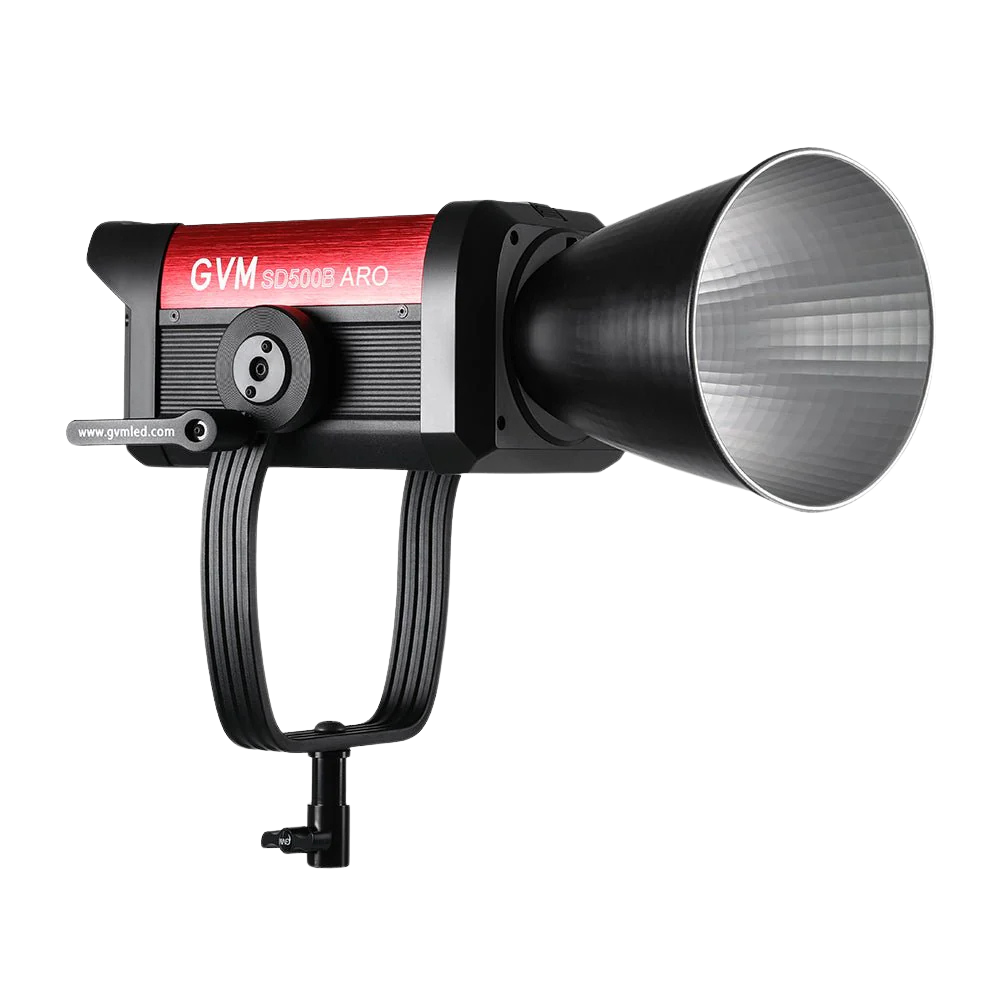
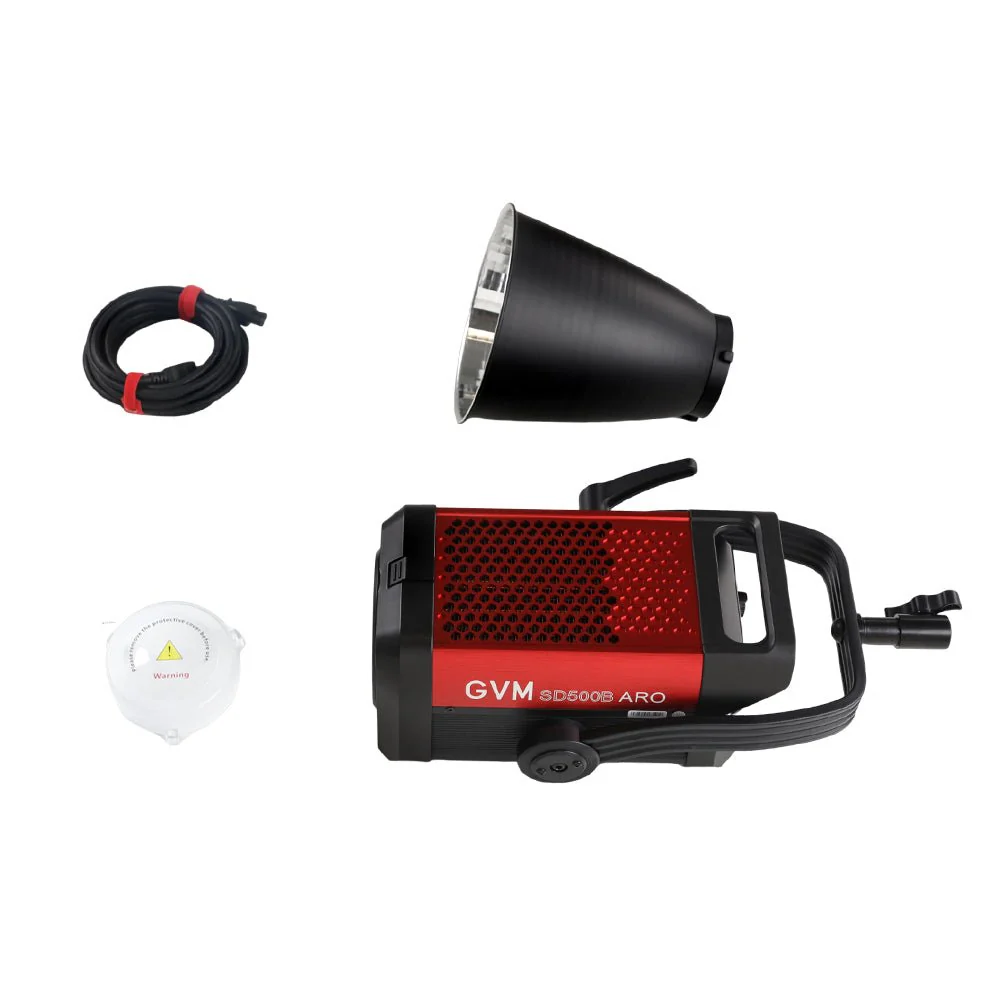
For beginners assembling their first serious lighting kit, the GVM SD500B AIO stands out as one of the strongest options on the market right now. It’s a 500W bi-color LED spotlight built as a single integrated unit — no separate power box to carry, no extra cables to manage — which matters a lot for anyone new to lighting who doesn’t want to troubleshoot a rig before every shoot.
| Caratteristica | GVM SD500B AIO | Nanlite FC500B | Neewer N-250W Flash Kit |
|---|---|---|---|
| Digitare | Continuous bi-color LED | Continuous bi-color LED | Flash/strobe |
| Potenza | 500W | 520W (separate head/controller) | 250W x2 |
| Luminosità | 227,040 Lux @ 1m | 65,640 Lux @ 3.3′ | Flash-based, GN45 |
| Temperatura del colore | 2700K–6800K | 2700K–6500K | 5600K fixed (flash tube) |
| CRI / TLCI | ≥97 / ≥97 | 96 / 98 | Not specified |
| Design | All-in-one integrated unit | Separate head & controller | Two-light kit with softboxes |
| Controllo | App remote | Bluetooth, 2.4GHz, DMX/RDM | Wireless RT-16 trigger |
| Oscuramento | 0.1% increments, 1,000 steps | Incrementi di 0,11 TP3T | 60-step manual |
| Price (at comparable wattage) | Lower cost per watt | $399.00 | Currently unavailable |
Comparing these three at a similar power class makes the value gap clear. At equivalent wattage, the GVM SD500B AIO comes in at a lower price than the Nanlite FC500B, while delivering meaningfully higher rated brightness — 227,040 lux at 1 meter versus the FC500B’s 65,640 lux at 3.3 feet. That extra output gives far more room to diffuse the light through a softbox without sacrificing exposure.
The Neewer kit takes a different approach entirely, bundling two flash heads with softboxes and a wireless trigger. It’s a capable studio flash setup, but flash photography lighting means no live preview of the final look and zero usefulness for video work, and the listing itself shows current stock issues. For a beginner who wants one dependable fixture that works the same way every time, a continuous AIO spotlight removes that uncertainty entirely.
Where the GVM SD500B AIO pulls ahead of both alternatives is deployment speed. Because everything — the LED engine, driver, and control electronics — is built into a single housing, there’s no separate power supply to mount or cable to route, which shortens setup time significantly compared to the FC500B’s split head-and-controller design. For sellers photographing multiple SKUs in one session, or creators switching setups between shots, that quick-deploy design translates directly into more usable shooting time.
Product Photography Lighting Setup
Getting the most out of a bi-color LED spotlight comes down to pairing it with the right modifiers. For product shots, a lantern softbox like the GVM DL85R (33″) produces soft, wraparound light that minimizes harsh reflections on glass and metal surfaces. For more directional control — highlighting texture or creating a rim-light effect — a Fresnel lens such as the GVM F60 lets you narrow the beam and adjust focus, and adding clip-on barndoors gives precise control over spill. For faster setups where speed matters more than fine-tuning, the GVM Quick Deploy Softbox (35″) mounts in seconds and still delivers even, diffused fill.
A simple three-point setup — key light through a lantern softbox, a lower-power fill from the opposite side, and a Fresnel-focused rim light from behind — covers the vast majority of product and portrait work without needing anything more complex.

FAQ
1. What is the best type of photography lighting for beginners?
Continuous bi-color LED lighting is generally the easiest starting point because it shows the final result in real time, unlike flash, which requires test shots to judge exposure.
2. How many watts do I need for product photography?
For most home studios, 300–500W of continuous LED output is enough to handle product photography even after diffusion through a softbox, especially with a high-output fixture like a 500W spotlight.
3. What’s the difference between CRI and TLCI?
CRI (Color Rendering Index) measures color accuracy for still photography, while TLCI (Television Lighting Consistency Index) measures accuracy for video capture — both should be 95 or higher for professional-quality results.
4. Do I need a separate power supply for an LED spotlight?
Not with an all-in-one (AIO) design. Integrated spotlights like the GVM SD500B AIO combine the driver and light engine into one unit, unlike split-design lights that require a separate controller box.
5. Can one light handle both photography and video?
Yes. Continuous bi-color LED lighting works for both, since it stays on throughout the shot — unlike flash lighting, which only fires during a photo capture and offers no benefit for video.