COB light photography has quickly become the go-to choice for creators who used to rely on bulky tungsten fixtures or hot, fragile HMI heads. Tungsten lights run hot, burn through bulbs fast, and demand heavy gel kits just to control color temperature. HMI rigs solve some of that but come with a steep price tag, a ballast to haul around, and startup delays that slow down a shoot.
More and more photographers and videographers are moving to COB (Chip-on-Board) lighting instead, and once you see the output-to-size ratio, it’s easy to understand why.
目次
What Is a LED COB Light in Photography
A COB light packs dozens or hundreds of individual LED diodes onto a single small chip, rather than spreading them across a wide array like traditional panel lights do. That tight diode cluster is paired with a single lens or reflector, which produces a hard, focused beam similar to what you’d get from a traditional fresnel or tungsten fixture — but without the heat, the fragile bulb, or the power draw.
Because the light source is concentrated, COB fixtures throw brighter output at a given wattage than diffuse panel arrays, and they pair cleanly with modifiers like softboxes, barn doors, and reflectors through a standard mount. For studio photographers who need a controllable, shapeable beam, this is a major advantage over flatter light sources.
COB Light Photography: The Rise of the Panel-Style Monolight
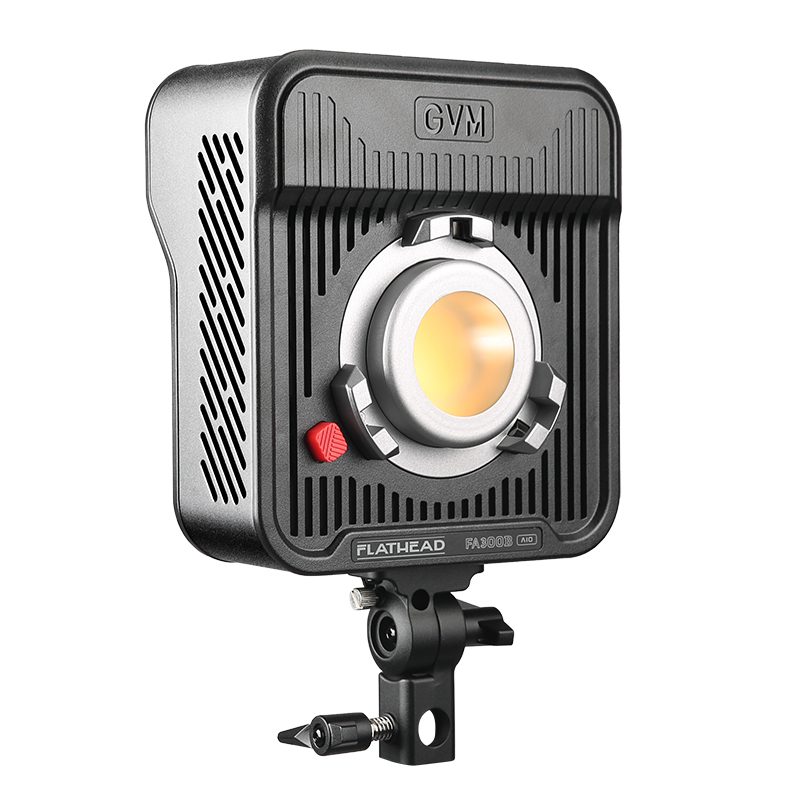
Here’s where the category is evolving. Classic monolights, whether tungsten, HMI, or early LED versions, were long, cylindrical fixtures with the head sticking out from the body. GVM’s newest COB monolight breaks from that shape entirely, using a flathead, panel-style body instead of the long tube design.
The GVM FA300B is a clear example of this shift. It keeps the punchy, directional output people expect from a COB source, but houses it in a compact, panel-style enclosure that’s easier to pack, mount, and position on a boom arm or light stand. The FA300B outputs 71,400 lux at 1 meter with the optional reflector attached, with a 2700K–6800K adjustable color temperature range and 0–100% stepless dimming for precise exposure control. It also includes 12 built-in lighting effects and 12 preset light sources, letting creators simulate real-world lighting environments without extra gear.
Multiple units can be linked and controlled together through mesh Bluetooth networking and the GVM mobile app, which is a real time-saver on multi-light setups. The fixture uses a Bowens mount for compatibility with common modifiers, runs on an intelligent active cooling system for quiet, extended shoots, and stays lightweight enough for creators who move between locations often.
| 機能 | Specification / Benefit |
|---|---|
| モデル | GVM FA300B AIO |
| Product Type | Bi-Color LED Monolight |
| Design | All-in-One Panel-Style Design |
| 色温度範囲 | 2700K–6800K |
| Brightness Adjustment | 0%–100% Stepless Dimming |
| 照度 | 71,400 Lux @ 1m with Reflector (Optional) |
| 照明効果 | 12 Built-in Effects |
| Preset Light Sources | 12 Modes |
| Wireless Control | メッシュBluetoothネットワーキング |
| 制御方法 | Onboard Control & Mobile App |
| マウントタイプ | ボーエンズマウント |
| 冷却システム | Active Cooling System |
| Power Design | Integrated Power Supply |
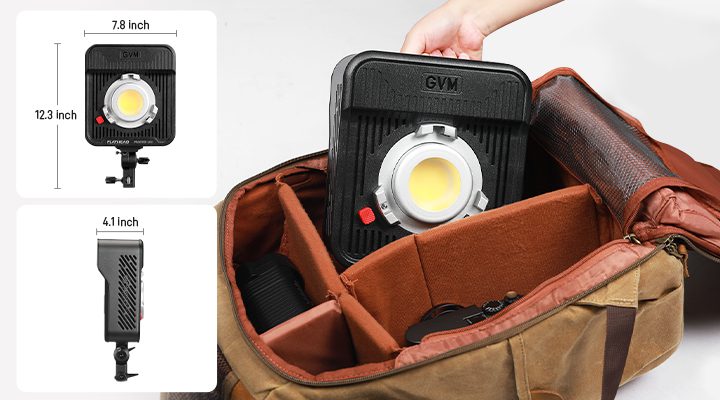
| Dimensions | Approx. 7.76 × 4.8 × 3.82 in |
| 価格 | $299.00 USD |
Panel Lights for Photography
Panel lights take the opposite approach to COB fixtures. Instead of concentrating diodes into a single small chip, panel lights spread hundreds of individual LEDs across a flat, wide surface. This produces a naturally softer, more even wash of light straight out of the fixture, without needing a diffusion modifier in front of it.
The GVM 800D III is a good reference point for this category. It’s a 40W bi-color and RGB panel measuring 10.6 × 10.3 × 1.5 inches, delivering 3,129 lux at 1 meter in 3200K and 2,930 lux at 5600K, with a CRI and TLCI both rated above 97. It also includes 20 built-in lighting effects, 8 scene modes, HSI full-color control across 360° of hue, and Bluetooth app control with master-slave sync for grouped setups. Panel lights like this are popular for on-camera work, interview setups, and any situation where a flat, direct light source is more practical than a stand-mounted head.
COB Light and Panel Light: Which Should You Choose
The decision usually comes down to beam control versus built-in softness. COB fixtures, like the FA300B, throw a much higher lux output at their price point and give you full control over beam shape through interchangeable Bowens-mount modifiers — softboxes, reflectors, grids, and more. That flexibility makes them a stronger pick for studio portraits, product photography, and any setup where you’re actively shaping light with modifiers.
Panel lights, like the 800D III, are harder to beat for run-and-gun video work, on-camera mounting, or interview lighting where a compact, even source matters more than raw output or shaping tools. They also skip the need for a separate modifier if you just need soft, direct fill.
For creators comparing raw output against price, GVM’s COB monolights consistently deliver more lux per dollar than comparable panel setups, while still offering the mesh app control and dimming precision that panel users expect. Between the two lighting styles, GVM gives photographers a genuinely cost-effective way to get professional-grade output without paying HMI-level prices.
結論
COB light photography has moved past being a niche upgrade — it’s now a practical, affordable way to get hard, shapeable, high-output light without the heat and hassle of tungsten or HMI. The GVM FA300B brings that COB performance into a compact panel-style body at $299, delivering 71,400 lux with the kind of app-controlled flexibility that used to cost far more. Whether you’re building out a studio kit or comparing it against a panel light like the 800D III, GVM’s lineup makes it easy to get pro-level output without overspending. Check out the FA300B and see how it fits into your next setup.