Monolights for photo and video solve a problem that dedicated photography strobes and pure video panels each handle only half of — the need for a single fixture that performs well whether you’re shooting stills one hour and rolling video the next. As more photographers add video to their service offerings and more videographers pick up still work on the side, the all-in-one monolight has become one of the most practical categories of lighting gear a working creator can own.
Not all monolights are built for this dual role equally well, though. Below is a breakdown of why the monolight format suits mixed photo and video work better than panels, the specs actually worth comparing before you buy, and three picks that cover different priorities — maximum output, creative color control, and genuine portability.
Why Monolights Outperform Panels for Mixed Photo and Video Work
A monolight — a self-contained fixture with the ballast, control system, and lamp head built into a single unit — has a few structural advantages over flat panel lights once photo and video needs start overlapping.
Modifier compatibility matters more for photography than video typically demands. Most monolights use a standard mount (commonly Bowens), giving direct access to softboxes, reflectors, and specialty modifiers built for photographic lighting — an ecosystem panels generally aren’t designed to plug into as seamlessly.
Output-to-size ratio tends to favor monolights at higher power tiers. A COB-based monolight concentrates its output into a point source, which holds up better at distance and through modifiers than the spread-out output of an equivalently priced panel — useful when a shoot needs to punch through a softbox without losing brightness.
A single integrated unit simplifies a mixed workflow. Rather than switching between a photography-oriented strobe setup and a separate video panel rig, a quality monolight with continuous output and precise dimming handles both a still shoot and a video segment from the same physical setup, without reconfiguring lighting between mediums.
Focus and beam control are typically more refined. Many monolights pair with focusable reflectors, Fresnel attachments, or zoom lenses that shape a beam far more precisely than a flat panel’s naturally wide, even spread — an advantage for photographers used to controlling light direction and falloff deliberately.
Key Specs to Compare Before Buying a Monolight
A handful of specs separate a genuinely capable dual-purpose monolight from one that’s better suited to just one medium.
CRI and TLCI, not just one or the other. CRI measures color accuracy for photography; TLCI measures how accurately color renders on video. A monolight intended for both mediums needs strong ratings — ideally 95+ — on both, not just whichever number looks better on the spec sheet.
Bi-color range, not fixed temperature. A wide, continuously adjustable color temperature range lets a single fixture match a huge range of ambient conditions across both photo and video work, avoiding the need for separate warm and cool fixtures.
Dimming precision and consistency. Video work in particular demands smooth, stepless dimming with minimal color shift across the brightness range — a monolight that shifts color temperature as it dims will cause visible inconsistency across a video clip in a way a single photo exposure might not reveal.
Output at realistic working distances. A headline lux number at 1 meter with a reflector doesn’t tell you much about how a light performs once it’s positioned at a normal shooting distance or through diffusion — check output figures at multiple distances when available.
Control method. Solo creators generally do fine with app control; anyone working with a crew or multiple lights benefits from DMX or Bluetooth Mesh support that lets several fixtures be coordinated from one interface.
Top 3 Monolights for Photo and Video in 2026
1. GVM SD700B AIO — Best Overall High-Output Monolight
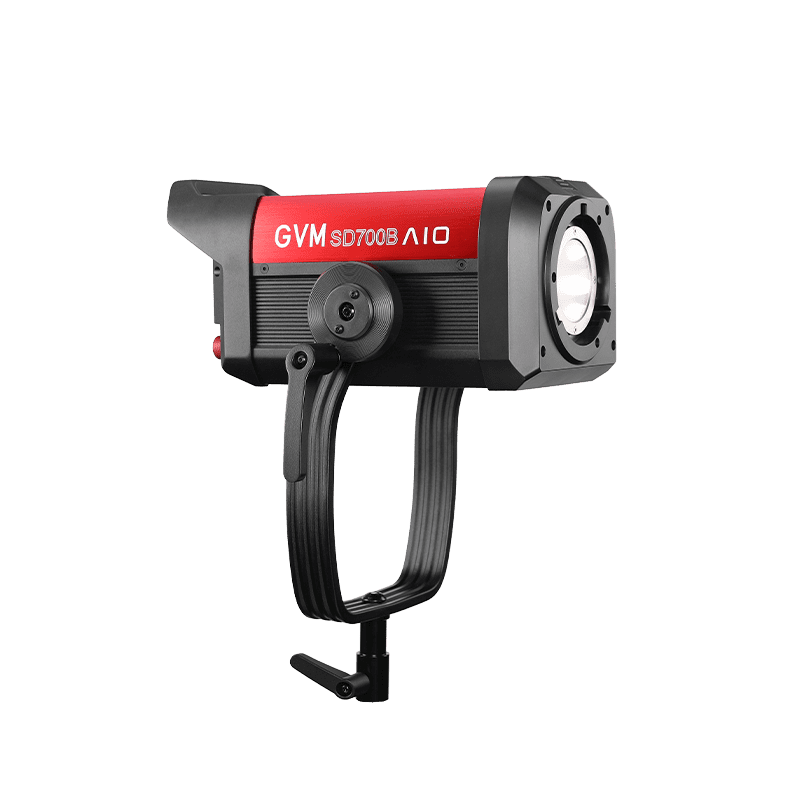
For creators who need serious brightness without sacrificing the all-in-one convenience of a monolight, the GVM SD700B AIO leads this category on raw capability. Its 700W output delivers 26,200 lux at 3 meters with the standard reflector, giving it enough headroom to shoot through softboxes, cover larger spaces, or maintain lower ISO settings for cleaner footage than lower-wattage alternatives can manage.
Color performance holds at CRI/TLCI 97+ across a 2700K–6800K bi-color range, with stepless dimming from 0.1% to 100% that maintains consistent color temperature throughout — a detail that matters significantly once you’re relying on the same fixture for both a photo shoot and continuous video recording. Its standard Bowens mount opens up a wide range of modifiers, and control scales from simple Bluetooth app use up to full 5-pin DMX and wireless CRMX for larger productions.
| 機能 | 仕様 |
|---|---|
| 力 | 700W |
| 明るさ | 26,200 lux @ 3m (with standard reflector) |
| 色温度 | 2700K–6800K bi-color |
| CRI/TLCI | 97+ |
| 調光 | 0.1%–100% stepless |
| 制御 | Bluetooth app, 5-pin DMX, wireless CRMX |
| 山 | Bowens |
| 最高 | High-output studio and commercial work, large spaces, softbox-heavy setups |
2. GVM PRO SD300C — Best Monolight for Creative Color Control
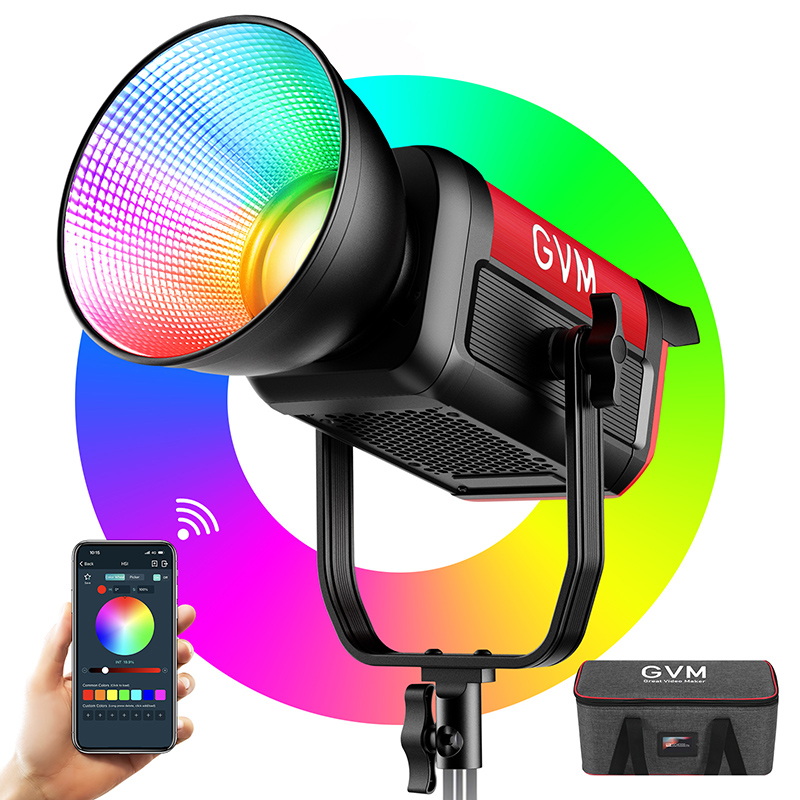
For photographers and videographers who lean into color as a creative tool rather than just a technical requirement, the GVM PRO SD300C stands out for its full RGB spectrum output layered on top of professional-grade white light performance. Its luminous flux reaches 48,200 lux at 1 meter with the standard reflector, and its 2000K–10,000K bi-color range extends noticeably wider than most competing monolights, covering everything from warm practical-light simulation to cool daylight matching.
Sixteen built-in cinematic lighting effects and twelve light source presets give this fixture genuine versatility for narrative and commercial work that needs to simulate specific environments quickly, while 1/1000-step dimming precision supports fine exposure control for both stills and video. Control options span smart app control, Bluetooth Mesh networking, and full DMX support — making it a strong choice for photographers who occasionally work alongside a lighting crew or console-based setup.
| 機能 | 仕様 |
|---|---|
| 力 | Bi-color + full RGB spectrum |
| 明るさ | 48,200 lux @ 1m (with standard reflector) |
| 色温度 | 2000K–10,000K |
| CRI/TLCI | 97+ |
| 調光 | 1/1000-step, flicker-free |
| 組み込みエフェクト | 16 cinematic effects, 12 light source presets |
| 制御 | App, Bluetooth Mesh, DMX |
| 最高 | Creative color work, commercial photography, narrative film production |
3. GVM-CL100B — Best Compact Monolight for Travel and Content Creators
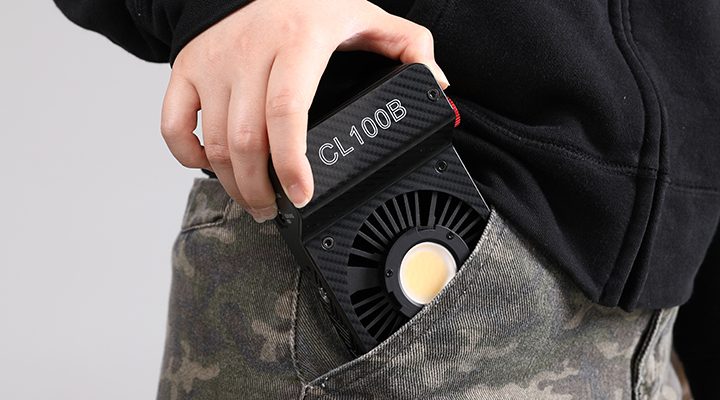
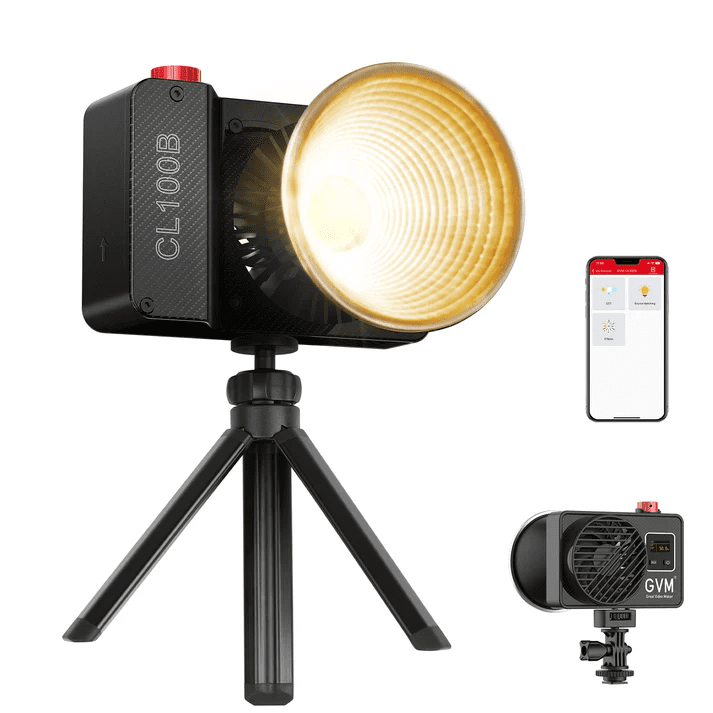
Not every photographer or videographer needs 700W of output — many need a monolight that disappears into a bag and still delivers professional color. The GVM-CL100B fills that role, weighing just 357g while still producing 100W of output and 18,500 lux at 1 meter, enough to function as a genuine key or fill light rather than a token travel accessory.
What sets it apart for dual photo-video use on the road is its triple power supply system — AC adapter, NP-F battery, or USB-C PD power bank — meaning it isn’t tied to a fixed studio setup or a single charging method. CRI and TLCI both rate at 97+, so color stays accurate whether it’s lighting a product shot or an on-location interview, and its included silicone light dome, small reflector, and tabletop tripod cover most basic modification needs without requiring a separate stand.
| 機能 | 仕様 |
|---|---|
| 力 | 100ワット |
| 重さ | 357グラム |
| 明るさ | 18,500 lux @ 1m |
| 色温度 | Bi-color, adjustable |
| CRI/TLCI | 97+ |
| Power Options | AC adapter, NP-F battery, USB-C PD |
| 制御 | Onboard LCD/knobs, Bluetooth app (50m mesh) |
| 最高 | Travel, on-location shoots, compact photo/video kits |
Which Monolight Fits Your Workflow
The right pick from this list depends less on which monolight is “best” in the abstract and more on which constraints actually shape your shoots.
If your work regularly demands lighting larger spaces, shooting through heavy diffusion, or covering distance — commercial sets, larger studios, or spaces with high ceilings — the SD700B AIO’s raw output gives you the most working headroom of the three.
If your projects lean into stylized color, narrative lighting, or commercial work where mood matters as much as technical accuracy, the PRO SD300C’s full RGB range and extended color temperature spread offer creative flexibility the other two don’t match.
If your priority is fitting a capable, color-accurate light into a bag that already holds a camera, lenses, and audio gear, the CL100B delivers professional output-to-weight performance that makes it the practical choice for photographers and videographers who move between locations regularly.
結論
A genuinely good monolight for photo and video work needs to earn its place in both mediums, not just one — strong CRI and TLCI ratings, precise stepless dimming, and output that holds up at real working distances all matter more than a single headline spec. Among current options, the GVM SD700B AIO leads on raw output, the GVM PRO SD300C leads on creative color control, and the GVM-CL100B leads on portability — giving creators a genuine choice based on how and where they actually shoot, rather than a single one-size-fits-all recommendation.
Ready to find your monolight? Explore the GVM SD700B AIO, PRO SD300C, and CL100B to see which fits your next shoot.