
LED video lighting has moved from optional gear to everyday production equipment. Bad light can make an expensive camera look amateur. Good light can make a modest camera look polished, consistent, and intentional. That is why more creators now start with lighting decisions before chasing another lens or body upgrade.
Traditional production lights were once dominated by tungsten and HMI fixtures: hot, power-hungry, and often bulky. Then came long-tube COB heads with separate ballasts and heavy cables. Those lights still work, but they were built for fixed rooms and slower setups. In 2026, compact flat-profile COB monolights are changing the standard, especially for creators who need professional output without a large crew.
目次
From Tungsten and HMI to COB Light Photography
Before LED took over, tungsten lights were common because they were simple and warm. The downside was heat, high power draw, and limited flexibility. HMI fixtures offered stronger daylight-balanced output for film work, but they were expensive, heavy, and less practical for small teams.
COB light photography became popular because one dense LED chip can deliver strong continuous output with better efficiency and less heat than old tungsten systems. The better question is no longer whether COB is “worth it.” For most modern photo and video work, it already is. The real question is which COB design fits the way people actually shoot now.
What Is a LED COB Light in Photography?
A COB light uses a Chip-on-Board LED engine: many LED chips packed into one module that behaves like a single bright point source. That design is useful because it:
- produces strong directional output
- works well with reflectors, softboxes, and optical modifiers
- gives a clearer falloff pattern than large flat panels
- supports both hard and soft looks depending on accessories
In practical terms, a COB light is often the better key light. Panels are useful for fill and close-range soft light, but COB fixtures usually give more control once modifiers enter the setup.
Types of LED Video Lighting
Not every fixture plays the same role.
| タイプ | Strength | Limitation | Best Use |
|---|---|---|---|
| LEDパネル | Soft, wide spread | Less punch at distance | Interviews, fill light |
| COB Spot / Monolight | Strong, directional, modifier-friendly | Needs softbox for flattering faces | Key light, portraits, product work |
| チューブライト | Portable and flexible | Lower output as main key | Rim light, accents, atmosphere |
| Softboxes / Lanterns | Diffused, flattering light | Depends on the source behind them | Portraits, talking-head video |
For most beginners building a serious setup, a COB monolight is the strongest first investment because one good key light improves almost every frame.
Key Specs That Actually Matter
Watts are not the full story
Wattage measures power consumption, not finished brightness on the subject. Always compare lux at a real distance.
Lux and usable intensity
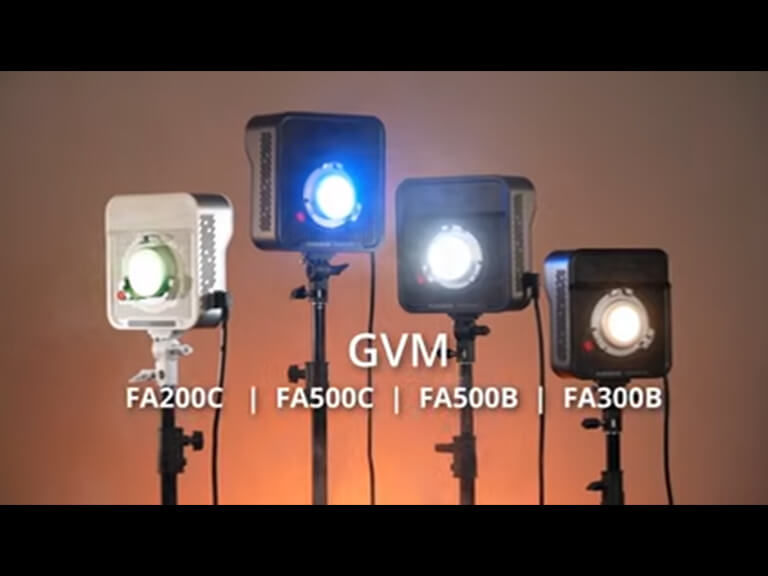
Lux tells you how much light reaches a point in space. For example, the GVM FA300B AIO delivers 17,000 lux at 1 m そして 1,920 lux at 3 m bare. Those numbers are more useful than a watt label alone.
色温度
Measured in Kelvin:
- around 2700K looks warm
- around 5600K–6500K looks closer to daylight
Bi-color lights are more flexible than fixed-CCT lights because they can match mixed rooms. RGB adds creative color, but bi-color is often enough for interviews, products, and standard commercial work.
CRI and TLCI
CRI and TLCI describe how accurately colors appear on camera. For skin tones and product work, 95+ is good and 97+ is better. Weak color performance creates extra correction work later.
Beam and dimming behavior
A narrow beam throws farther and feels more focused. A wider beam covers more area. Dimming curves also matter. Linear, log, exponential, and S-curve options help keep brightness transitions smooth in video rather than abrupt.
GVM FA300B AIO: A Practical COB Example
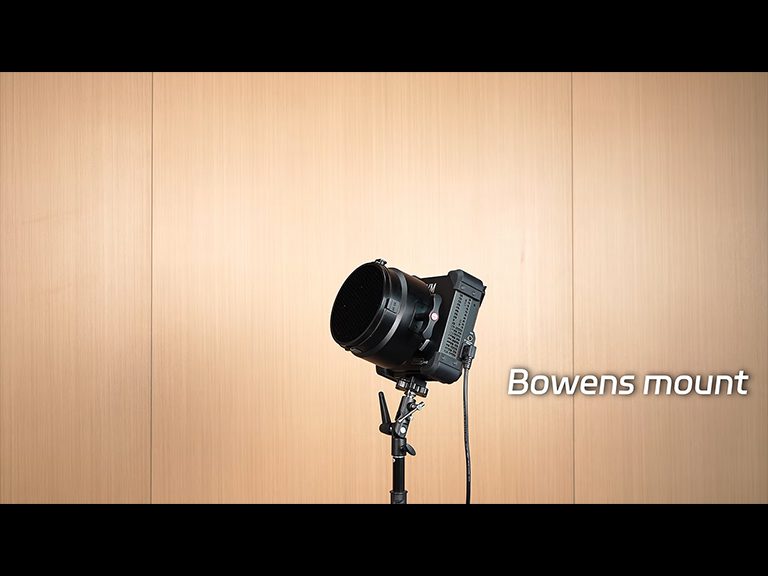
について GVM FA300B AIO is a flat-profile 300W bi-color COB monolight designed for livestreamers, studio creators, and small production teams. Unlike older long-tube COB lights with external power bricks, it uses an all-in-one body that is easier to place in compact rooms.
Product Spec Table
| パラメーター | GVM FA300B AIO |
|---|---|
| 力 | 300 W |
| Output | 17,000 lux @ 1 m / 1,920 lux @ 3 m |
| CCT | 2700K–6800K |
| 色の精度 | CRI ≥97 / TLCI 97+ |
| Design | Flat all-in-one COB monolight |
| 重さ | 2.99 kg |
| サイズ | 312.5 × 198 × 104 mm |
| 山 | Bowens |
| 制御 | Onboard + Bluetooth Mesh + NFC |
| Modes | CCT, 12 source presets, 12 FX |
| Dimming Curves | Linear / Log / Exp / S-Curve |
| 力 | AC 100–240V |
Why its design matters
Older COB lights were often long, front-heavy, and paired with external controllers. The FA300B AIO’s flat body is easier to pack and position, while Bowens mount support keeps the light expandable with softboxes and other modifiers. For creators comparing value, that mix of output, color accuracy, and all-in-one convenience is where GVM becomes a highly cost-effective choice against bulkier traditional systems.
Must-Have Light Shaping Tools
A bare COB source is only the starting point.
- Reflector: increases throw and intensity
- Softbox: softens shadows for faces and interviews
- Grid / snoot: controls spill and narrows the beam
- Barn doors: shapes the edges of the light
- Diffusion cloth: quick softening when a full softbox is too much
- Solid stand or boom: keeps the setup safe once modifiers are added
The fixture creates output. Accessories decide whether that output looks refined.
Beginner Lighting Setup and a Simple Case
A reliable first setup does not need five lights.
One-light starter
- Place the COB key light at about 45 degrees from the subject
- Raise it slightly above eye level
- Add a softbox
- Use a white reflector on the opposite side for fill
Case example:
A creator records a desk interview in a small apartment. Ceiling lights make the face flat and slightly green. One FA300B AIO with a softbox is set to around 4500K to balance the room, placed camera-left at 45 degrees. A reflector opens the shadow side of the face. The background falls off naturally, skin looks cleaner, and the whole setup stays compact enough for a one-person workflow.
That single change usually improves production quality more than a camera upgrade.
How to Buy Your First LED Video Light
Prioritize:
- measured lux, not only watt claims
- CRI/TLCI near 97+
- bi-color flexibility for mixed rooms
- Bowens mount for long-term modifiers
- quiet operation for talking-head work
- all-in-one design if you shoot in small spaces
If the budget is limited, one strong COB key light is better than several weak lights with poor color.
よくある質問
Is COB better than panel soft light?
For a main key light, yes in most cases. COB fixtures offer more intensity and better modifier control. Panels remain useful for fill.
Is 300W enough for creator studios?
Yes for many portraits, interviews, product setups, and livestreams indoors, especially with a softbox.
Why does silent mode lower output on some lights?
Because the fan is restricted or stopped, so power is reduced to manage heat. On the FA300B AIO, silent mode limits output for safety.
Do I need RGB on a first video light?
Not always. Bi-color covers most standard work. RGB becomes useful later for accents and stylized scenes.
最終評決
LED video lighting is now the practical center of modern content production. Watts, CRI, and color temperature only become useful when they translate into accurate skin tones, controllable brightness, and faster setup.
COB light photography earned its place because it combines strong continuous output with modifier flexibility. Compared with older tungsten, HMI, and long-tube ballast systems, flat all-in-one monolights are simply easier to live with. The GVM FA300B AIO shows what that next step looks like: 300W output, CRI/TLCI 97+, bi-color control, Bowens expansion, and a compact body that fits real creator spaces.
For most people building or upgrading a setup in 2026, that balance of performance and value is the point. One well-chosen LED video light, shaped correctly, still does more for the final image than almost any other single piece of gear.