For years, discussions around lighting have revolved around output. But modern video production demands we look beyond raw wattage—focusing instead on why battery power and DMX matter more than sheer brightness.
300 watts.
500 watts.
1200 watts.
Specifications became shorthand for capability. The assumption was simple: more power meant a better light.
Yet anyone who spends enough time on real productions eventually discovers that brightness solves only one problem.
The more difficult questions arrive later.
Can the light operate where no power outlet exists?
Can adjustments be made without lowering the fixture from a stand twelve feet in the air?
Can several lights respond simultaneously during a live production or commercial set?
Can the lighting package move from studio interiors to mountain roads, abandoned factories, hotel rooms, or rooftop locations without requiring a generator truck?
Those questions often determine what becomes one of the best lights for videography, not the wattage printed on the side of the housing.
The Evolution of Video Lighting
A decade ago, most continuous lighting systems were designed around fixed environments.
Studios had wall power.
Cable runs were planned in advance.
Lighting positions changed slowly.
Modern production rarely works that way.
Commercial filmmakers move between locations in a single day. Documentary crews travel with smaller teams. Content creators shoot interviews in offices in the morning and exterior scenes before sunset.
Lighting equipment has quietly adapted to this reality.
Power systems became modular.
Controllers moved away from the lamp head.
Battery operation evolved from a backup feature into an expected part of professional workflow.
Remote control stopped being a luxury and became a necessity.
The result is a new category of fixtures designed less around the studio and more around movement.
Why External Control Boxes Changed Set Workflow
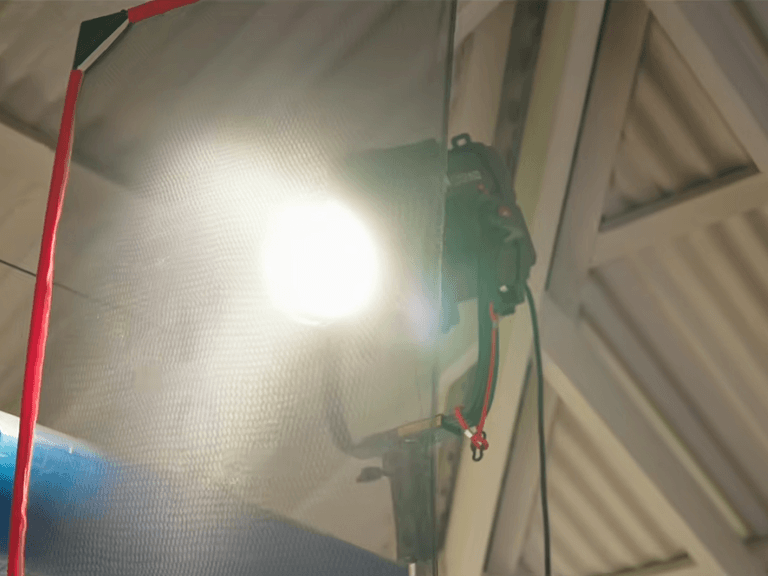
Anyone who has adjusted a light mounted on a boom arm understands the problem immediately.
The fixture sits overhead.
The stand is sandbagged.
A softbox blocks access to the rear controls.
Changing output by five percent suddenly requires lowering the stand, making adjustments, and rebuilding the setup.
Multiply that by six fixtures on a commercial set and the lost time becomes significant.
This is one reason control boxes have become increasingly common on professional lighting systems.
Separating the control unit from the fixture itself makes day-to-day shooting noticeably easier. The head stays lighter, larger modifiers feel more stable, and settings can be adjusted without interrupting the setup. After a few long production days, it quickly starts to feel like the more practical approach.
Battery Power Is No Longer Reserved for Documentary Crews
Battery-powered lighting was once associated with run-and-gun filmmaking.
That distinction no longer exists.
Corporate productions now regularly film in historical buildings where generators are prohibited.
Automotive shoots happen in remote roads before sunrise.
Wedding filmmakers work inside venues where cable runs create safety concerns.
Commercial productions increasingly choose battery operation simply because it removes friction from the process.
The ability to place a key light exactly where it needs to be — without negotiating with extension cords — changes the pace of production.
Sometimes the difference between capturing a shot and missing it entirely is measured in minutes rather than equipment quality.

DMX Is Quietly Becoming Essential
DMX control often sounds intimidating to newer filmmakers.
In reality, its purpose is straightforward.
Consistency.
When a production uses several fixtures, matching intensity manually becomes inefficient.
Most interview setups involve more than a single light. One shapes the subject, another controls contrast, while others help define the space behind them. On commercial sets, that number tends to grow quickly.
Without centralized control, every adjustment becomes a walk across the set.
DMX allows a lighting console to manage all fixtures simultaneously.
Brightness changes occur instantly.
Lighting cues can be programmed.
Complex setups remain repeatable across multiple shooting days.
For larger productions, this is not merely convenient. It is expected.
Where the GVM PRO SD500B Fits
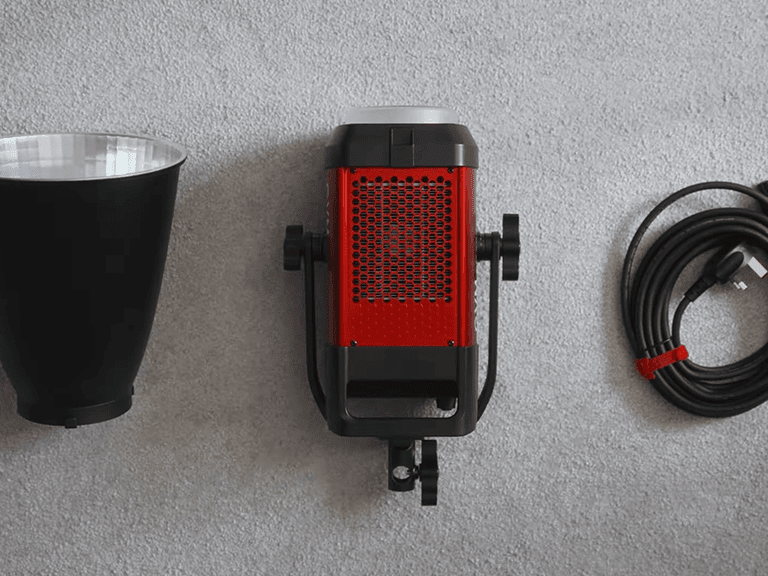
The transition toward mobile professional lighting explains why fixtures such as the GVM PRO SD500B have attracted attention among filmmakers working across different environments.
Rather than focusing exclusively on output, its design reflects the realities of contemporary production.
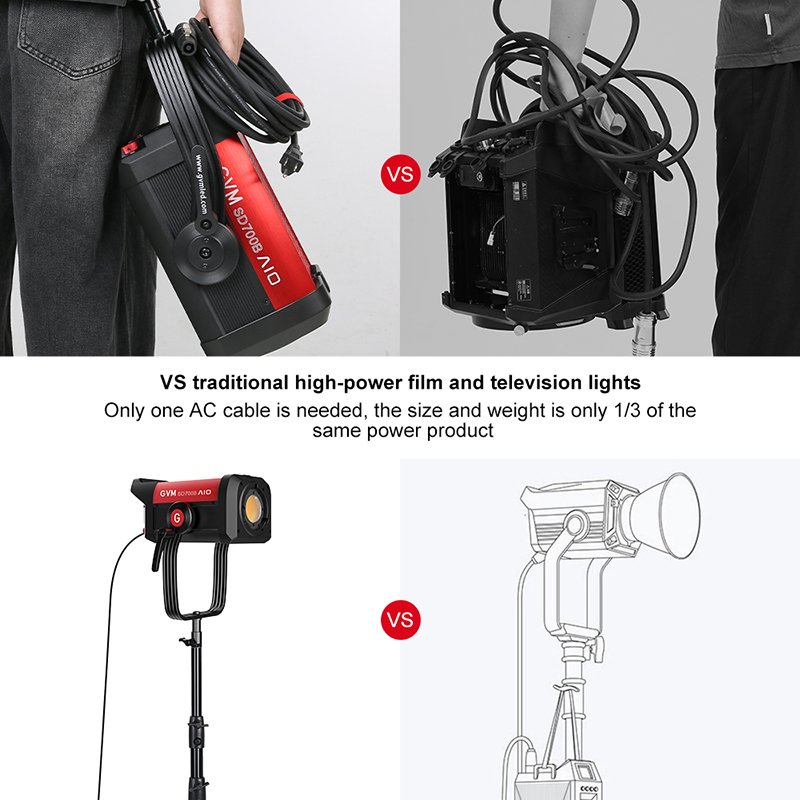
The separate control box reduces weight on the lamp head and places adjustments within easy reach of the crew.
Integrated V-mount battery support allows operation far from conventional power sources, making the fixture practical for exterior interviews, documentary work, remote locations, and temporary sets where electrical infrastructure may not exist.
For productions already using professional lighting workflows, DMX input and output provide compatibility with dedicated lighting consoles and larger control networks. That capability allows the fixture to move comfortably from independent productions to more structured commercial environments.
This flexibility often matters more than raw brightness figures.
A light that can only function near an outlet remains a studio tool.
A light that travels with the production becomes part of the storytelling process.
| Feature | GVM PRO-SD500B (Bi-Color) |
| Best For | Film Production & Commercial Shoots |
| Power Output | 500W High Output COB LED |
| Color Temp | 2,700K – 6,800K |
| Color Modes | CCT + Source Matching + FX Modes |
| CRI / TLCI | 97+ / 97+ |
| Special Effects | 12 Built-in Lighting Effects |
| Brightness | 61,600 Lux @1m (with Reflector) |
| Portability | Separate Controller Design for Better Weight Distribution |
| Control Type | APP + Bluetooth Mesh + DMX/RDM + RF Control |
| Cooling System | Intelligent / High Speed / Silent / Passive Modes |
| Mount Type | Standard Bowens Mount |
| Power Source | AC Power + V-Mount Battery Support |
Final Thoughts:The Definition of the Best Lights for Videography Is Changing
The industry still values output.
It always will.
But brightness alone no longer defines professional lighting.
Increasingly, the best lights for videography are defined less by output and more by flexibility. They move comfortably between studio and location work, adapt to different power situations, and fit naturally into larger productions when needed. Those qualities rarely appear first on a specification sheet.
They become visible only after months of use.
Usually on a cold morning before sunrise, standing beside a road where no power outlet exists, when a battery-powered fixture quietly turns on and the day begins exactly as planned.
At that moment, lighting stops being equipment.
It becomes infrastructure for creativity.
Explore the full range of GVM professional lighting solutions(https://gvmled.com/)today.