Quick answer: “Pro lighting” in 2026 splits into four tiers — entry-level, prosumer, professional, and broadcast/film. The dividing lines are output (lux @ 3m), mount standard (Bowens vs. G7), control protocols (APP vs. DMX/RDM/Art-Net/sACN/CRMX), and environmental sealing (IP rating). For film, broadcast, and large-scale studio work, the GVM REIGN R1200B sits at the top — a 1200W bi-color COB with the ARRI-standard G7 mount, IP65 dust and water protection, and 12 built-in light source presets. Below, I’ll break down what makes a light genuinely “pro” — and where the marketing fluff ends.
Table of Contents
1. What Does “Pro Lighting” Actually Mean in 2026?
Ten years ago, “pro lighting” was a 1K Fresnel, a 575W HMI, or a 2K Joker — wired to a dimmer rack, drawing 15+ amps per circuit, and needing a generator truck. That whole category has collapsed into a single LED category. But the term “pro” now means very different things to different buyers.
Here’s the tier breakdown most manufacturers won’t publish:
| Tier | Wattage Range | Mount | Control | IP Rating | Typical User |
|---|---|---|---|---|---|
| Entry-level | 50–150W | Bowens | On-board + APP | None | Hobbyist YouTuber |
| Prosumer | 200–300W | Bowens | APP + DMX | None | Solo creator, wedding videographer |
| Professional | 500–1200W | Bowens or G7 | APP + DMX + RDM + CRMX | IP54+ | Indie film, commercial, interview |
| Broadcast/Film | 1200W+ | G7 / ARRI standard | Full network: DMX/RDM/Art-Net/sACN/CRMX | IP65 | Film set, virtual production, live event |
Where the REIGN R1200B sits: Tier 4, broadcast and film. It’s the only light in GVM’s current lineup rated for full IP65 weather sealing and ARRI G7 mount compatibility.
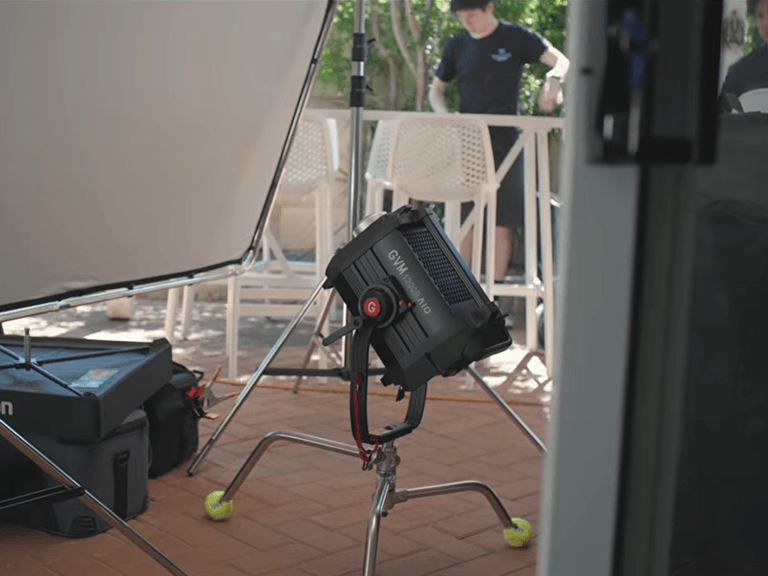
2. The Four Specs That Separate Pro Lighting from Marketing
Anyone can stamp “professional” on a 200W LED. Here’s how to read the spec sheet and know whether it’s real.
2.1 Output at working distance, not peak
Manufacturers love to print “100,000 lux!” in the headline — then bury the asterisk that says “measured at 0.5m with a hyper-spot reflector.” What matters on set is lux at 3m, because that’s the distance your subject is usually 8–12 feet from the light.
- 200W prosumer COB: ~3,000–4,500 lux at 3m (bare)
- 650W professional COB: ~6,000–8,000 lux at 3m (bare)
- 1200W broadcast COB: 9,000+ lux at 3m (bare) — REIGN R1200B hits 9,360 lux at 3m
If the manufacturer only quotes lux at 1m, multiply by 1/9 to estimate 3m. If they don’t quote 3m at all, be suspicious.
2.2 Mount standard — Bowens is prosumer, G7 is pro
The mount matters more than wattage.
- Bowens mount — the consumer/prosumer standard. Inexpensive modifiers, wide compatibility, but light loss at the modifier junction (typically 15–25%).
- G7 mount — the ARRI Open-Source standard for film and broadcast. Larger diameter, less light loss, compatible with ARRI-original modifiers (Fresnels, Lanterns, SnapBags).
When you’re running 1200W through a Bowens mount, you lose enough light at the modifier to make a 1200W behave like a 900W. G7 is built for that wattage class.
2.3 Control protocol — DMX alone is not enough
Pro lighting has to integrate with the lighting desk, the console, and the network. A fixture that only does APP control is consumer, period.
The full broadcast protocol stack:
- DMX-512 — legacy wired control (still standard on set)
- RDM — DMX with bidirectional feedback (lets the desk read fixture status)
- Art-Net / sACN — Ethernet-based DMX for large networks
- CRMX / LumenRadio — wireless DMX (the standard for film sets today)
- Bluetooth + APP — local control (convenient but not a “pro” feature alone)
The REIGN R1200B ships with all five. Most 200W–500W “pro” lights on Amazon ship with two at most.
2.4 Environmental sealing — IP rating tells the truth
A light that’s safe outdoors in light rain is rated IP54. A light that can sit in a storm for a week is IP65. A light that can be submerged is IP67.
If you’re shooting on a beach, a desert, or anywhere with weather, IP54 is the minimum. IP65 lets you leave the light rigged overnight without a rain cover. The REIGN R1200B is rated IP65.
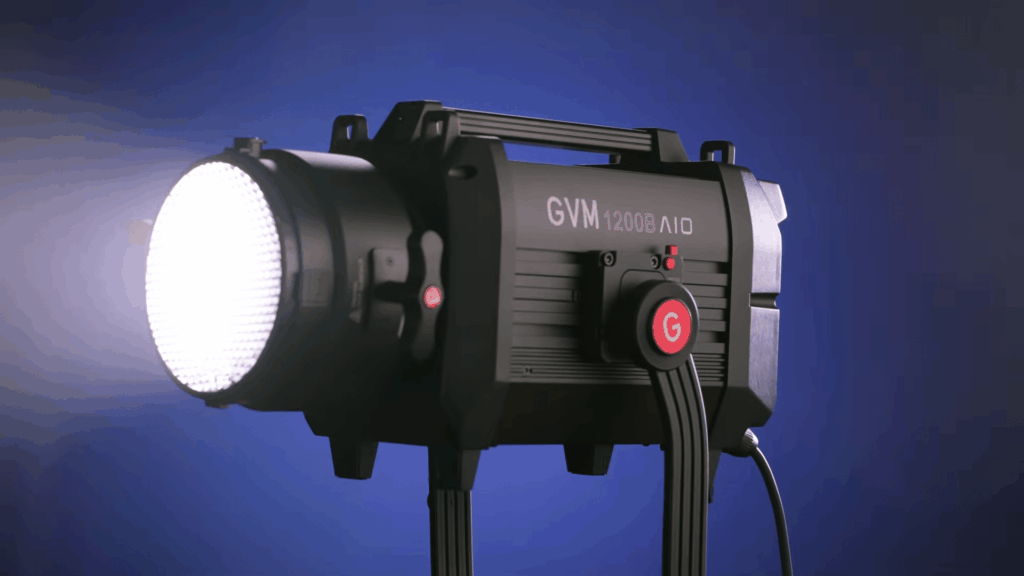
3. Why a 1200W COB Is the New “Pro Lighting” Default
In 2026, the 1200W COB has effectively replaced the 2K HMI as the “default pro light” for three reasons:
- Output parity with 2K HMI — a 1200W COB with a quality reflector matches a 2K HMI on a daylight exterior. The HMI draws 16 amps; the COB draws 5.5 amps.
- Bi-color without gels — 2700K–6800K in one fixture, no ¼ CTO warming gels, no full CTO cooling gels, no color shift between setups.
- Flicker-free at any frame rate — HMIs flicker at high shutter speeds; modern COBs are DC-driven and flicker-free to 10,000 fps.
For a single DP running an indie feature, one 1200W COB with a 4-light kit (key, fill, rim, bounce) covers 90% of setups.
4. The REIGN R1200B: Built for Broadcast and Film
The GVM REIGN R1200B is the first fixture in GVM’s flagship REIGN series — explicitly designed to compete with the ARRI Orbiter and Aputure Nova at the broadcast tier. Here’s the full spec breakdown.
R1200B Specifications
| Spec | Value |
|---|---|
| Power | 1200W (COB) |
| Max Output (bare) | 9,360 lux @ 3m / 2,900 lux @ 5m |
| Color Temperature | Bi-Color 2700K–6800K |
| CRI / TLCI | 97+ (not yet published, expected ≥97) |
| Mount | G7 (ARRI Open-Source standard) |
| Lighting Effects | 12 built-in (Lightning, Flame, Bonfire, Welding, etc.) |
| Light Source Presets | 12 (Tungsten, HMI 5600, HMI 6000, Candlelight, Sunrise/Sunset, etc.) |
| Control Protocols | RDM, DMX-512 (In/Out), Ethernet (Art-Net, sACN), Bluetooth, LumenRadio CRMX, GVM App |
| Waterproof / Dustproof | IP65 |
| Yoke | Quick-release, detachable (aerospace-grade aluminum) |
| Optical Boost | Detachable convex lens (boosts throw by ~3x) |
| Application | Film, virtual studio, broadcast, live event, e-commerce |
What’s actually new vs. the AIO 1200B
GVM already has a 1200W AIO 1200B (which we covered in our best LED movie lights guide). The REIGN R1200B is a different category of fixture, not a refresh:
- AIO 1200B: Bowens mount, IP-rated for indoor/studio, 12 lighting effects, 42,800 lux @ 3m with reflector
- REIGN R1200B: G7 mount, IP65 weather-sealed, 12 effects + 12 light source presets, 9,360 lux @ 3m bare (3x brighter with optical lens)
In short: the AIO 1200B is the studio king; the REIGN R1200B is the location-agnostic broadcast king.
5. G7 Mount vs. Bowens Mount: The Modifier Question
If you’re buying pro lighting, you have to commit to a modifier ecosystem. Here’s the practical difference:
| Modifier | Bowens Mount | G7 Mount |
|---|---|---|
| Standard reflector | (light loss ~15%) | (light loss ~5%) |
| 48″ Lantern | (third-party only) | (GVM DL120RG + ARRI-original) |
| 4-way barndoor | (universal) | (GVM BD4G9 + ARRI-original) |
| Softbox (3’x3’+) | (universal) | (GVM Quick Release + ARRI SkyPanel series) |
| Fresnel lens | (add-on only) | (native GVM + ARRI) |
| Price of modifier | $30–$200 | $200–$1,500 |
For a single shooter on a budget, Bowens wins on price. For a rental house or a DP building a kit for 5+ years, G7 wins on modifier quality and durability. The REIGN R1200B is G7 — and ARRI-original modifiers are forward-compatible, so your investment holds.
6. Pro LED Lighting by Use Case
Not every pro shoot needs a 1200W COB. Here’s how to match the light to the job.
6.1 Narrative film / commercial
Recommended: 1200W COB, G7 mount, full DMX/RDM/CRMX
Why: Long throw (5m+), modifier flexibility, weather resilience for exteriors, console integration for DPs running scripted lighting cues.
GVM pick: REIGN R1200B. For a smaller kit, the SD300B-AIO covers 200W–300W class with the same protocol stack (minus IP65).
6.2 Interview / corporate / talking-head video
Recommended: 200–500W COB, Bowens or G7, APP + DMX
Why: Output only needs to fight a window, modifiers stay simple (one softbox), and silence matters more than weather sealing.
GVM pick: GVM 1200B AIO (Bowens mount, 12 effects, fast 60-second setup) or the SD300B-AIO for tighter budgets.
6.3 Photography studio (portrait, product, e-commerce)
Recommended: 300W–1200W COB, Bowens or G7, daylight-balanced or bi-color
Why: Studio is controlled environment — IP rating is irrelevant. Modifier ecosystem matters most.
GVM pick: GVM 1200B AIO for the flagship, or the REIGN R1200B if you also shoot on location and want one fixture that does both.
6.4 Live event / virtual production / stage
Recommended: 1200W+ COB, G7 mount, full network protocol stack (Art-Net/sACN)
Why: Lighting designer controls from a console — APP and DMX-512 alone aren’t enough for an LED wall with 20+ fixtures.
GVM pick: REIGN R1200B. The Art-Net/sACN support is the deciding factor.
7. The 12 Light Source Presets: Why They Matter
Most “pro lighting” fixtures ship with 8–12 generic effects — paparazzi, lightning, candle. The REIGN R1200B ships with two separate effect banks:
- 12 Lighting Effects — narrative effects (Flame, Lightning, Welding, etc.)
- 12 Light Source Presets — color-matched real-world sources
The presets are the bigger deal. When you’re shooting a scene set in a kitchen at 7am with morning sun through a window, the “Sunrise/Sunset” preset matches the 2700K warm side of dawn. When you’re cutting to an industrial office lit by HMI 5600K, the “HMI 5600” preset dials in. No gels, no guessing, no color shift between setups.
This is the part of “pro lighting” that hobbyist lights can’t replicate. The presets are tuned by GVM’s color science team to match real spectral outputs — not approximate CCT values.
8. Pro Lighting vs. “Prosumer” Lighting: The Real Cost Difference
A 200W prosumer LED costs $250–$400. A 1200W pro LED costs $1,800–$2,800. The price gap is real — but so is the capability gap.
| Capability | 200W Prosumer | 1200W Pro (REIGN R1200B) |
|---|---|---|
| Modifiers (reflector + 4′ softbox) | $80 total | $700+ (G7 native) |
| Light Source Presets | None | 12 industry-matched |
| Weather sealing | None | IP65 |
| Console integration | DMX-512 only | DMX + RDM + Art-Net + sACN + CRMX |
| Wireless DMX (CRMX) | Optional add-on | Built-in LumenRadio |
| Service life at 100% duty cycle | ~5,000 hours | ~50,000 hours (COB) |
| 5-year total cost of ownership | $1,200 (with 1 replacement) | $2,500 (no replacement) |
The math flips around 18 months of professional use. The prosumer light needs replacement; the pro light doesn’t.
9. How to Set Up a Pro Lighting Kit (Without Overspending)
For a solo DP or small production company, here’s a working 4-light pro kit:
| Role | Fixture | Mount | Why |
|---|---|---|---|
| Key | REIGN R1200B | G7 | 1200W, full modifier ecosystem, IP65 for exteriors |
| Fill | GVM SD300B-AIO | Bowens | 300W, 60-second setup, mesh Bluetooth sync to the R1200B |
| Rim / Back | GVM PRO SD200B | Bowens | 200W bi-color, ultra-fine 1/1000 dimming for hair light control |
| Bounce / Practical | GVM FH400B Flathead | Bowens | 400W, low profile, great for table-top and interview bounce |
Total kit cost: ~$3,500. That’s a working pro kit for indie film, commercial, and broadcast — covering 90% of setups you’d encounter in a year.
10. The Bottom Line on Pro Lighting in 2026
“Pro lighting” used to mean you owned a dimmer rack and had a gaffer on call. In 2026, it means a 1200W bi-color COB with broadcast-grade control protocols, IP65 weather sealing, and a modifier ecosystem that scales with your shoots.
The GVM REIGN R1200B is GVM’s answer to the ARRI Orbiter class — at roughly one-third the price. For the full breakdown of the broader LED movie light market, see our best LED movie lights 2026 guide. For a deeper look at the underlying color science, our CRI explained guide covers what those 97+ CRI numbers actually mean on set.
If you’re building a pro kit, start with the key light. Everything else is a fill — and you can always rent the second and third units for a specific shoot. One REIGN R1200B in the bag is worth four 200W prosumer lights on a shelf.

FAQ: Pro Lighting in 2026
What wattage counts as “pro lighting”?
The dividing line moved up over the last five years. In 2026, anything below 200W is consumer, 200–500W is prosumer, 500W–1200W is professional, and 1200W+ with full broadcast control protocols is film/broadcast tier. The GVM REIGN R1200B sits at the top of the 1200W class with full Art-Net/sACN/CRMX support.
Is pro LED lighting worth the cost over prosumer?
For anyone shooting professionally (i.e., charging clients), yes. The 5-year total cost of ownership of a 1200W pro COB is lower than a 200W prosumer light, because the COB runs ~50,000 hours vs. ~5,000 hours for the prosumer diode, and you don’t need to replace the fixture every 18 months. The REIGN R1200B is the entry point for that math to flip.
What mount should I choose — Bowens or G7?
If you’re a solo creator on a budget, Bowens. Modifiers are cheap, the ecosystem is huge, and most third-party softboxes fit. If you’re a rental house, a DP building a 5-year kit, or a production company, G7. Modifiers cost 5–10x more, but they last 5x longer, and ARRI-original modifiers are forward-compatible across generations of G7 fixtures. The REIGN R1200B is G7.
Do I really need IP65 weather sealing?
If you ever shoot outside — even a porch, a tent, or a covered patio — IP65 is worth the upgrade. IP65 means the fixture survives direct rain and dust ingress, so you don’t have to baby it with rain covers and you can leave it rigged overnight. If you’re a strict studio shooter, you can skip IP65 and save the cost.
Can I use a 1200W COB on a household circuit?
Yes, in most cases. A 1200W COB draws ~5.5 amps at 220V (or ~10 amps at 110V). A standard US household circuit is 15–20 amps, so you can run one 1200W COB on a circuit with your laptop and monitor. You can’t run two 1200W COBs on the same 15A circuit — but you can run them on separate circuits. The REIGN R1200B draws 5.5A at 220V / 10A at 110V.
What’s the difference between CRI 95 and CRI 97?
Practically nothing on a monitor. CRI 95 and CRI 97 are both “broadcast-grade” — the difference is visible only on a calibrated reference monitor or when you push color in post. The bigger jump is from CRI 90 to CRI 95; from 95 to 97 is incremental. The REIGN R1200B is rated CRI 97+, putting it at the top of the broadcast tier.