Photography lighting equipment shapes the final image more than any camera body or lens ever will. A photographer with an entry-level camera and controlled light will consistently outperform someone shooting a flagship body under harsh, uneven conditions.
Yet lighting is where most beginners get stuck — dealing with unwanted shadows, color casts that ruin skin tones, and exposure that shifts unpredictably from shot to shot. This guide walks through the equipment categories, the specs that actually matter, and how to match gear to your shooting style.
Table of Contents
Monolights vs. Strobes: Knowing the Difference
A monolight is a self-contained flash unit with its power supply, controls, and flash tube built into a single housing — plug it in (or attach a battery) and it’s ready to fire. A strobe, in the broader sense, refers to any flash unit, but photographers often use the term to distinguish battery-pack-driven heads from all-in-one monolights.
The practical difference comes down to power source and portability. Monolights are self-sufficient and easier to set up on location, while pack-and-head strobe systems separate the power supply from the flash head, which can mean higher output but more cables and bulk to manage. Below, we’ll cover monolight reviews criteria and help you identify the best monolight for photography based on your setup, including battery powered monolight options for shooting away from AC outlets.
Main Types of Photography Lighting Equipment
Continuous Lights (Panel Lights, COB LEDs) Best for video and hybrid photo/video work. Because the light stays on, what you see is what you get (WYSIWYG) — no guessing how a flash exposure will render.
Flash / Strobe Lights Best for freezing motion and delivering high output in short bursts. Ideal for fashion, sports, and any scenario where ambient light needs to be overpowered.
Speedlights (On-Camera Flash) Compact, battery-driven, and highly portable. The go-to choice for events and weddings where mobility matters more than raw power.
Key Specifications to Evaluate
Choosing photography lighting equipment comes down to five specs: brightness, color accuracy, color temperature range, power source, and build/portability.
- Brightness (Lumens vs. Lux): Lumens measure total light output; lux measures intensity at a specific distance. Lux ratings are more useful for comparing units you’ll actually position at a working distance.
- Color Accuracy (CRI & TLCI): Anything above CRI/TLCI 95 renders skin tones and product colors faithfully. Below that, colors can shift subtly and require correction in post.
- Color Temperature: Fixed-temperature lights are cheaper but limit flexibility; bi-color lights adjust between warm and cool; RGB units add full-spectrum creative control.
- Power Source: AC-only units are stable for studio work; battery or dual-power units free you up for location shoots.
- Build & Portability: Weight, foldability, and mount compatibility (like Bowens mount) determine how fast you can move between setups.
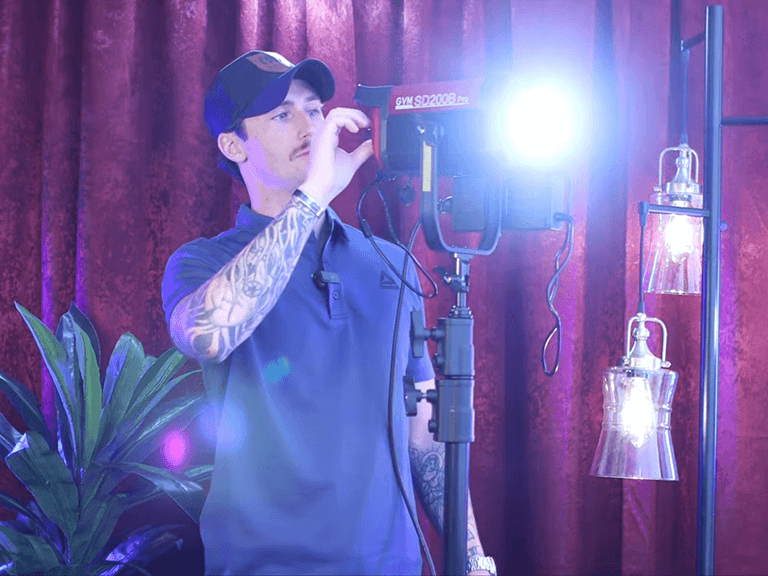
A standout example that hits all five criteria is the GVM PRO SD200B, a bi-color LED spotlight built for professional photography and video production.
| Model | Brightness (lux) | CRI/TLCI | Power Source | Key Feature | Best For |
|---|---|---|---|---|---|
| GVM PRO SD200B | 45,400 lux (at 1m) | ≥97 / ≥97 | AC, DMX-integrated | Bluetooth Mesh multi-light sync | Interviews, portraits, product shoots, studio/on-location |
The SD200B’s 2700K–6800K bi-color range, 1/1000-step dimming precision, and three control methods — onboard knobs, the GVM app, and a 5-pin DMX interface — make it easy to fit into an existing studio workflow. At this brightness and color-accuracy tier, it delivers strong value against comparably specced units from other brands.
Essential Modifiers and Accessories
Raw output only gets you halfway there. Modifiers shape and soften light:
- Softboxes — diffuse light for flattering portraits
- Umbrellas — quick, affordable broad lighting
- Reflectors — bounce existing light without adding a source
- Diffusers — soften harsh direct light
- Grids and snoots — narrow the beam for dramatic, controlled spill
- Light stands and boom arms — position lights precisely, including overhead
Choosing the Right Setup for Your Genre
- Portrait: Soft continuous light paired with high CRI output for accurate skin tones.
- Product: Even, shadowless lighting that eliminates hot spots on reflective surfaces.
- Event: Portable speedlights or battery-powered strobes that move with you.
- Video: Flicker-free bi-color panels for consistent color across takes.
Current Trends in Photography Lighting Equipment (2026)
Three shifts define this year’s gear:
- Compact high-output panels — foldable designs that pack studio-level brightness into travel-friendly form factors.
- Dual-power hybrid lights — AC and battery input on the same unit, removing the tradeoff between studio stability and location flexibility.
- App-controlled, multi-light syncing — systems like the SD200B’s Bluetooth Mesh let photographers adjust an entire multi-light setup from one device, without walking between stands.
Frequently Asked Questions
Do I need a monolight or a speedlight to start?
If you’re shooting mostly in one location, a monolight offers more power and control. If you need to move fast between locations, start with a speedlight.
What CRI rating should I look for?
Aim for CRI/TLCI 95 or higher if color accuracy matters for your work — this covers most portrait, product, and video applications.
Can continuous lights replace strobes?
For video, yes. For freezing fast motion in photography, strobes still have the edge in raw power delivered in a fraction of a second.
Conclusion
The right photography lighting equipment comes down to matching output, color accuracy, and portability to how you actually shoot. Whether you’re building a first studio kit or adding a versatile bi-color unit like the GVM PRO SD200B to an existing setup, prioritize gear that delivers strong specs without the premium price tag of legacy brands — that’s where the real value-per-dollar gains show up. Match your lighting to your shooting environment, and even a modest composition will look considerably more professional.