Respuesta rápida: “Iluminación profesional” en 2026 se divide en cuatro niveles: nivel de entrada, prosumidor, profesional y broadcast/cine. Las líneas divisorias son la potencia (lux a 3 m), el estándar de montaje (Bowens vs. G7), los protocolos de control (APP vs. DMX/RDM/Art-Net/sACN/CRMX) y el sellado ambiental (clasificación IP). Para cine, broadcast y trabajo en estudios a gran escala, el GVM REIGN R1200B se sienta en la parte superior — un COB bicolore de 1200 W con montura G7 estándar ARRI, protección IP65 contra polvo y agua, y 12 preselecciones de fuentes de luz incorporadas. A continuación, desglosaré lo que hace que una luz sea genuinamente “pro”, y dónde termina el marketing superficial.
Tabla de contenidos
1. ¿Qué significa realmente “Iluminación Profesional” en 2026?
Hace diez años, la “iluminación profesional” era un Fresnel de 1K, un HMI de 575W o un Joker de 2K, conectado a un rack de dimmers, consumiendo más de 15 amperios por circuito y necesitando un camión generador. Toda esa categoría se ha reducido a una sola categoría de LED. Pero el término “profesional” ahora significa cosas muy diferentes para los diferentes compradores.
Aquí está el desglose por niveles que la mayoría de los fabricantes no publican:
| Tier | Rango de vataje | Montar | Control | Clasificación IP | Usuario Típico |
|---|---|---|---|---|---|
| Nivel de entrada | 50–150W | Bowens | A bordo + APP | Ninguno | YouTuber aficionado |
| Prosumidor | 200–300W | Bowens | APP + DMX | Ninguno | Creador en solitario, videógrafo de bodas |
| Profesional | 500–1200W | Bowens o G7 | APP + DMX + RDM + CRMX | IP54+ | Cine independiente, comercial, entrevista |
| Radiodifusión/Cine | 1200W+ | G7 / Estándar ARRI | Red completa: DMX/RDM/Art-Net/sACN/CRMX | IP65 | Set de filmación, producción virtual, evento en vivo |
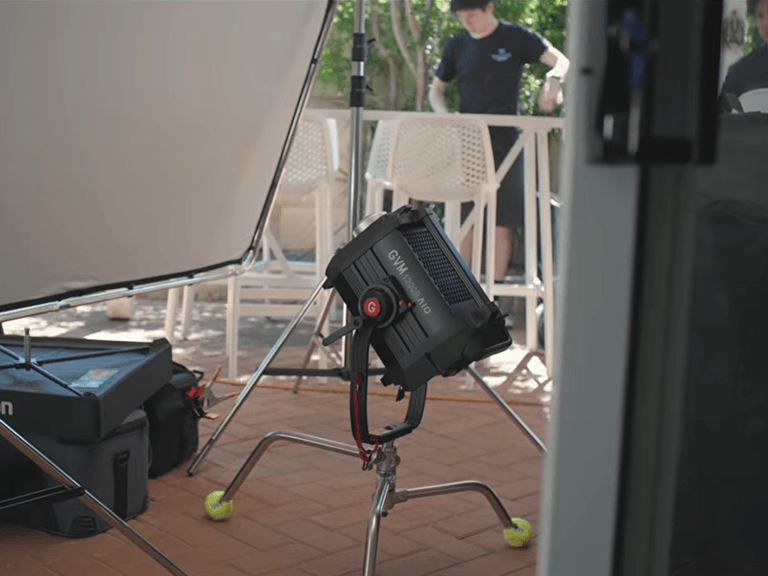
Dónde se sitúa la REIGN R1200B: Nivel 4, difusión y cine. Es la única luz en la línea actual de GVM con clasificación IP65 completa para resistencia a la intemperie y compatibilidad con montura ARRI G7.
2. Las cuatro especificaciones que separan la iluminación profesional del marketing
Cualquiera puede estampar “profesional” en un LED de 200W. Aquí te explicamos cómo leer la hoja de especificaciones y saber si es real.
2.1 Salida a distancia de trabajo, no pico
A los fabricantes les encanta poner “¡100.000 lux!” en el titular, y luego enterrar el asterisco que dice “medido a 0,5 m con un reflector hiper-focal. Lo que importa en el set es lux a 3m, ya que esa es la distancia a la que tu sujeto suele estar de la luz, entre 8 y 12 pies.
- COB prosumer de 200W: ~3000–4500 lux a 3m (sin reflector)
- COB profesional de 650W: ~6,000–8,000 lux a 3m (desnudo)
- COB de transmisión de 1200W: 9,000+ lux a 3 m (desnudo) — REIGN R1200B alcanza 9,360 lux a 3m
Si el fabricante solo indica los lúmenes a 1 metro, multiplique por 1/9 para estimar los lúmenes a 3 metros. Si no indican los lúmenes a 3 metros en absoluto, sea sospechoso.
2.2 Montura estándar — Bowens es prosumidor, G7 es profesional
El soporte importa más que la potencia.
- Montura Bowens — el estándar para consumidores y prosumidores. Modificadores económicos, amplia compatibilidad, pero con una ligera pérdida de luz en la unión del modificador (normalmente entre 15 y 251 TP3T).
- Montura G7 — el estándar de código abierto de ARRI para cine y televisión. Diámetro mayor, menor pérdida de luz, compatible con modificadores originales de ARRI (Fresnel, Lanternas, SnapBags).
Cuando estás pasando 1200 W a través de un montura Bowens, pierdes suficiente luz en el modificador para que un 1200 W se comporte como un 900 W. El G7 está diseñado para esa clase de potencia.
2.3 Protocolo de control: DMX por sí solo no es suficiente
La iluminación profesional tiene que integrarse con la mesa de control de iluminación, la consola y la red. Una luminaria que solo hace control vía APP es de consumo, y punto.
La pila completa del protocolo de transmisión:
- DMX-512 — control cableado heredado (todavía estándar en el set)
- RDM - DMX con retroalimentación bidireccional (permite que la consola lea el estado del dispositivo)
- Art-Net / sACN — DMX basado en Ethernet para redes grandes
- CRMX / LumenRadio — DMX inalámbrico (el estándar actual en los sets de filmación)
- Bluetooth + Aplicación — control local (conveniente pero no una característica “pro” por sí sola)
El REIGN R1200B se envía con los cinco. La mayoría de las luces “pro” de Amazon de 200W a 500W se envían con un máximo de dos.
2.4 Protección ambiental — La clasificación IP dice la verdad
Una luz que es segura en exteriores con lluvia ligera tiene clasificación IP54. Una luz que puede permanecer en una tormenta durante una semana es IP65. Una luz que puede sumergirse es IP67.
Si estás filmando en una playa, un desierto o en cualquier lugar con clima, IP54 es lo mínimo. IP65 te permite dejar la luz instalada durante la noche sin una cubierta para la lluvia. La REIGN R1200B tiene clasificación IP65.
3. Por qué una COB de 1200W es el nuevo estándar de “iluminación profesional”
En 2026, el COB de 1200W ha reemplazado efectivamente al HMI de 2K como la “luz profesional por defecto” por tres razones:
- Paridad de salida con HMI 2K — un COB de 1200W con un reflector de calidad iguala a un HMI de 2K en un exterior de día. El HMI consume 16 amperios; el COB consume 5,5 amperios.
- Bicolor sin geles — 2700K–6800K en una sola luminaria, sin geles de calentamiento ¼ CTO, sin geles de enfriamiento CTO completos, sin cambios de color entre configuraciones.
- Sin parpadeo a cualquier velocidad de fotogramas — Las HMI parpadean a altas velocidades de obturación; las COB modernas son de corriente continua y no parpadean hasta 10.000 fps.
Para un único director de fotografía que trabaje en un largometraje independiente, un COB de 1200 W con un kit de 4 luces (luz principal, de relleno, de contorno y de rebote) cubre 90% de configuraciones.
4. El REIGN R1200B: Diseñado para Broadcast y Cine
En GVM REIGN R1200B es la primera luminaria de la serie REIGN insignia de GVM, diseñada explícitamente para competir con el ARRI Orbiter y el Aputure Nova en el nivel de transmisión. Aquí está el desglose completo de especificaciones.
Especificaciones R1200B
| Spec | Value |
|---|---|
| Poder | 1200W (COB) |
| Max Output (bare) | 9,360 lux @ 3m / 2,900 lux @ 5m |
| Temperatura de color | Bi-Color 2700K–6800K |
| CRI / TLCI | 97+ (not yet published, expected ≥97) |
| Montar | G7 (ARRI Open-Source standard) |
| Efectos de iluminación | 12 built-in (Lightning, Flame, Bonfire, Welding, etc.) |
| Light Source Presets | 12 (Tungsten, HMI 5600, HMI 6000, Candlelight, Sunrise/Sunset, etc.) |
| Control Protocols | RDM, DMX-512 (In/Out), Ethernet (Art-Net, sACN), Bluetooth, LumenRadio CRMX, GVM App |
| Waterproof / Dustproof | IP65 |
| Yoke | Quick-release, detachable (aerospace-grade aluminum) |
| Optical Boost | Detachable convex lens (boosts throw by ~3x) |
| Aplicación | Film, virtual studio, broadcast, live event, e-commerce |
¿Qué hay de nuevo en realidad en comparación con el AIO 1200B?
GVM already has a 1200W AIO 1200B (which we covered in our best LED movie lights guide). The REIGN R1200B is a different category of fixture, not a refresh:
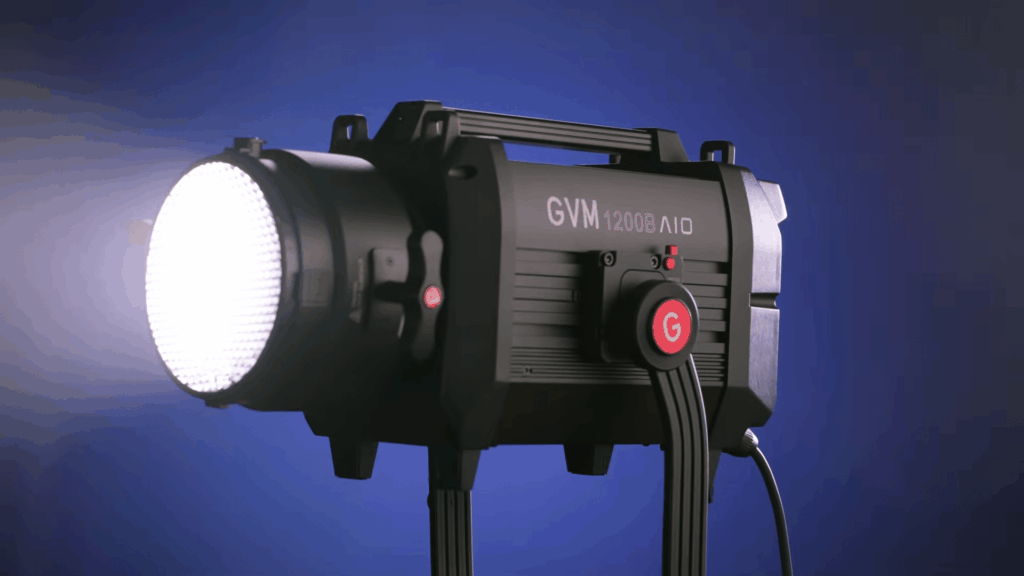
- AIO 1200B: Bowens mount, IP-rated for indoor/studio, 12 lighting effects, 42,800 lux @ 3m with reflector
- REIGN R1200B: G7 mount, IP65 weather-sealed, 12 effects + 12 light source presets, 9,360 lux @ 3m bare (3x brighter with optical lens)
In short: the AIO 1200B is the studio king; the REIGN R1200B is the location-agnostic broadcast king.
5. Montura G7 vs. Montura Bowens: La Pregunta del Modificador
If you’re buying pro lighting, you have to commit to a modifier ecosystem. Here’s the practical difference:
| Modifier | Montura Bowens | G7 Mount |
|---|---|---|
| Standard reflector | (light loss ~15%) | (light loss ~5%) |
| 48″ Lantern | (third-party only) | (GVM DL120RG + ARRI-original) |
| 4-way barndoor | (universal) | (GVM BD4G9 + ARRI-original) |
| Softbox (3’x3’+) | (universal) | (GVM Quick Release + ARRI SkyPanel series) |
| Fresnel lens | (add-on only) | (native GVM + ARRI) |
| Price of modifier | $30–$200 | $200–$1,500 |
For a single shooter on a budget, Bowens wins on price. For a rental house or a DP building a kit for 5+ years, G7 wins on modifier quality and durability. The REIGN R1200B is G7 — and ARRI-original modifiers are forward-compatible, so your investment holds.
6. Iluminación LED Pro por Caso de Uso
Not every pro shoot needs a 1200W COB. Here’s how to match the light to the job.
6.1 Película narrativa / comercial
Recommended: 1200W COB, G7 mount, full DMX/RDM/CRMX
Por qué: Long throw (5m+), modifier flexibility, weather resilience for exteriors, console integration for DPs running scripted lighting cues.
GVM pick: REIGN R1200B. For a smaller kit, the SD300B-AIO covers 200W–300W class with the same protocol stack (minus IP65).
6.2 Entrevista / corporativo / video de declaración
Recommended: 200–500W COB, Bowens or G7, APP + DMX
Por qué: Output only needs to fight a window, modifiers stay simple (one softbox), and silence matters more than weather sealing.
GVM pick: GVM 1200B AIO (Bowens mount, 12 effects, fast 60-second setup) or the SD300B-AIO for tighter budgets.
6.3 Estudio fotográfico (retrato, producto, comercio electrónico)
Recommended: 300W–1200W COB, Bowens or G7, daylight-balanced or bi-color
Por qué: Studio is controlled environment — IP rating is irrelevant. Modifier ecosystem matters most.
GVM pick: GVM 1200B AIO for the flagship, or the REIGN R1200B if you also shoot on location and want one fixture that does both.
6.4 Evento en vivo / producción virtual / escenario
Recommended: 1200W+ COB, G7 mount, full network protocol stack (Art-Net/sACN)
Por qué: Lighting designer controls from a console — APP and DMX-512 alone aren’t enough for an LED wall with 20+ fixtures.
GVM pick: REIGN R1200B. The Art-Net/sACN support is the deciding factor.
7. Los 12 preajustes de fuente de luz: por qué son importantes
Most “pro lighting” fixtures ship with 8–12 generic effects — paparazzi, lightning, candle. The REIGN R1200B ships with two separate effect banks:
- 12 Lighting Effects — narrative effects (Flame, Lightning, Welding, etc.)
- 12 Light Source Presets — color-matched real-world sources
The presets are the bigger deal. When you’re shooting a scene set in a kitchen at 7am with morning sun through a window, the “Sunrise/Sunset” preset matches the 2700K warm side of dawn. When you’re cutting to an industrial office lit by HMI 5600K, the “HMI 5600” preset dials in. No gels, no guessing, no color shift between setups.
This is the part of “pro lighting” that hobbyist lights can’t replicate. The presets are tuned by GVM’s color science team to match real spectral outputs — not approximate CCT values.
8. Iluminación profesional vs. Iluminación “prosumer”: La diferencia real de costo
A 200W prosumer LED costs $250–$400. A 1200W pro LED costs $1,800–$2,800. The price gap is real — but so is the capability gap.
| Capability | 200W Prosumer | 1200W Pro (REIGN R1200B) |
|---|---|---|
| Modifiers (reflector + 4′ softbox) | $80 total | $700+ (G7 native) |
| Light Source Presets | Ninguno | 12 industry-matched |
| Weather sealing | Ninguno | IP65 |
| Console integration | DMX-512 only | DMX + RDM + Art-Net + sACN + CRMX |
| Wireless DMX (CRMX) | Optional add-on | Built-in LumenRadio |
| Service life at 100% duty cycle | ~5,000 hours | ~50,000 hours (COB) |
| 5-year total cost of ownership | $1,200 (with 1 replacement) | $2,500 (no replacement) |
The math flips around 18 months of professional use. The prosumer light needs replacement; the pro light doesn’t.
9. Cómo configurar un kit de iluminación profesional (sin gastar de más)
For a solo DP or small production company, here’s a working 4-light pro kit:
| Role | Fixture | Montar | ¿Por qué? |
|---|---|---|---|
| Key | REIGN R1200B | G7 | 1200W, full modifier ecosystem, IP65 for exteriors |
| Fill | GVM SD300B-AIO | Bowens | 300W, 60-second setup, mesh Bluetooth sync to the R1200B |
| Rim / Back | GVM PRO SD200B | Bowens | 200W bi-color, ultra-fine 1/1000 dimming for hair light control |
| Bounce / Practical | GVM FH400B Flathead | Bowens | 400W, low profile, great for table-top and interview bounce |
Total kit cost: ~$3,500. That’s a working pro kit for indie film, commercial, and broadcast — covering 90% of setups you’d encounter in a year.
10. El balance final sobre iluminación profesional en 2026
“Pro lighting” used to mean you owned a dimmer rack and had a gaffer on call. In 2026, it means a 1200W bi-color COB with broadcast-grade control protocols, IP65 weather sealing, and a modifier ecosystem that scales with your shoots.
The GVM REIGN R1200B is GVM’s answer to the ARRI Orbiter class — at roughly one-third the price. For the full breakdown of the broader LED movie light market, see our best LED movie lights 2026 guide. For a deeper look at the underlying color science, our CRI explained guide covers what those 97+ CRI numbers actually mean on set.
If you’re building a pro kit, start with the key light. Everything else is a fill — and you can always rent the second and third units for a specific shoot. One REIGN R1200B in the bag is worth four 200W prosumer lights on a shelf.

Preguntas frecuentes: Iluminación profesional en 2026
¿Qué potencia se considera “iluminación profesional”?
The dividing line moved up over the last five years. In 2026, anything below 200W is consumer, 200–500W is prosumer, 500W–1200W is professional, and 1200W+ with full broadcast control protocols is film/broadcast tier. The GVM REIGN R1200B sits at the top of the 1200W class with full Art-Net/sACN/CRMX support.
¿Merece la pena el costo de la iluminación profesional LED sobre la semiprofesional?
For anyone shooting professionally (i.e., charging clients), yes. The 5-year total cost of ownership of a 1200W pro COB is lower than a 200W prosumer light, because the COB runs ~50,000 hours vs. ~5,000 hours for the prosumer diode, and you don’t need to replace the fixture every 18 months. The REIGN R1200B is the entry point for that math to flip.
¿Qué montura debo elegir: Bowens o G7?
If you’re a solo creator on a budget, Bowens. Modifiers are cheap, the ecosystem is huge, and most third-party softboxes fit. If you’re a rental house, a DP building a 5-year kit, or a production company, G7. Modifiers cost 5–10x more, but they last 5x longer, and ARRI-original modifiers are forward-compatible across generations of G7 fixtures. The REIGN R1200B is G7.
¿Realmente necesito sellado contra la intemperie IP65?
If you ever shoot outside — even a porch, a tent, or a covered patio — IP65 is worth the upgrade. IP65 means the fixture survives direct rain and dust ingress, so you don’t have to baby it with rain covers and you can leave it rigged overnight. If you’re a strict studio shooter, you can skip IP65 and save the cost.
¿Puedo usar un COB de 1200W en un circuito doméstico?
Yes, in most cases. A 1200W COB draws ~5.5 amps at 220V (or ~10 amps at 110V). A standard US household circuit is 15–20 amps, so you can run one 1200W COB on a circuit with your laptop and monitor. You can’t run two 1200W COBs on the same 15A circuit — but you can run them on separate circuits. The REIGN R1200B draws 5.5A at 220V / 10A at 110V.
¿Cuál es la diferencia entre CRI 95 y CRI 97?
Practically nothing on a monitor. CRI 95 and CRI 97 are both “broadcast-grade” — the difference is visible only on a calibrated reference monitor or when you push color in post. The bigger jump is from CRI 90 to CRI 95; from 95 to 97 is incremental. The REIGN R1200B is rated CRI 97+, putting it at the top of the broadcast tier.