Alta calidad movie lighting is essential for any successful shoot. Whether you’re crafting a scene in your living room or managing a full-scale production, the right movie lighting creates the depth and atmosphere your audience craves. Our 2026 breakdown covers everything from professional studio movie lights to portable LED solutions that are changing the movie lighting landscape.
Movie Studio Lights
Professional movie studio lights are built for consistency, output, and control. On a studio floor, you’re usually working with a three-point lighting setup — key, fill, and backlight — and each fixture needs to hold its color temperature steady across long shooting days.
Studio-grade fixtures typically offer:
- High lumen output for large sets and multiple camera angles
- Adjustable color temperature (usually 2700K–6500K or wider)
- DMX or wireless app control for remote adjustments
- Sturdy stands, yokes, and mounts for repeated setup and teardown
Because studio lights run for hours at a time, cooling systems matter too. Fixtures with quiet or adjustable fan modes let crews keep noise out of on-set audio while still managing heat from high-output COB or LED panels. Many studios also standardize on a single mount type, such as Bowens, so modifiers like softboxes, grids, and reflectors can be swapped quickly between fixtures.
Movie Room Lights
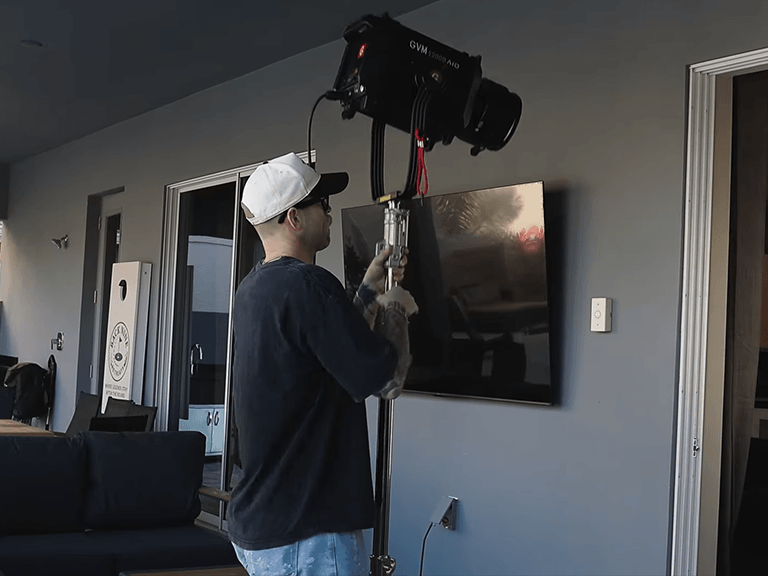
Not every production happens on a soundstage. A growing number of creators shoot movie-style content directly in a home studio, spare bedroom, or converted garage — and movie room lights need to work within tighter physical constraints.
For a room setup, prioritize:
- Compact, lightweight fixtures that don’t overwhelm a small space
- Dimmable output so you can match a softer, more intimate look
- Bi-color or full-spectrum LEDs to blend with window light or lamps already in the room
- Simple stands or clamp mounts when floor space is limited
Room lighting is also where color accuracy really shows. A light with a high CRI (color rendering index) rating will reproduce skin tones and set colors far more naturally than a cheap fixture, which matters even more in a small room where the light source sits close to the subject.
LED Movie Lights
LED movie lights have largely replaced older tungsten and fluorescent fixtures, and for good reason. They run cooler, use less power, last longer, and give filmmakers precise control over brightness and color that older technology simply couldn’t match.
Key advantages of LED movie lights include:
- Stepless dimming from near-zero to full brightness without flicker
- Wide color temperature range, often spanning warm tungsten to cool daylight
- Built-in effects, like simulated lightning, fire, TV flicker, or candlelight
- App and wireless control, letting operators adjust settings from a phone or tablet instead of climbing a ladder
- Lower heat output, which is safer for talent and reduces strain on air conditioning during long shoots
Because LED fixtures are also more energy-efficient, productions can run more lights off the same power circuit — a practical benefit for smaller crews and independent filmmakers working with limited electrical setups.
Best Movie Lighting
So what actually makes for the best movie lighting setup? It comes down to matching the fixture to the job rather than chasing the single “best” light on paper.
A few practical guidelines:
- Match output to distance. A light needs enough lux at your working distance, not just on a spec sheet measured at close range.
- Prioritize CRI over raw brightness. Accurate color rendering will save hours in post-production color correction.
- Choose flexible color temperature. Being able to shift between warm and cool light means fewer fixtures for more scenes.
- Think about control. Wireless app or DMX control saves time on multi-light setups and lets one operator manage several fixtures at once.
- Consider portability. Even studio productions benefit from lights that break down quickly for location days.
Featured Product: GVM 1200B AIO 1200W Bi-Color LED Video Light
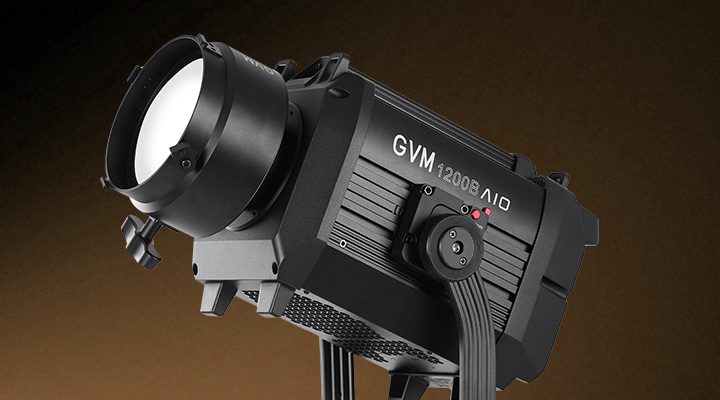
For creators looking for a single fixture that covers studio, room, and location work, the GVM 1200B AIO 1200W is a strong example of where modern LED movie lights are headed. It’s an all-in-one COB video light with no external ballast required, designed for filmmaking, photography, and content creation at a professional level.
The light delivers up to 42,800 lux at 3 meters with a standard reflector, along with stepless dimming from 0.3% to 100% and a bi-color range of 2700K–6800K with a CRI rating above 97. It also includes app-based wireless control and support for CRMX, DMX, RDM, and Art-Net protocols via the GVM BOX accessory, making it easy to integrate into larger multi-light setups.
| Característica | Specification / Benefit |
|---|---|
| Max Poder | 1200W for high-output professional lighting |
| Brillo | 42,800 LUX @ 3M (with reflector) for strong throw distance |
| Disminución | 0–100% stepless, from 0.3% to 100% for smooth exposure control |
| CRIMEN | >97 for accurate, true-to-life color reproduction |
| Temperatura de color | 2700K–6800K bi-color range for warm-to-cool flexibility |
| Control | Smartphone app, CRMX, DMX, RDM, Art-Net (via GVM BOX) |
| Enfriamiento | Three fan modes (Auto/Low/Off) for quiet operation |
| Diseño | All-in-one, no external ballast, plug and play |
| Montar | Bowens mount with safety lock for secure modifier attachment |
| Peso | 10kg (22 lbs) for relatively easy transport |
| Effects | 12 built-in lighting FX and 12 light source simulation modes |
Beyond the spec sheet, the fixture’s detachable U-shaped yoke and Bowens mount make it easy to reposition between key, fill, or backlight roles, while the 12 built-in effects (lightning, fire, TV, candle, paparazzi, and more) add creative options without extra gear. It’s suited to film and television production, commercial photography and video, studio work, live streaming, interviews, and on-location shoots — essentially covering all four categories discussed above in a single unit.
Conclusión
Choosing the best movie lights isn’t about buying the most expensive fixture on the market — it’s about understanding how studio lights, room lights, and LED technology fit your specific workflow. For crews that need one flexible, high-output solution across multiple shooting environments, an all-in-one bi-color LED fixture like the GVM 1200B AIO offers a practical starting point for building out a professional lighting kit. If you’re planning your next production, take stock of your space, your power setup, and your creative needs before investing in movie lights — then build outward from there.

Preguntas frecuentes
What are the best movie lights for beginners?
Compact bi-color LED panels or COB lights with app control are a good starting point, since they’re easier to adjust than older tungsten fixtures and don’t require as much technical setup.
Do LED movie lights get hot?
LED fixtures run significantly cooler than older tungsten or HMI lights, though high-output models like 1200W COB lights can still generate noticeable heat during extended use, which is why built-in cooling fans are common.
What CRI rating should movie lights have?
Look for a CRI above 95 for professional film and video work. Higher CRI ratings mean more accurate skin tones and color reproduction, reducing the need for corrections in post-production.
Can I use movie room lights for a home studio?
Yes. Compact, dimmable LED fixtures with adjustable color temperature work well in smaller rooms and can be paired with clamp mounts or small stands to fit tighter spaces.
What’s the difference between movie studio lights and on-location lights?
Studio lights are often larger and optimized for consistent, repeated use in a fixed space, while on-location lights tend to prioritize portability, quick setup, and battery or flexible power options.