Modern LED focos are no longer the heavy tungsten fresnels of broadcast studios. They have evolved into compact, high-output, color-accurate fixtures that photographers, filmmakers, and content creators can take anywhere. This 2026 guide breaks down what makes a great spotlight today, which features actually matter, and three GVM picks that cover the most common production scenarios — from bright daylight interiors to travel-friendly interviews.
What Is a Spotlight and How Does It Differ From a Panel?
A spotlight is a directional light that produces a controlled, focused beam — usually through a lens or reflector — to mimic sunlight, project patterns, or isolate a subject. A panel light, by contrast, spreads soft, even illumination across a wide area.
The practical difference comes down to intent:
- Spotlights create shape, contrast, and direction. They are the light you reach for when you want a motivated key, a dramatic background, or a hot accent.
- Panels and softboxes create a soft, wraparound fill that hides texture and reduces contrast.
For most hybrid creators, the smartest kit uses both: a panel for ambient base light and a spotlight lamp to carve shape into the scene.
Brightest Spotlights: How Bright Is Bright Enough in 2026?
When shoppers search for the brightest spotlights, they are usually trying to solve a real problem — overpowering daylight, throwing a clean beam across a large room, or punching a hot spot through a window. Three specs tell you almost everything you need to know:
- Lux at 1 meter (with standard reflector): The industry standard. Anything above 60,000 lux at 1m is “sunlight-defying.” Modern 300W bi-color monolights routinely hit 65,000–220,000 lux.
- CRI and TLCI scores: Both should be 97+ for accurate skin tones. Anything below 95 starts to require heavy color correction in post.
- Color temperature range: A true bi-color range of 2700K–6800K covers everything from candlelight to overcast noon. RGB versions (2000K–10000K + full color) add creative flexibility.
A common 2026 mistake is buying a “300W” light that is rated at 300W power draw but only delivers 15,000 lux — usually because the COB is small or the reflector is poorly designed. Always check the lux number, not the wattage.
Spotlight Cinematography: Key Techniques That Actually Work
En spotlight cinematography, the light is used as a storytelling tool, not just illumination. Three setups cover roughly 80% of narrative and commercial work:
- Hard key + soft fill: Place a hard spotlight 45° off-axis as the key. Use a bounced panel or softbox on the opposite side as fill. The contrast ratio between key and fill creates the “cinematic” look viewers unconsciously associate with film.
- Motivated practical: A spotlight aimed through a window, doorway, or lamp shade gives the scene a motivated light source. The audience does not see the lamp — they see the result on the subject.
- Background projection: Use a focusable spotlight to project patterns (gobos), shadows, or hard cutouts onto a wall. This adds depth and visual interest for almost zero budget.
For all three, the light needs a clean, even beam with minimal spill — which is exactly what a well-engineered LED spotlight is designed to deliver.
Portable Spotlight Options for Travel and Run-and-Gun
A portable spotlight has to balance three trade-offs: output, weight, and battery compatibility. For solo creators shooting interviews on location, the sweet spot in 2026 is a 100W–300W bi-color fixture under 8 lbs (3.6 kg) that accepts V-mount or NP-F batteries.
Key features to look for in a portable spotlight:
- V-mount battery plate (or Gold-mount) for true cordless operation
- Mesh Bluetooth app control so you can adjust power and color from the camera position
- Silent fan mode for dialogue-heavy shoots
- Montura Bowens compatibility so your existing modifiers (softboxes, reflectors, beauty dishes) still work
- Built-in lighting effects (lightning, candle, fire) for run-and-gun narrative work
If you primarily shoot in a controlled studio, you can ignore weight and battery and prioritize raw output. If you travel, every pound matters more than another 20% of brightness.
3 GVM Spotlights Worth Buying in 2026
The current GVM lineup covers the three most common spotlight scenarios. All three use the same Mesh Bluetooth control ecosystem, so they play well together on multi-light sets.
| Modelo | Mejor para | Max Poder | Lux @ 1m | Rango de CCT | Weight Class | Notable Feature |
|---|---|---|---|---|---|---|
| GVM PRO SD300B | Studio & location workhorses | 300W | 65,700 lux | 2700K–6800K | V-mount monolight | V-mount + mesh + waterproof |
| GVM SD300B-AIO | Brightest single point in the lineup | 300W | 221,950 lux | 2700K–6800K | Integrated AIO | Brightest 300W in class |
| GVM PRO PF100B | Portable interviews & travel | 100W | Focusable (lens) | Bi-color | Compact focusable | True focusable LED spotlight |
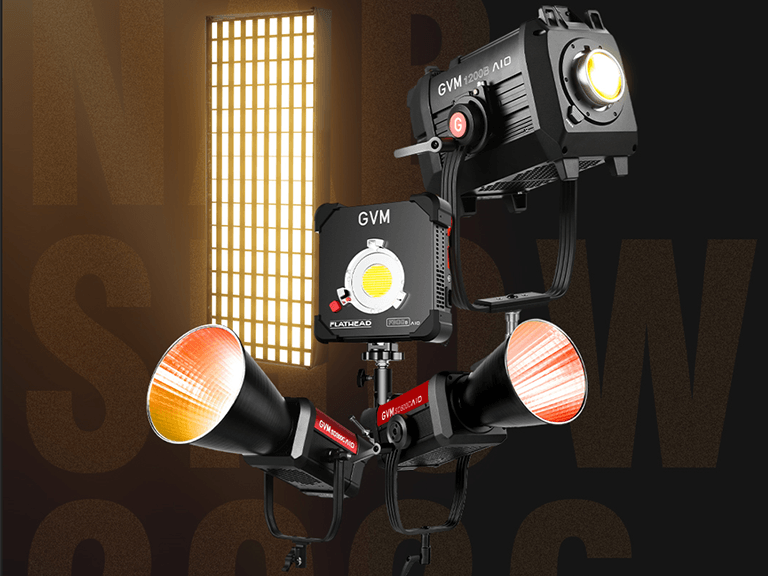
En PRO SD300B is the all-rounder — high output, rugged V-mount build, and a CRI/TLCI of 97+ that handles skin tones without correction. The SD300B-AIO is the brightness play: at 221,950 lux it competes with 1K tungsten fresnels while staying under 10 lbs, which is why narrative DPs reach for it when daylight won’t quit. The PRO PF100B is a true focusable LED spotlight with a lens system that lets you go from a tight pinpoint to a wide flood — ideal for solo shooters and travel kits.
Quick Buying Checklist
Before you click “add to cart,” run through this short list:
- Power needs: Match the wattage to your typical room size. A 100W spotlight is plenty for a 12’x12′ room. A 300W unit is justified for larger sets or daylight interiors.
- Color accuracy: Confirm CRI/TLCI ≥ 97 if you shoot skin tones or product.
- Mount type: Bowens mount is the safest bet for future modifier compatibility.
- Control: App and DMX control save real time on multi-light setups.
- Power options: AC + V-mount gives you both studio and location flexibility.
Conclusión
La derecha spotlight comes down to your shooting style, not the spec sheet. Studios chasing the brightest spotlights for daylight interiors should look at 300W monolights like the PRO SD300B or the SD300B-AIO. Filmmakers practicing spotlight cinematography benefit most from a focusable design that lets them shape the beam precisely. And creators who need a portable spotlight for travel should prioritize weight, battery, and silent operation over raw output. A single well-chosen GVM spotlight, paired with a soft panel for fill, will handle roughly 80% of the lighting situations most creators face in 2026.

Preguntas frecuentes
What is the difference between a spotlight and a floodlight?
A spotlight produces a narrow, focused beam designed to highlight a specific subject. A floodlight produces a wide, even wash of light that covers a large area. Most LED fixtures can be tuned between the two by changing reflectors or adjusting focus.
Are LED spotlights bright enough to replace traditional tungsten fresnels?
Yes. Modern 300W LED spotlights deliver 65,000–220,000 lux at 1 meter, which is comparable to or brighter than a 1K tungsten fresnel — at a fraction of the heat and power draw.
What CRI rating should I look for in a spotlight?
For accurate skin tones and product work, choose a spotlight with CRI and TLCI both at 97 or above. Anything below 95 will require noticeable color correction in post.
Can I use a spotlight for video interviews?
Absolutely. A focusable spotlight 45° off-axis is the standard interview key light. Pair it with a soft fill on the opposite side for a flattering, cinematic look.
Do I need a V-mount battery for portable shooting?
If you shoot on location away from AC power, yes. A V-mount plate lets you run a 100W–300W spotlight for roughly 45–90 minutes per fully charged 99Wh battery.
What is the best GVM spotlight for beginners?
The PRO PF100B is the easiest entry point. It is compact, focusable, bi-color, and silent — covering most beginner scenarios from YouTube videos to small interview setups.