In video production, there is a quiet truth that experienced creators rarely say out loud:
The camera does not define the image. Light does.
Resolution can be upgraded. Lens can be replaced.
But once a scene is poorly lit, every correction becomes a compromise.
This is why the search for best led light for video shooting is less about equipment comparison and more about understanding what light is expected to do in real production environments.
Before choosing a fixture, it is worth stepping back and asking a simpler question—what makes lighting “good” in the first place?
Table of Contents
Light Is Not Just Illumination
In controlled environments like studios, light behaves almost like a language.
A soft source can flatten emotional tension.
A hard source can introduce structure and depth.
A shift in color temperature can subtly alter the perceived time of day.
These effects are not decorative. They guide perception.
Yet many early-stage productions still approach lighting as a binary tool—on or off, bright or dim. In practice, professional lighting exists on a much wider spectrum of control.
The real challenge is not producing light.
It is shaping it without losing consistency.
What Defines Good Lighting for Video Work
Good lighting for video isn’t really about specs. It’s about how the light behaves once you’re actually shooting.
Color stability is usually the first thing you notice—or the first thing that breaks the image. If the tone shifts between takes, skin tones start to feel inconsistent fast. A stable bi-color setup keeps things grounded so you’re not chasing white balance all day.
Output matters, but control matters more. Big brightness numbers don’t help much if you can’t fine-tune the low end. The small adjustments are what make a face feel natural instead of slightly overdone.
Color accuracy is less of a “feature” now and more of a baseline. High CRI and TLCI aren’t impressive on paper anymore—they’re just expected if you want footage that holds up in post.
And then there’s workflow. Most sets run multiple lights at once. Key, fill, background—they all need to talk to each other. Whether you’re using an app, DMX, or onboard controls, what matters is how fast you can make changes without breaking the rhythm of the shoot.
At the end of the day, good lighting is the one thing you don’t have to think about while you’re filming.
Where Practical Lighting Design Matters
Lighting design is often judged during shooting, but its real value appears in transitions.
Changing setups quickly without disrupting continuity is a subtle but critical advantage in production environments.
This is where control systems, dimming precision, and thermal stability quietly matter more than headline specifications.
A light that behaves consistently under pressure reduces decision fatigue on set.
And that is often what professionals are actually buying.
A Practical Example: GVM PRO-SD500B
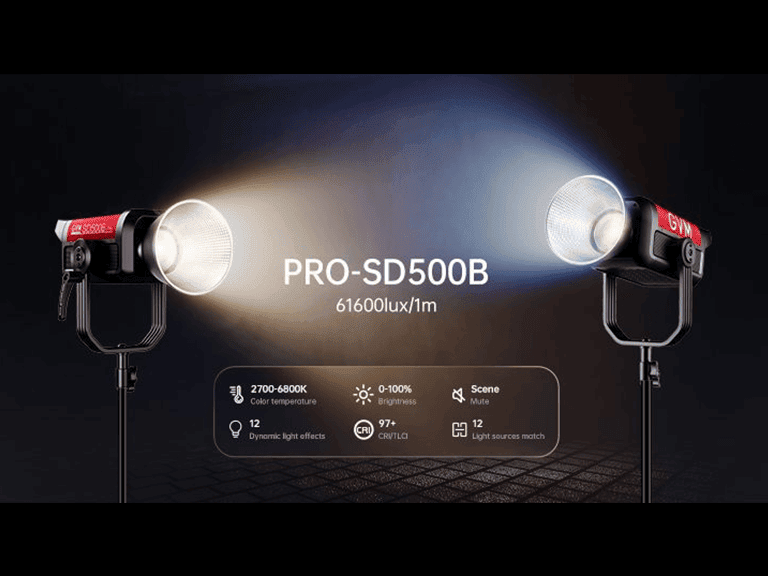
The GVM PRO-SD500Bis a 500W COB bi-color light built for everyday production work.
In real use, it’s less about specs and more about flexibility. It moves easily between warm indoor tones and daylight-balanced scenes, so you’re not constantly fixing color in post. Skin tones stay consistent, which makes a big difference when you’re shooting interviews or people-focused content.
It also has enough power for softboxes or brighter setups, but still gives you control when you need lower output. That’s usually where good lighting actually happens—small adjustments, not full power.
Control is straightforward. You can adjust it on the fixture, through an app, or integrate it into DMX if you’re working on a larger set. It fits into different workflows without slowing things down.
It’s not a specialized tool. It’s just a reliable one that works across different types of shoots.
| Feature | GVM PRO-SD500B (Bi-Color COB) |
| Best For | Film Production, Studio Lighting, Broadcast, Commercial & On-Location Shooting |
| Power Output | 500W High-Output COB LED |
| Color Temperature | 2,700K – 6,800K |
| Color Modes | Bi-Color (CCT) + Source Matching + 12 Built-in Presets |
| CRI / TLCI | 97+ / 97+ |
| Special Effects | 12 Cinematic FX Modes (e.g. Lightning, TV, Candle, Fire, Explosion, etc.) |
| Brightness | Up to ~61,600–81,500 lux @1m (with reflector, depending on CCT) |
| Dimming | 0–100% Flicker-Free, 0.1% Precision (1000-step dimming) |
| Control Type | On-board Control + GVM App (Bluetooth Mesh) + DMX-512 (8/16-bit) |
| Cooling System | Intelligent Active Cooling (Multiple Fan Modes, Silent <40dB) |
| Build / Design | Aluminum Alloy Body, Separate Controller Unit |
| Mount Type | Bowens Mount |
| Power Source | AC Power + Dual V-Mount Battery Support |
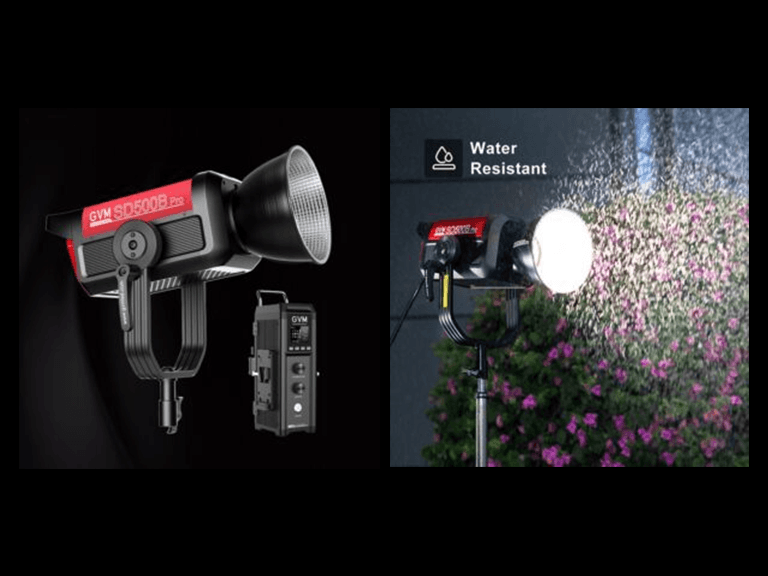
| Special Features | Waterproof Design, LCD Display, Group Control, RDM Support |
Where It Fits in Real Production Work
You don’t really think about lighting in categories when you’re on set. It just shows up where it needs to.
Sometimes it’s an interview where everything has to stay consistent for long takes, and you don’t want the light pulling attention away from the subject. Other times it’s a commercial setup, where even a slight shift in tone can change how the product feels on camera.
And then there are those smaller studio days—just you, a camera, and a setup you end up rebuilding over and over again. In those cases, what matters most is whether the light behaves the same way every time you turn it on. No surprises. No re-learning the setup.
The SD500B fits into those situations without needing much adjustment. It’s not trying to define the shot—it just stays out of the way so you can focus on it.
A Broader Perspective on Video Lighting
The phrase best led light for video shootingoften leads people toward specification comparisons.
But in real production, the better question is more subtle:
Which light can maintain its behavior when the environment stops being controlled?
Because once shooting begins, conditions change quickly. Angles shift. Subjects move. Time becomes limited.
A reliable light does not solve creativity.
It simply removes obstacles between intention and execution.
Final Thoughts
Lighting is often introduced as a technical requirement in video production.
But in practice, it behaves more like structure beneath the image—something that is felt before it is noticed.
The GVM PRO-SD500B represents a practical approach to this idea. Not by redefining lighting, but by making existing lighting principles easier to apply consistently.
And in that sense, good lighting is rarely about what stands out in the frame.
It is about what allows everything else to stand still.
Explore the full range of GVM professional lighting solutions(https://gvmled.com/)today.